
PITTSBURGH — Nearly eight years after the worst antisemitic attack ever carried out on American soil, the rabbi who guided his congregation through unimaginable grief is stepping down.
Rabbi Jeffrey Myers of Tree of Life Congregation in Pittsburgh says that after presiding over funeral after funeral for his slain congregants, he found himself struggling to connect with prayer. “There was this emptiness to it,” he recalled.
Searching for answers, Myers turned to the biblical Book of Psalms, which he described as covering “the entire spectrum of human existence and emotion, from elation to utter despair.” He read through all 150 chapters in sequence. It was Psalm 121 that finally reached him, with the words: “My help comes from God, maker of the heavens and the Earth.”
“There it was,” Myers says. “My faith did have the answers. It just took time to be able to find them.”
Myers, 70, is retiring this month as the spiritual leader of Tree of Life — a role he had taken on just over a year before the horrors of October 27, 2018. That Saturday morning, a gunman forced his way into the synagogue, hurling antisemitic slurs and killing 11 worshippers from the three congregations that shared the building: Dor Hadash, New Light, and Tree of Life.
In the years that followed, the congregation navigated grief, a long-delayed criminal trial that ended in the shooter’s death sentence, a global pandemic, and the beginning of a new building project.
“My mission has come to a conclusion to the best that I could,” Myers said. “It was time for the next chapter also for the Tree of Life. It’s time to step aside so that there is space for new voices.”
Myers plans to move back to his home state of New Jersey to be closer to his daughter and granddaughter. He hopes to catch up on reading, do some writing, and work through a “bucket list” with his wife. He also intends to focus on his own emotional healing — something he put on hold while prioritizing his congregation’s recovery.
“As Mr. Spock says in ‘Star Trek II,’ the needs of the many outweigh the needs of the few,” said Myers, who is known for weaving together references from scripture and popular culture.
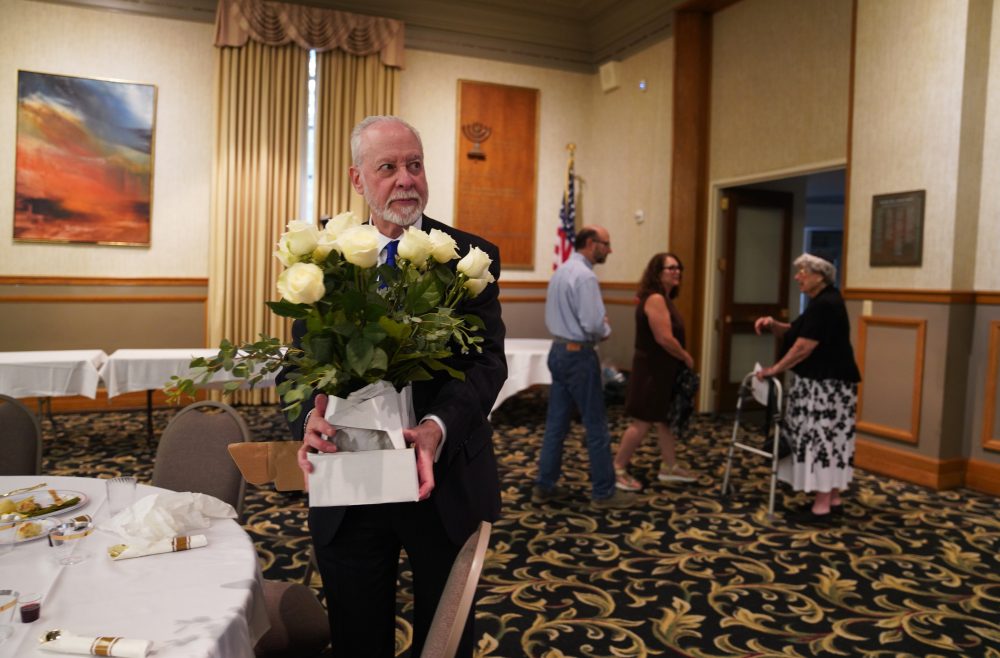
On July 17, Myers delivered a farewell address to his congregation that drew on quotes from the Beatles and the Broadway musical “Rent.” He expressed gratitude to congregants, fellow clergy, public officials, and the police officers who risked their lives to rescue him during the attack — some of whom were seriously injured. He honored each of the 11 victims by name, saying, “May your memories always be for a blessing,” before leading the congregation in singing Carole King’s “You’ve Got a Friend.”
Congregants credit Myers with holding the community together through its darkest chapter.
“He was really just a new rabbi and hardly broken in yet, and we went through the thing that we went through,” said Audrey Glickman, a survivor of the attack. “He has steered a constant ship and taken care of everyone, and I think he has earned himself a rest.”
Myers grew up near Newark, New Jersey, spending summers at the beach in Asbury Park, where pop music drifted from transistor radios. As a child, he sang soprano in his synagogue choir. By his mid-teens, he was directing that choir and cultivating the high tenor voice that in 2018 was heard around the world as he sang traditional Jewish mourning prayers for those who were killed.
He began college on a pre-med path but shifted toward his passions for Judaism and music, eventually training to become a cantor — a Jewish clergy member who leads worship. After years serving congregations in New York and New Jersey within the Conservative denomination of Judaism, he pursued rabbinical ordination and came to Tree of Life. The congregation shared its building with two others in Pittsburgh’s Squirrel Hill neighborhood, the center of Jewish life in the city.
On the morning of the attack, Sabbath services had just gotten underway when Myers heard gunfire in the lobby. He urged those who could move to escape, and those who could not to hide or lie down. He took cover as shots rang out.
“I was praying,” Myers recalled from the witness stand during the gunman’s 2023 trial. “I thought about the history of my people, how we’ve been persecuted and hunted and slaughtered for centuries, and how all of them must have felt the moments before their death, and what did they do.”
He asked God to forgive him for being unable to save his congregants. He had expected to die, but police officers escorted him to safety — still wearing his prayer shawl.
In the days that followed, funeral services came one after another. Alan Hausman, a longtime lay leader in the congregation with a background in public safety, stayed by Myers’ side throughout that week. Responding to deadly crises “takes a toll on you,” Hausman said. “And he kept going.”
With the synagogue building closed as a crime scene, Tree of Life began holding services at a nearby congregation, Rodef Shalom. For Myers and others, resuming Jewish observances was an act of defiance against the killer’s intent.
Amid the grief, there were bright moments. Sam Schachner, who was then serving as congregation president, recalls his son’s bar mitzvah just weeks after the attack — the first truly joyful occasion since October 27.
Myers “could have reasonably said, ‘I’ve been through a lot. Can we postpone this?’” Schachner said. “He didn’t. He had this ability to be there for others when he was going through such pain.”
Then came the COVID-19 pandemic, further disrupting the path to healing. Myers led services remotely from his home. One meaningful bright spot: officiating at his daughter’s outdoor wedding, which he connected to the words of another Psalm. “God turned my mourning into rejoicing,” he said.
When in-person worship resumed, the three congregations faced the long-awaited trial, which began in the spring of 2023. Myers told prosecutors that if his daughter gave birth to a boy during his scheduled testimony, he would attend the circumcision ceremony regardless — he refused to “let the shooter deprive me” of that milestone. As it turned out, a granddaughter was born, and Myers testified as planned.
The trial ended with the gunman’s conviction and a death sentence. He remains on death row.
Tree of Life also built a meaningful connection with Mother Emanuel AME Church of Charleston, South Carolina — a historically Black congregation that lost nine members to a racist gunman during a Bible study in 2015. The two communities exchanged visits, and Myers developed a close relationship with the church’s pastor, the Rev. Eric Manning. When Myers testified at trial, Manning was present in the courtroom.
Manning has spoken out against rising antisemitism and other forms of hatred — a word he refuses to say aloud, referring to it only as “H.”
“Antisemitism is the world’s oldest disease,” Manning said. “It doesn’t require any sort of prescription or inoculation to eliminate. It requires people to honor the worth and dignity of every human being.”
Most of the aging and damaged Tree of Life building has since been torn down. A new structure is planned, incorporating a memorial to the 11 victims, exhibits on antisemitism, a sanctuary, and event space. Though scaled back from the original vision, the building is expected to open in 2028, according to Carole Zawatsky, who leads the nonprofit overseeing the project alongside the congregation.
“The memorial is there to remember each of the 11 victims. To always ground us,” Zawatsky said.
Robin Friedman, the congregation’s current president, called Myers “the right guy at the right time” and described his departure as “bittersweet.” She noted that roughly 50 Jewish families — many with young children — have recently joined the congregation, bringing fresh energy and optimism for the future.
Glickman, the survivor, summed up the congregation’s resolve: “We intend not to let the shooter win and not to fade away into history.”