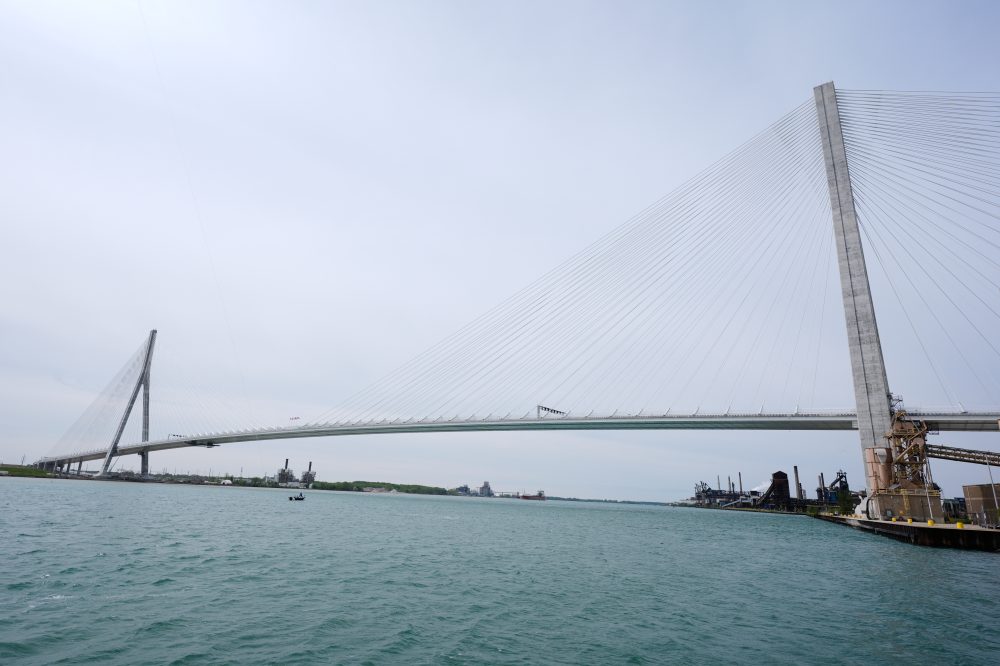

Officials gathered Friday in Windsor, Ontario, to mark the upcoming opening of a new bridge spanning the Detroit River between the United States and Canada — a crossing expected to boost trade and give travelers and truckers another route between the two countries.
The ceremony took place ahead of the Gordie Howe International Bridge’s scheduled opening to traffic on Monday. What was originally planned as a joint celebration on the bridge deck with officials from both nations was scaled back after Canada declined to participate in a two-country event. The decision came following President Donald Trump’s surprise announcement this week of 50% tariffs on Canadian goods entering the United States.
“It’s regretful that we’re at this point in time with our trade relationship. We’re hopeful for better days ahead,” Windsor Mayor Drew Dilkens told a Detroit television station.
The stakes are high for both countries. More than 70% of Canada’s exports are destined for the U.S., making America its top trading partner. According to the U.S. Department of Transportation, Detroit ranks as the number one port for truck traffic along the entire U.S.-Canada border.
Detroit Mayor Mary Sheffield said she had originally been invited to a joint event Friday before plans suddenly shifted. She remained upbeat about the bridge’s long-term impact. “It will be vital for our economy,” Sheffield said, choosing not to weigh in on whether the bridge had become a “political football” amid the strained relationship between the two nations.
The new bridge will end nearly a century of monopoly held by the privately owned Ambassador Bridge, which has been the sole crossing for large commercial trucks between the two countries at Detroit. The Howe bridge will now offer direct competition for that traffic.
The bridge carries the name of a beloved Canadian hockey legend who spent much of his career playing for the NHL’s Detroit Red Wings. He passed away in 2016. Construction on the project began in 2018 and stretched over several years, in part due to delays caused by the global COVID-19 pandemic.
The six-lane span measures 1.5 miles (2.4 kilometers) in length and rises 151 feet (46 meters) above the Detroit River at its tallest point. Within a few weeks of opening, pedestrians and cyclists with proper identification will be permitted to cross at no charge.
Canada funded the construction of the bridge, with costs estimated at $6.4 billion. Under a recent agreement, Canada will share a portion of toll revenue with the U.S. federal government over a 15-year period. Michigan is also set to receive a share of that revenue, though not until Canada has recouped its construction costs — a timeline that could stretch decades into the future.