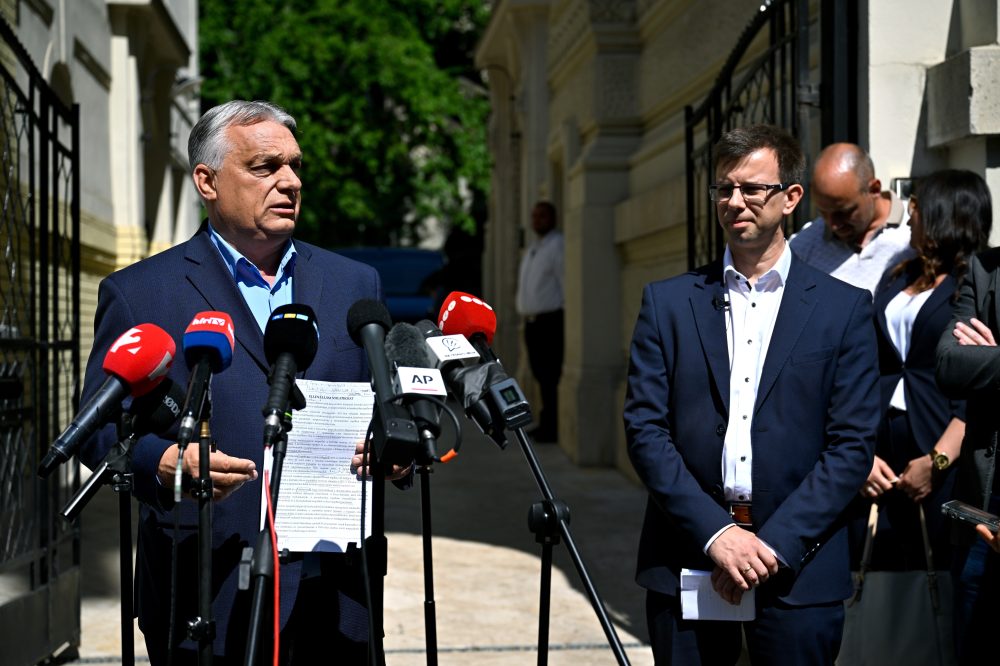

BUDAPEST, Hungary — Former Hungarian Prime Minister Viktor Orbán stepped before cameras Wednesday to announce that he and his far-right Fidesz party are launching a peaceful “resistance” movement, accusing the country’s new center-right government of ruling like tyrants.
Orbán’s 16-year grip on power came to an abrupt end when Prime Minister Péter Magyar and his pro-European Tisza party handed him a landslide defeat in April elections. The Fidesz party has been struggling to find its footing ever since.
Speaking at a news conference held outside Fidesz party headquarters in Budapest, Orbán took direct aim at a constitutional amendment passed last week by Tisza’s parliamentary majority. The amendment removed Hungary’s president — who had served under Orbán — and established a 12-year term limit for members of Parliament. Orbán said the move “dismantled the rule of law and eliminated the system of checks and balances.”
The term limit is retroactive, and Orbán drew a stark comparison, arguing it returns Hungary to conditions resembling the final years of Communist rule in the late 1980s, “when there was no democracy in Hungary, there was no rule of law.”
He also noted that the retroactive term limit would effectively bar roughly half of his party coalition’s current parliamentary members from competing in the next national elections, scheduled for 2030.
“This new political system is not a democracy, it is tyranny,” Orbán declared.
Since Magyar’s administration took office in May, it has moved quickly to undo what it describes as Orbán’s “mafia” — removing political appointees and replacing leadership at institutions accused of enabling Orbán’s authoritarian style of governance.
The new government suspended Hungary’s public television and radio news service, which Magyar characterized as a “propaganda factory” for Fidesz, and shut down the Sovereignty Protection Office — an agency that Orbán’s critics viewed as a mechanism for targeting political opponents and suppressing independent journalism.
Fidesz has framed these actions as attacks on democracy and warned that an authoritarian system is being built. Tisza, meanwhile, maintains it is simply delivering on the sweeping mandate voters gave it — fighting corruption and reestablishing the rule of law that eroded under Orbán’s watch.
On Wednesday, Orbán announced that Fidesz considers any officials appointed by Tisza to replace previous appointees to be “illegitimate,” and formally unveiled what the party is calling its “Declaration of Resistance” against Magyar’s government.
The declaration, which Fidesz released publicly late Tuesday, states that “from this day forward, our mission is to restore the democratic rule of law.” It goes on to say: “Every citizen has the right to stand against tyrannical rule. Fidesz … will use every peaceful means, both inside and outside Parliament, to resist the arbitrary exercise of power.”
The document offered limited specifics but indicated the party would support “victims of the authoritarian regime” and keep records of alleged legal violations.
After nearly two decades of dominance in Hungarian politics, Fidesz has seen its support collapse following the election loss. A June survey conducted by pollster Medián and published by news site HVG.hu found Tisza commanding 60% support among Hungary’s total population, while Fidesz has fallen to just 18%.
The party’s troubles deepened Tuesday when prosecutors and investigators from Hungary’s tax authority raided offices containing Fidesz data servers as part of a criminal investigation into suspected embezzlement and other offenses alleged to have occurred during Orbán’s time in power. Orbán responded Wednesday by claiming the raid came “on political orders” and said such a move could happen “only in severe dictatorships.”
Several high-profile Fidesz figures have also stepped back from the political stage. Last week, the party’s parliamentary caucus leader Gergely Gulyás resigned from his leadership role, and former foreign minister Péter Szijjártó announced he was leaving Parliament to take an executive position with Chinese automaker BYD.