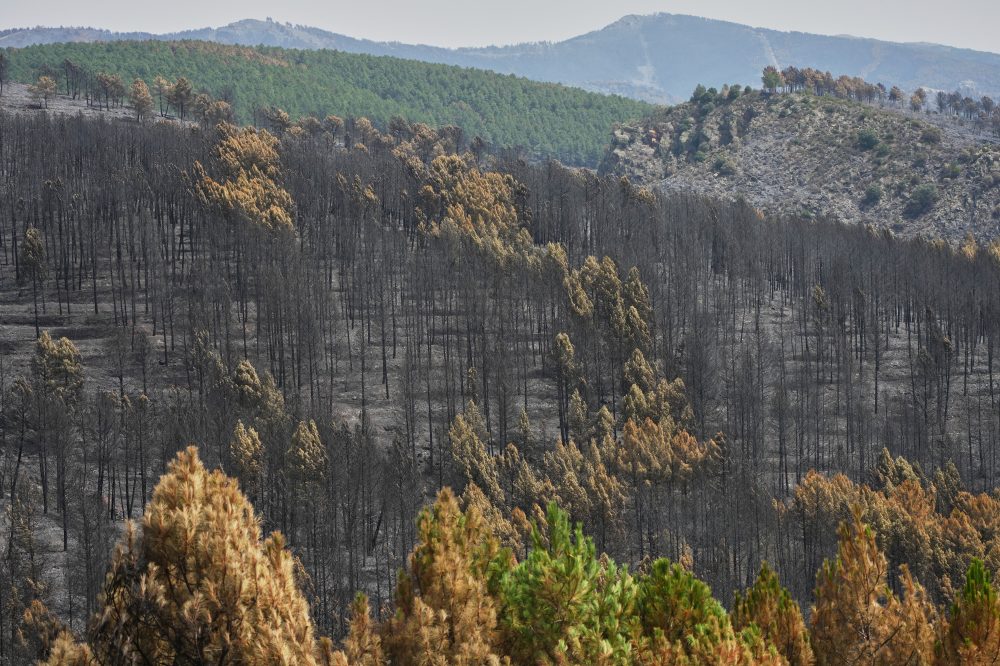

Firefighters in central Spain spent Wednesday fighting a massive wildfire that has consumed more than 32,000 hectares — roughly 79,000 acres — making it one of the largest blazes the country has seen in recent history.
The fire is burning through rural Guadalajara, a region located less than two hours northeast of Madrid by car. It broke out nearly a week ago, and about 34 villages have been evacuated as a result. Fortunately, no serious injuries or deaths have been reported.
This disaster comes just under two weeks after a separate, fast-moving fire tore through a small expat community in southern Spain, killing 13 people — including several foreign nationals — in one of the deadliest wildfire events in the country’s recent history.
Spanish Prime Minister Pedro Sánchez traveled to the fire zone Wednesday, stopping in the village of Tamajón where he spoke about the growing threat of climate change.
“Year after year we clearly see how climate change kills and destroys wealth in our communities,” Sánchez said.
“This isn’t politics. It is science, it’s about facts,” he added, urging all political parties to come together around a national agreement to address climate change.
Sánchez, who leads the Socialist party, noted that Spain has already recorded 22 major forest fires so far this year — defined as fires burning more than 500 hectares, or about 1,235 acres. He said the total area burned is four times greater than it was during the same period last year, and that more than 100,000 hectares — around 247,000 acres — have already been destroyed in the first half of 2025 alone, matching Spain’s entire yearly average over the past decade.
Spain’s Minister for the Ecological Transition, Sara Aagesen, called the Guadalajara fire “one of the largest in the recent history of our country” and said it is the biggest wildfire ever recorded in the Castilla La Mancha region.
Regional authorities reported that firefighters, aided by aircraft dropping water, have so far managed to protect homes in all 40 villages within the burn zone. About 90% of the affected land falls within a national park. Emiliano García-Page, the regional president of Castilla La Mancha, said crews hope to bring the fire under control by Friday.
In the village of Zarzuela de Jadraque, Mayor Miguel Ángel Moreno said all 100 residents were evacuated last Friday, with 14 of them finding shelter at a Red Cross facility. Firefighters managed to save every home in the village, though two barns were destroyed in the process.
Moreno praised the firefighters’ efforts, drawing a comparison to Spain’s soccer team, which won the World Cup on Sunday.
“(The firefighters) had to run from one side of the village to the other putting out fires,” Moreno told Spanish national television TVE. “Besides the heroes who won the World Cup, we have other heroes who remain nameless.”
The wildfire is being fueled in part by an intense heat wave that began Tuesday. Spain’s weather agency said temperatures were expected to peak between Wednesday and Thursday, reaching 40 degrees Celsius — about 104 degrees Fahrenheit — across many inland areas. In parts of Andalusia in southern Spain, temperatures were forecast to climb even higher, topping 42 Celsius, or 108 Fahrenheit. Large portions of Spain, including Guadalajara, were placed under high-temperature alerts.
Like much of Europe, Spain is dealing with extreme heat that, combined with wind and little rainfall, creates dangerous conditions for wildfires to spread rapidly. According to the European Union’s Copernicus Climate Change Service, Europe is warming twice as fast as the global average since the 1980s, making it the fastest-warming continent on Earth.
Globally, 2025 ranked as the third-hottest year on record, contributing to severe heat waves across the continent. Scientists warn that climate change is intensifying the frequency and severity of heat and drought — particularly in southeastern Europe — increasing the risk of wildfires and threatening public health.