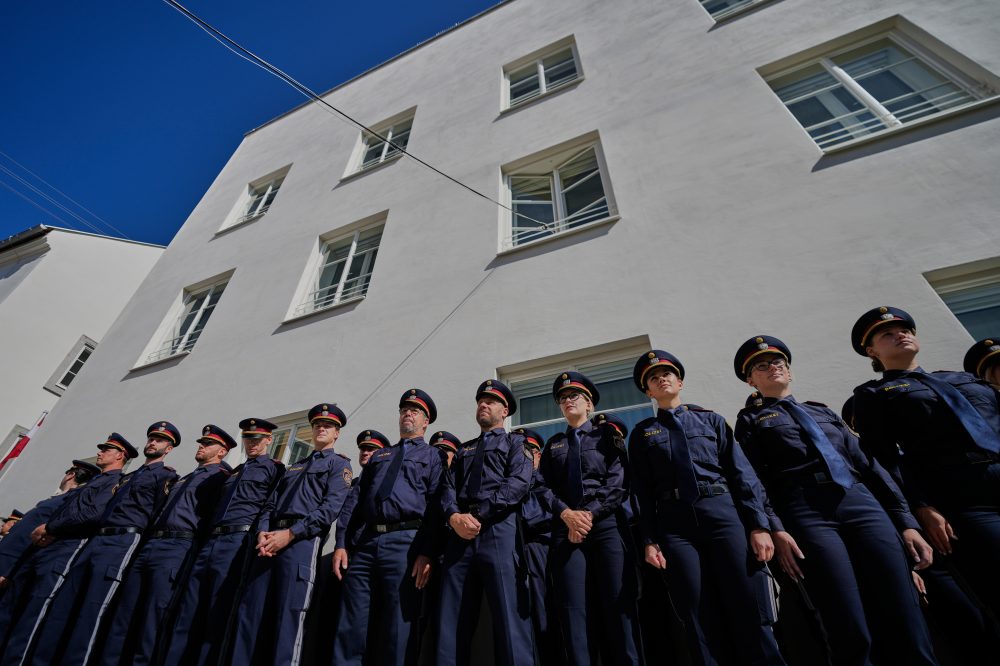

BRAUNAU AM INN, Austria — The building where Adolf Hitler came into the world has been given a new purpose, officially opening its doors as a police station on Wednesday in an effort to strip away its appeal as a destination for those who revere the Nazi leader.
A commemorative stone will remain standing outside the house in Braunau am Inn, a town near the Austrian border with Germany. The inscription reads: “For freedom, democracy and liberty. Never again fascism. Millions of dead remind us.”
Hitler entered the world in this building on April 20, 1889. His family departed for another home in Braunau am Inn within a matter of months, and later lived for a time in Passau, in southern Germany.
Driven by racial hatred, Hitler’s Nazi government was responsible for the murder of roughly 6 million Jews and other minority groups during the Holocaust. The dictator also triggered World War II, a conflict that claimed the lives of at least 60 million people worldwide. Hitler took his own life in April 1945, just weeks before the war’s conclusion.
At the police station’s opening ceremony Wednesday, Austria’s Interior Minister Gerhard Karner addressed the significance of the occasion. “The Republic of Austria, the state, the county is facing up to this heritage, the terrible heritage of this time, and commits itself to deal with it,” he said. “This entails this house and this address.”
According to the Austrian news agency APA, the building’s renovation spanned several years and carried a price tag of roughly 20 million euros, equivalent to about $22.8 million. The project followed a lengthy dispute over who owned the property.
That ownership battle came to an end in 2017, when Austria’s highest court determined that the government had the legal authority to seize the building after its owner declined to sell. An earlier proposal to tear the structure down was ultimately abandoned.
Since 1972, Austria’s Interior Ministry had been renting the building to keep it from being exploited for inappropriate purposes, subletting it to various charitable groups over the years. The building sat vacant after a care facility serving adults with disabilities vacated the premises in 2011.
Austrian officials determined that stationing police inside the building — as protectors of civil liberties — would be its best use going forward. However, critics have argued that the building, as it now stands, does not adequately provide historical context for visitors.
An expert panel also advised against converting the site into a museum, instead recommending changes to the building’s appearance that would make it difficult to identify as Hitler’s birthplace.
The exterior has undergone a dramatic transformation. The building’s original ochre-yellow color was painted white, its arched windows were swapped out for plain rectangular ones, and the front facade was extended upward toward the roofline. APA reported that construction debris was disposed of at an undisclosed location to prevent it from being sought out as Nazi memorabilia.
Over the years, far-right extremists have repeatedly gathered at the site to pay tribute to the dictator — photographing the exterior, pocketing stones as keepsakes, and leaving flowers and wreaths. As recently as 2024, four German nationals were apprehended at the building after placing white roses in its window alcoves and posing for photographs. One woman in the group was caught performing the stiff-armed Hitler salute.