
NASHVILLE, Tenn. — Tennessee’s Republican-controlled legislature is set to consider legislation Thursday that would break apart the state’s only majority-Black congressional district, a move backed by President Donald Trump as part of his broader effort to maintain Republican control of the U.S. House.
This redistricting push in Tennessee represents one of multiple fast-moving initiatives across the South, where GOP leaders are capitalizing on a recent Supreme Court decision that diminished protections under the federal Voting Rights Act.
The Supreme Court determined that Louisiana placed excessive emphasis on racial considerations when establishing a second district with a Black majority in an effort to comply with federal voting rights requirements. This ruling shifted longstanding interpretations of the law, providing Republicans with justification to target majority-Black districts that typically elect Democratic representatives.
Louisiana has delayed its congressional primary to allow state legislators time to develop a revised House map. Alabama lawmakers are also considering legislation that would disrupt their state’s congressional primaries if courts permit changes to House districts. In South Carolina, Republican legislators, encouraged by Trump, have begun preliminary steps to include congressional redistricting in their legislative agenda.
These states join what has become an intense nationwide redistricting fight. Following Trump’s encouragement of Texas to redraw its House districts last year, eight states have implemented new congressional maps. Republicans believe they could secure up to 13 additional seats from these changes, while Democrats estimate they might gain as many as 10. However, competitive races suggest neither party may achieve all their redistricting goals in November’s elections.
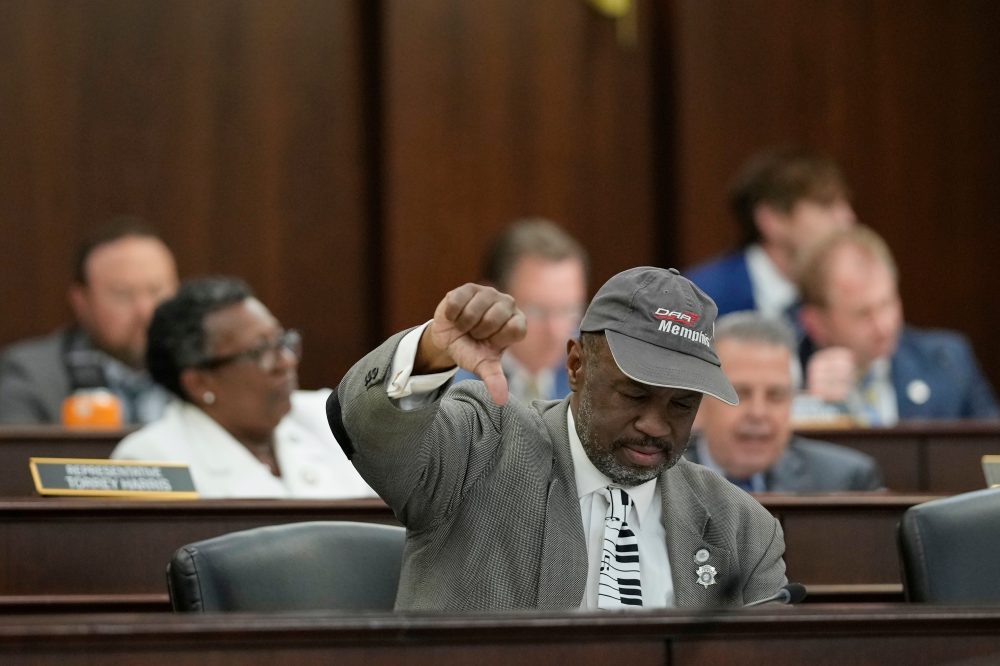
During Wednesday’s legislative hearings on the redistricting proposals, protesters repeatedly disrupted proceedings, though Republicans still moved the measures forward for potential final votes in both chambers.
The legislative package would eliminate a state law that prevents redistricting between census cycles and reopen candidate filing periods to allow new candidates to enter primaries and current candidates to change districts. The proposed House map would dismantle Tennessee’s single Democratic-held district, which centers on Memphis and its majority-Black population, triggering widespread changes to districts across western and central Tennessee.
Republican House Speaker Cameron Sexton defended the proposed districts, stating they were created based on population and political considerations rather than racial demographics.
Civil rights advocates and Democratic officials strongly criticized the initiative.
“This proposal represents Black vote dilution at an industrial scale,” said Sekou Franklin, a political science professor at Middle Tennessee State University who works with the Tennessee NAACP chapter.
Democrats highlighted that the state Supreme Court rejected a challenge to the current congressional map in April 2022, determining it was too close to election day to implement changes. With even less time remaining before the August 6 primary this year, Democrats warned of potential confusion for both candidates and voters.
Alabama’s House approved legislation Wednesday establishing special congressional primaries as Republicans pursue the possibility of implementing a different congressional map before November’s elections. The Senate could vote on the measure by Friday.
Alabama seeks to overturn a federal court mandate that established a second House district with a near-majority Black population. That map resulted in the 2024 election of Rep. Shomari Figures, a Black Democrat. Republicans prefer to implement a 2023 map created by state lawmakers that would give the GOP a chance to regain Figures’ district.
The legislation passed along party lines following four hours of heated discussion during which Black lawmakers referenced the state’s historical struggles. Democratic state Rep. Juandalynn Givan compared the legislation to poll taxes and jelly bean counting exercises — nearly impossible tasks used to prevent Black voters from participating during the Jim Crow period.
“This represents a calculated political strategy driven by fear, specifically fear of Black people and Black political influence,” Givan stated.
Alabama’s primaries are scheduled for May 19. If a court approves the state’s request, the legislation would disregard congressional race results and direct the governor to organize new primaries under the modified districts.
South Carolina’s Senate may consider a resolution Thursday authorizing lawmakers to return after their regular session concludes to redraw congressional districts, potentially eliminating the state’s sole Democratic-held district. The proposal, which passed the House Wednesday, requires two-thirds approval in both chambers.
Republican House leaders announced plans to introduce a new map Thursday and conduct committee meetings Friday following the vote. During Wednesday’s debate, Republicans avoided specific questions from Democrats about their willingness to halt the June 9 House primary elections after candidates had already filed and the potential costs of rescheduled primaries.
Democratic Rep. Justin Bamberg expressed sympathy for Republicans who, he argued, were abandoning their principles to accommodate Trump’s demands.
“The president wields significant influence through Truth Social, X, Meta, and Instagram. Honestly, I don’t envy our Republican colleagues,” Bamberg said.