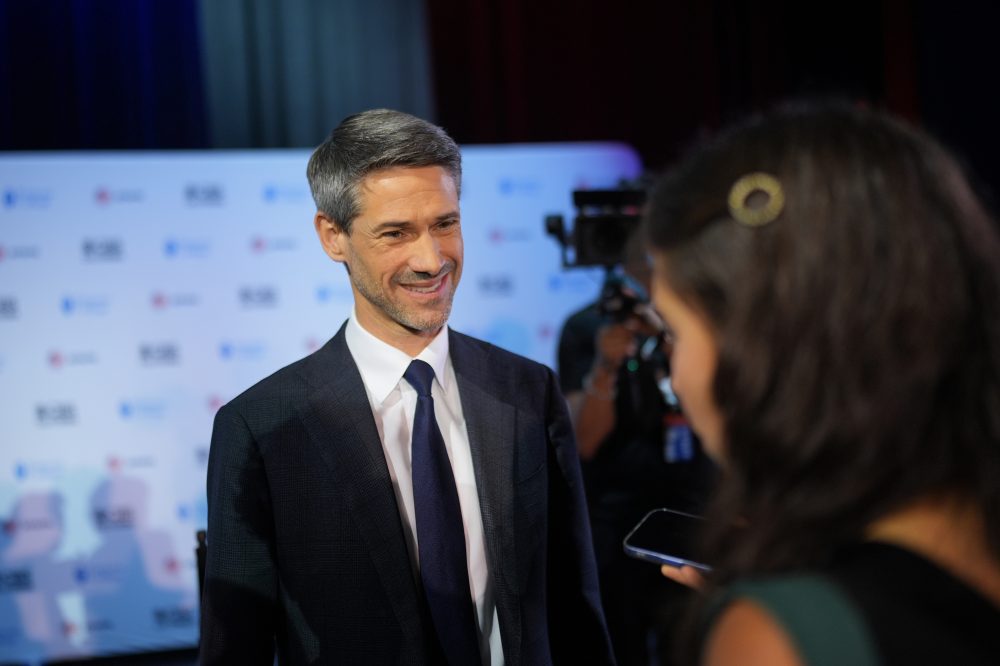

SACRAMENTO, Calif. — Silicon Valley leaders have found their champion in the California governor’s race, and they’re opening their wallets wide to support him.
Matt Mahan, the 43-year-old mayor of San Jose, has become the technology sector’s preferred choice to lead the Golden State. One tech investor described him as “the only sane” Democrat seeking to replace Governor Gavin Newsom, while others have contributed millions to his campaign, including funding for a Super Bowl commercial to introduce him to California voters.
The former technology executive entered the competitive gubernatorial contest in January, positioning himself as a practical leader focused on results. As a moderate Democrat, Mahan has gained statewide attention primarily through his criticism of Governor Newsom and state lawmakers’ handling of homelessness and criminal justice issues. His centrist approach has resonated with technology industry leaders seeking a business-oriented governor to follow Newsom, who cannot seek reelection due to term limits.
In an impressive fundraising sprint spanning just three months, Mahan has collected more campaign contributions than his competitors, most of whom began their campaigns over a year ago. (Billionaire Tom Steyer is primarily financing his own candidacy.)
During Tuesday evening’s CNN debate, Mahan portrayed his opponents as entrenched politicians while presenting himself as the candidate offering realistic answers to California’s problems.
“We don’t need MAGA values, but we also don’t need more of the same,” Mahan stated, referencing President Donald Trump’s “Make America Great Again” philosophy embraced by Republican candidates Chad Bianco and Steve Hilton, both of whom have received Trump’s endorsement.
However, Mahan appears to lack the political momentum he anticipated and the broad public recognition necessary to defeat his competitors — with limited time remaining to persuade voters before the June 2 primary election. His connections to the tech industry particularly concern labor organizations and some Democratic voters who doubt his willingness to challenge the sector.
“People do not want somebody who is a puppet of these big tech billionaires, of these AI billionaires — and that’s who he has always been,” stated Lorena Gonzalez Fletcher, president of the California Labor Federation, which has endorsed Steyer, former U.S. Rep. Katie Porter and former Los Angeles Mayor Antonio Villaraigosa.
Mahan argues he’s the sole candidate with genuine experience dealing with the massive technology industry, highlighting a collaborative effort he established in San Jose where over 900 public agencies cooperate to explore responsible artificial intelligence implementation in government operations. During Tuesday’s debate, he expressed support for taxing AI companies to fund worker training programs.
“Voters can see past the kind of, you know, shallow connection that because I’m the mayor of the largest city in Silicon Valley, that might mean that I’m not willing to regulate tech,” Mahan told The Associated Press. “It’s actually been quite the opposite.”
Political analysts point out that California has historically pioneered policies designed to both support and control its homegrown technology sector.
“If they can ensure that they get a governor in California who’s weak on tech accountability, then that can save them a lot of money across the states,” J.B. Branch of Public Citizen, a progressive consumer rights advocacy group, said regarding Silicon Valley executives supporting Mahan.
Throughout the political landscape, the technology industry is demonstrating its political influence as public doubt about social media and artificial intelligence grows. Independent organizations supported by tech companies and billionaires have already pledged at least $40 million to shape California legislative contests.
Political action committees supporting Mahan have collected over $25 million, including contributions from Google co-founder Sergey Brin, venture capitalist Michael Moritz and Reddit CEO Steve Huffman.
Several contributors, including Brin and Palantir co-founder Joe Lonsdale, are diversifying their investments — they have also donated to Hilton, the former Fox News personality.
Mahan is “focused on actually solving problems — building more housing, improving public safety and making it possible for people to live and work here again,” Garry Tan, who leads a startup accelerator that helped launch companies like Airbnb and DoorDash, said through a spokesperson.
A Harvard University alumnus, Mahan was a classmate of Meta CEO Mark Zuckerberg, who he has said convinced him to pursue technology instead of attending law school.
Mahan participated in developing an early Facebook application called Causes that enabled users to promote nonprofit organizations. He later co-founded Brigade, a nonpartisan digital voter network.
However, that background isn’t central to Mahan’s campaign messaging. Instead, he emphasizes his childhood as the son of a postal worker and a schoolteacher. He stands as the only prominent Democrat supporting a suspension of the state’s gasoline tax.
He won the mayoral election in 2022 against a labor-endorsed opponent after spending two years on the city council. As mayor, he persuaded council members to allocate additional city funds toward temporary housing to remove homeless individuals from streets and made them subject to arrest for refusing shelter. Both initiatives faced strong resistance, but San Jose experienced a reduction in the number of people without shelter access last year, according to county statistics.
He opposed Newsom in 2024 by supporting a strict crime prevention ballot measure. Mahan has subsequently moderated his criticism, acknowledging the governor has addressed appropriate issues.
Mahan has pledged not to increase taxes to address budget shortfalls — including rejecting a one-time billionaire tax that most of his competitors also oppose. He proposes linking future salary increases for elected state officials and appointees to progress on issues like unemployment and homelessness.
“Raising taxes isn’t always the answer, Tom,” he directly told Steyer on Tuesday when the billionaire proposed requiring corporations to pay higher property taxes.
Mahan collected over $13 million in 11 weeks, enabling him to launch television advertisements to reach voters in some of the nation’s most expensive media markets. Two independent expenditure organizations have spent more than $18 million promoting his candidacy.
As of last month, only approximately 730 contributions to Mahan’s campaign were under $250, suggesting limited grassroots backing. By comparison, nearly all of Porter’s 46,000 donations fell below that threshold, as did roughly 5,600 contributions to former state attorney general Xavier Becerra.
Nevertheless, voters’ support for other Democratic candidates “is very soft” Mahan said regarding his prospects. “Even if people are leaning a certain way, they’re still persuadable.”
Technology executives’ backing of Mahan’s campaign and his regulatory plans dominated discussion during a recent “Ask Me Anything” session Mahan conducted on Reddit, where participants can pose questions anonymously.
Multiple participants asked when Mahan would withdraw to prevent a disastrous outcome for Democrats where two Republicans could advance to the November general election. One inquired which Democrat he would support after leaving the race.
“I plan to win!” he replied.