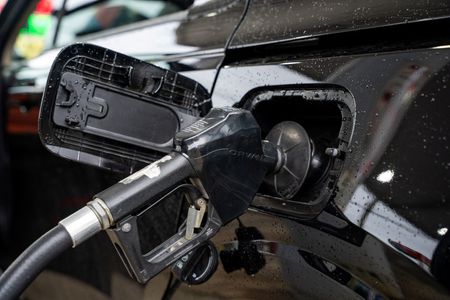

Drivers across the country may soon be paying $4 or more every time they fill up their tanks, as a fresh round of hostilities between the United States and Iran has sent energy prices climbing again by choking off oil traffic through the Strait of Hormuz — one of the world’s most important oil shipping corridors.
As of Tuesday, the national average for a gallon of regular gasoline sat at $3.84, according to fuel tracking service GasBuddy — nearly 10 cents higher than just one week ago. Compared to the same time last year, prices are up more than 22%.
For President Donald Trump and his Republican Party, the spike arrives at a difficult moment. The GOP is preparing to defend narrow margins in both chambers of Congress during November’s midterm elections, and high fuel costs have become a politically sensitive issue.
The $4-a-gallon threshold — widely seen as a breaking point for household budgets — was last crossed in late March, when Iran shut down traffic through the Strait of Hormuz. Prices dipped back below that mark in June after Washington and Tehran reached a memorandum of understanding to bring the conflict to a close. But that agreement fell apart last week, and the U.S. has since reinstated a naval blockade on Iran, sending fuel and crude oil prices back up.
Shipping data released Monday showed that the number of tankers passing through the Strait of Hormuz dropped to its lowest point in two months over the past day. Before the conflict with Iran began, roughly 20% of the world’s oil supply moved through that narrow passage.
Fuel prices have also been pushed higher by damage to Russian refining operations, as Ukraine has stepped up targeted strikes against energy infrastructure there.
GasBuddy analyst Patrick De Haan issued a stark warning in a blog post Monday: “I now expect the national average price of gasoline to reach $4 per gallon in the next 7-10 days, if not sooner, while the U.S. average diesel price is likely to again reach $5 per gallon by the end of this week, potentially as soon as Friday.” De Haan also noted that some states could see prices cross the $4 mark even earlier.
Beyond the pain at the pump, economists are warning that higher fuel costs could reignite broader inflation concerns. June’s inflation data had offered some relief, with energy prices pulling back and helping cool overall price pressures. But that progress could be short-lived.
“While June’s inflation data reflected easing price pressures largely due to lower energy costs, a sustained increase in gasoline prices throughout July could quickly alter that narrative,” said Simon-Peter Massabni, head of business development at XS.com.
Massabni added that the effects reach far beyond what consumers pay at the pump: “The impact extends beyond fuel itself. Higher gasoline prices feed into transportation costs, freight rates, and broader logistics expenses, which eventually pass through to the prices of goods and services across the economy.”
Mark Zandi, chief economist at Moody’s Analytics, warned in an email that if the conflict escalates further and the Strait of Hormuz remains largely closed for several more weeks, already historically low global oil stockpiles will continue to shrink. He said that scenario could trigger sharp spikes in oil, gasoline, and other energy prices — and potentially lead to physical fuel shortages around the world.