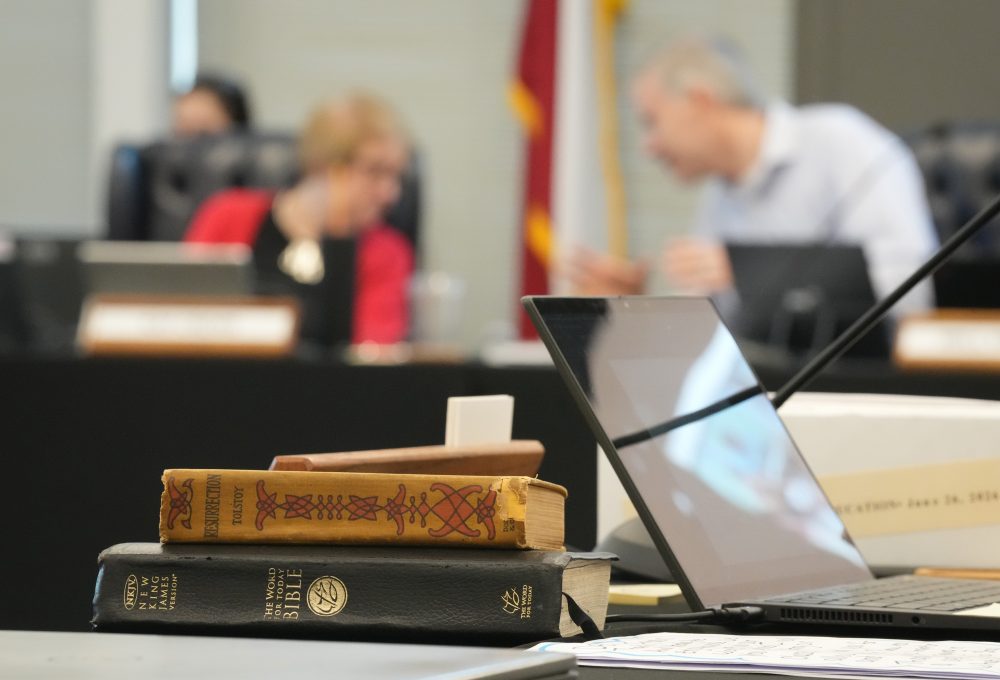

AUSTIN, Texas — The Texas State Board of Education is scheduled to vote Friday on a sweeping mandatory reading list for more than 5 million public school students — one that includes passages from the Bible alongside classic works of literature, marking what education experts say is an unprecedented move in American public education.
The proposal would require students to read literary works such as Charles Dickens’ “Great Expectations” as well as parables drawn from the New Testament. Education watchers across the country have been closely monitoring the situation, noting it appears to be the first mandatory reading list of its kind anywhere in the nation.
Should the Republican-controlled board give it the green light, the new reading requirements would not take effect until 2030.
Texas, which accounts for roughly one out of every ten public school students in the entire country, has increasingly moved to bring religion into its classrooms. The state already permits public schools to bring on chaplains to counsel students, requires the Ten Commandments to be posted in classrooms, and has approved an optional curriculum with strong ties to the Bible.
The proposal has drawn sharp criticism for months, with opponents taking issue both with the inclusion of religious texts and with the idea of the state dictating what books students must read — a decision traditionally left to individual teachers. Under the plan, teachers would still be free to assign additional reading beyond the required list.
Opponents argue the list fails to represent a diversity of voices, undermines the constitutional separation of church and state, and strips teachers and students of meaningful choice in their reading.
“Kids of all faith backgrounds and no faith are served by Texas schools and they should all feel welcome in Texas schools,” said Elva Mendoza, legislative communications associate for the progressive Texas Freedom Network. “But this is sending the message to children that one and only one religious text — a Christian one — is worthy of making this required reading list.”
On the other side, some community members have welcomed the prospect of mandated religious reading in public schools. Brooke Mazel, a retiree from Lubbock, urged the board to adopt the biblical materials, pointing to her own family’s upbringing with “strong faith and family values.”
“America should celebrate our 250 years that started as a nation of unwavering Christian values,” Mazel said.
The board is also expected to vote Friday on a social studies curriculum that connects Bible stories to American history.
A state law enacted in 2023 required that at least one literary work be mandated per grade level. The proposed reading list goes far beyond that minimum, containing roughly 200 texts — including Bible passages, essays, and books.
Antero Garcia, president of the National Council of Teachers of English and a professor at Stanford University, said he is unaware of any other state with a required reading list that incorporates religious texts. Garcia noted that educators at the district and school level typically make those selections themselves.
Kasey Meehan, director of PEN America’s Freedom to Read program, also described the move as “unique” to Texas.
The list starts early: elementary school students would be required to read picture-book stories including “David and Goliath” and “Daniel and the Lion’s Den.” By fourth grade, students would begin encountering passages about Jesus from the New Testament.
Middle school students would be expected to read multiple passages about Jesus, including portions of his most well-known sermon and a passage in which he urges people to let go of worldly worries and pursue the kingdom of God.
At the high school level, specific Bible passages are listed as supplementary materials tied to works such as Dickens and Jane Austen’s “Pride and Prejudice.”
Meehan compared the strict requirements to book bans, calling them “almost de facto censorship.”
“It certainly leans ideologically more conservative,” she said. “It excludes a lot of diverse voices from the reading list.”
The list also requires that students reading Shakespeare’s “The Tragedy of Julius Caesar” read a eulogy for President Ronald Reagan written by former British Prime Minister Margaret Thatcher, described as a staunch conservative.
Frank Strong, an English and journalism teacher and co-founder of the student advocacy group Texas Freedom to Read, emphasized that diversity in reading materials matters not only so students can see themselves reflected in the texts, but also as a way to expose them to different cultures.
While many titles on the list are not considered controversial, Mendoza questioned why certain books need to be mandated at all — pointing to titles like “Chicka Chicka Boom Boom” as an example.
“Can’t our kindergarten teachers be trusted to choose board books?” Mendoza asked.