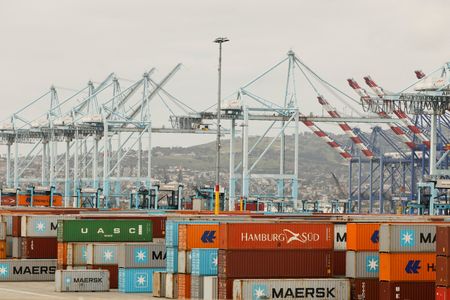

On Friday, the Trump administration announced new tariffs of 10% and 12.5% targeting goods from 60 trading partners around the world, including the European Union and China. The move came amid accusations that those countries have not done enough to crack down on forced labor — and it took effect just as a temporary 10% global tariff was expiring.
Here is how several world leaders and officials responded to the announcement:
EU FOREIGN POLICY CHIEF KAJA KALLAS
Speaking to reporters on the sidelines of ASEAN meetings in Manila, Kallas pushed back firmly against the justification for the tariffs. “You can’t say that for the European Union,” she said. “If you compare our labour laws to the ones of the United States, I mean, we have paid vacations, we have very good labour conditions for our employees, so it’s not really grounded.” Kallas also expressed frustration over what she described as a broken agreement. “We had a deal with America and we have kept to that deal, that side of the deal. That’s why this is a negative surprise that this agreement is not kept.”
AUSTRALIAN TRADE MINISTER DON FARRELL
Australian Trade Minister Don Farrell called the new U.S. tariffs “completely unjustified” and said he would continue to “argue very strongly” with American trade officials to have all duties on Australian goods removed.
MEXICO’S ECONOMY MINISTER MARCELO EBRARD
Mexico’s Economy Minister Marcelo Ebrard said his country would “see no change in the effective tariff that Mexico pays” as a result of the new measures. In a video posted to social media, he explained: “One replaces the other, so tariff treatment is maintained.”
BANK OF FRANCE GOVERNOR EMMANUEL MOULIN
Speaking to BFM Business TV, Bank of France Governor Emmanuel Moulin said the impact on Europe may be limited due to an existing agreement. “For Europe, it ought not to change much because we have the Turnberry agreement which should be respected by Donald Trump,” he said. However, he added a note of caution: “But obviously it creates more uncertainty for world trade and clearly it’s not favourable for growth.”
GOVERNMENT OF BRAZIL
Brazil’s government issued a strongly worded statement, accusing U.S. trade officials of exploiting human rights concerns to justify protectionist policies. “Lacking a legal basis under domestic law to support its protectionist trade policy, the U.S. Trade Representative chose to manipulate an issue of great importance to human rights and workers’ rights movement,” the statement read, calling the tariffs arbitrary and unjustified. Brazil announced it would immediately begin procedures under its “Reciprocity Law” and would bring the matter before the World Trade Organization’s dispute settlement process.
MALAYSIAN PRIME MINISTER ANWAR IBRAHIM
According to Malaysia’s state news agency Bernama, Prime Minister Anwar Ibrahim said his country was “relieved” that the tariff on Malaysian goods came in at the lower 10% rate compared to what other nations face. He said Malaysia would pursue further negotiations with the United States to protect its national interests, adding: “If we don’t get a satisfying response, we will raise the matter again.”
PHILIPPINE TRADE MINISTER CRISTINA ROQUE
Philippine Trade Minister Cristina Roque said her country would keep working with the U.S. to highlight its strong stance against forced labor. “The Philippines will continue to engage with the U.S. to emphasise that the country has a strong policy against forced labor consistent with various International Labor Organization (ILO) Conventions,” she said, noting that a Joint Administrative Order had just been signed to address the issue. She added: “In the meantime, we will continue to value our strategic relationship with the U.S. especially in ensuring that our trade remains intact, resilient, and stable. This is especially true since Philippine exports to the United States, particularly in electronics, semiconductors, and key agricultural products, support U.S. supply-chain stability.”