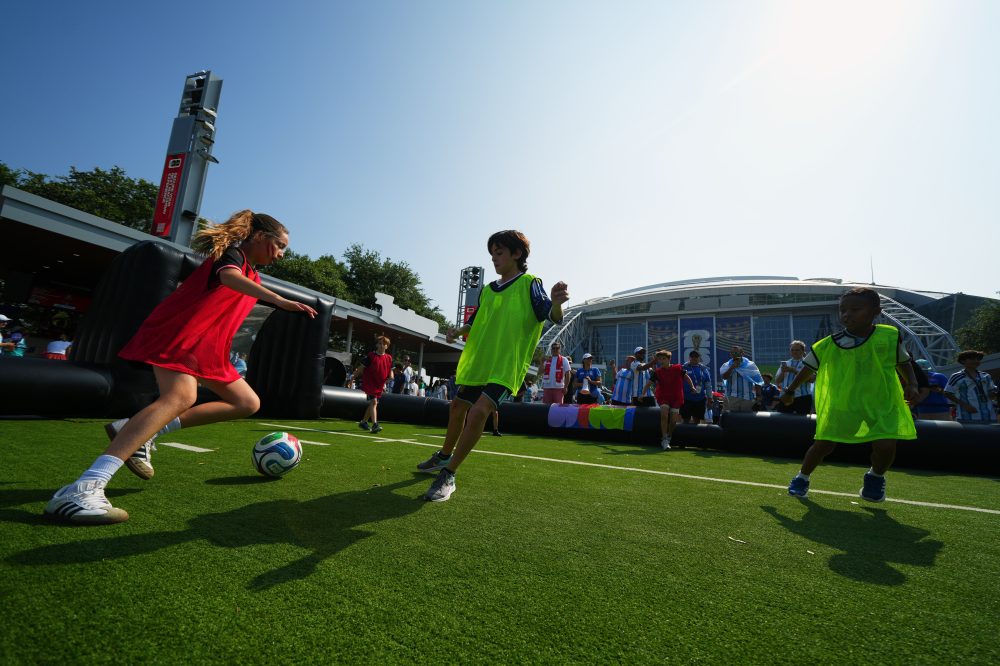

Big sporting events like the World Cup have a way of lighting a fire in young people — inspiring some to try a brand-new sport and others to dream about competing on a world stage one day. Researchers have even given this motivating power a name: the “demonstration effect.” The same thing has been observed with the Winter Olympics, the Masters Tournament, and Formula 1 racing.
But for many families, that burst of enthusiasm comes with real-world questions. How much time and money should you invest in a sport your child might abandon after one season? How do you know if the passion will last? And where’s the line between encouragement and too much pressure?
Experts and parents who’ve been through it have some answers — and they center on keeping kids healthy, happy, and in the driver’s seat of their own athletic journey.
When a child catches the sports bug after watching a big event, the natural instinct for many adults is to dive in headfirst — buying gear, signing up for lessons, and registering for competitions. But specialists say pumping the brakes a little gives families a chance to see whether the interest is genuine or just a passing phase, since children tend to cycle through hobbies as they develop.
Rather than locking in full seasons or ongoing lessons from the start, parents might consider lower-cost, lower-commitment ways for kids to explore — like pickup games with friends, one-time camps, or short clinics.
Travis Dorsch, the founding director of the Families in Sport Lab at Utah State University, said talking to other families about local coaches, programs, and leagues can be a big help. He also stressed the importance of learning about the sport alongside your child and letting the child take the lead.
“If it is soccer, parents should go down to the park, take a ball and kick it around with their kids, show them that you care about what they care about,” Dorsch said.
One of the trickiest pitfalls for some parents is the temptation to live out their own unfinished athletic dreams through their children. JJ Rauchwarger, 39, a youth baseball and basketball coach in Oregon who played collegiate basketball in Arizona, says some parents hold their kids to standards shaped by their own past ambitions — and that mindset can quietly affect how children see themselves as athletes.
Rauchwarger recommends keeping things in perspective by focusing on the value of staying active and healthy rather than chasing glory.
“I already had my career. It was 20 years ago. What matters is my little one scored his first basketball this year in little tiny top basketball, and he was stoked beyond measure,” Rauchwarger said. “My oldest one figured out how to one-up a layup and hit the free throw. That is way cooler than anything I ever did.”
She encourages parents to treat youth sports as a tool for building well-rounded kids — whether or not those kids ever become the next Lionel Messi, LeBron James, Simone Biles, or Shohei Ohtani.
“When we specialize early, we, as parents and coaches, put too much pressure on it,” she said. “I’m all for accountability and expectations. But that means are you being a good teammate? Are you putting forth your best effort? Are you showing up with a positive attitude?”
Dorsch said some parents fear their children will fall behind if athletic development doesn’t start early. With college scholarships, name, image and likeness deals, and million-dollar professional contracts in the picture, it can be easy to lose sight of the fact that youth sports are supposed to be fun.
“Most parents want what’s best for their kids and are just trying to operate as best as they can within the system,” he said.
Nick Asinjo, 14, is a defender for Cincinnati United Premiere, a travel soccer club that competes year-round, requires tryouts, and places a strong emphasis on achievement. Nick, who lives in Dayton, Ohio, said he made the decision in sixth grade to zero in on soccer after encouragement from coaches, teammates, and family — and after recognizing his own potential in the game.
“I want to get better. I see the pros, I see how they live and how they play, and it motivates me to go out there and be better,” he said.
While parents handle the logistics — driving to practices, paying fees, and juggling schedules — experts say children should ultimately be the ones deciding how much of themselves they want to give to a sport. Dorsch said healthy motivation grows from environments where young athletes feel a sense of independence, confidence in their abilities, and a real bond with their teammates.
Nick’s mother, Tess Mitchner Asinjo, 51, said it became clear over years of participation that her two children were genuinely committed to sports. When they started asking for extra training and actively seeking ways to improve, she took that as a signal they were ready for a bigger commitment.
Tamara McLeod, chair of the Department of Athletic Training at A.T. Still University in Mesa, Arizona, said that kind of internal drive is a key indicator. Specializing in one sport and traveling to compete year-round can be both expensive and time-consuming, and the demands can wear on athletes and their families alike.
Some kids do thrive under that level of intensity — especially when the push comes from within, McLeod said. But as families sink more time and money into a sport, some may feel trapped into continuing to pursue higher levels of competition even when a child’s interest starts to fade.
Outside pressure without genuine enthusiasm can also take a physical and emotional toll. Early signs of overuse injuries are often easy to miss but can escalate to the point of needing long recovery periods or even surgery.
No matter how talented a young athlete appears, experts say it’s important to help children keep sports in the right perspective. The vast majority of teenagers will not build careers around athletics, so focusing on personal growth and enjoyment — rather than elite outcomes — is both realistic and constructive.
Of the nearly 8 million students playing high school sports, only around 560,000 will go on to compete at NCAA member schools, according to data from the governing body for college athletics and the National Federation of State High School Associations. Of those, only a small fraction will ever reach the professional or Olympic level.
The U.S. Olympic and Paralympic Committee’s American Development Model urges parents and coaches to prioritize long-term development over early competitive wins. The framework, used by many national sport governing bodies, recommends children try multiple sports — especially before age 12 — with an emphasis on skill-building and enjoyment over winning. It also encourages adults to keep an eye on training loads and make sure young athletes get enough rest.
“We want our kids to be healthy. We want them to learn to respect authority figures. We want to learn how to win and lose with grace. We want them to become resilient and have grit,” Dorsch said. “But it’s incumbent upon the coaches and parents to actually deliver on that promise and not just assume that sport is going to do it automatically.”