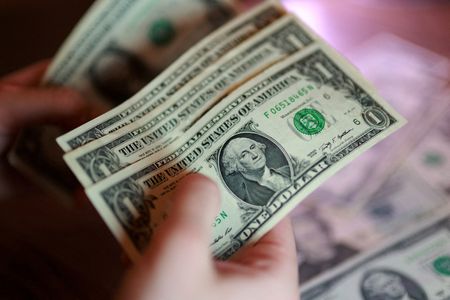

The U.S. dollar is entering the back half of 2026 on a remarkable upswing, buoyed by growing expectations for higher American interest rates and an insatiable global appetite for U.S. investments — a trend that analysts warn could put serious pressure on currencies around the world.
At the halfway mark of the year, the dollar has climbed 3%, making it the strongest-performing currency globally. That stands in stark contrast to the same point last year, when it had dropped more than 10% — its steepest first-half decline since the early 1970s — largely due to concerns over U.S. tariff policy.
Even as a potential ceasefire in the Iran conflict has helped bring energy prices and inflation fears down a notch, the U.S. economy continues to roar ahead, powered significantly by an artificial intelligence boom. As a result, investors are now betting that the next move in interest rates will be upward, not downward — a shift that continues to push the dollar higher.
Geopolitical tensions have added further fuel to the dollar’s rise. New Federal Reserve Chair Kevin Warsh has struck a hawkish tone, keeping attention squarely on inflation, which remains well above the Fed’s 2% target. Traders now anticipate at least one rate increase this year, with a 50-50 chance of a second hike — a significant change from expectations just weeks ago that called for no movement at all.
The dollar has climbed to 40-year highs against the Japanese yen, rattling officials in Tokyo, and is trading near yearly highs against the euro.
Stephen Jen, chief executive and chief investment officer of Eurizon SLJ Asset Management, acknowledged that while American goods are becoming pricier for foreign buyers, that may not be enough to slow the trend.
“The strong dollar is not welcomed by anyone in the world, including the United States,” Jen said. “But U.S. companies, and being in the U.S., are just too valuable (or) attractive. Foreign companies are investing heavily in the U.S. to have a foothold and that is also holding up the dollar.”
From Auckland to Zurich, policymakers are grappling with weakening local currencies that are driving up the cost of imports. While energy prices have eased, the price of food, travel, and other goods and services has climbed sharply. South Korea’s won has sunk to record lows, stoking a frothy stock market and worrying regulators. Meanwhile, emerging economies like India have been intervening to support their currencies or raising interest rates to defend against dollar strength.
INVESTORS PILE IN AT RECORD PACE
Market participants have been building up bets on a continued dollar rally faster than at any other first-half period on record, according to data from the Commodity Futures Trading Commission. Speculators currently hold a net long position worth roughly $30 billion — the largest since the beginning of Donald Trump’s second presidency. The net increase of $37 billion in those holdings is the fastest pace for any first half of the year since CFTC records began in 2012.
Joseph Purtell, a portfolio manager at Neuberger, said the near-term risk clearly points toward a stronger dollar. “I certainly think in the near term, the risk is that you get a stronger dollar because of this increase to real rates in the U.S.,” he said. “Can we break out of this range that we sort of held over (the last) six- to nine-month period? I think it’s likely.”
Purtell added, however, that his firm’s longer-term outlook calls for dollar weakness, citing structural concerns including the sustainability of U.S. government finances.
RECORD CASH FLOWING INTO U.S. MARKETS
U.S. economic data has delivered nearly continuous positive surprises since April, and corporate earnings growth has outpaced forecasts. Morgan Stanley flagged in a recent note that the euro could slip toward $1.10 in the near term if markets keep pricing in a more aggressive Federal Reserve. The euro is currently trading around $1.135.
The artificial intelligence frenzy — along with trillion-dollar initial public offerings, beginning with SpaceX — has drawn in record sums of money. Bank of America estimates that an unprecedented $341 billion has poured into U.S. equities so far this year, compared with $134 billion at the same point last year.
The United States is home to the major technology companies racing to construct data centers for the AI expansion, as well as leading quantum computing firms, giving some investors additional reasons to favor the dollar.
Mabrouk Chetouane, global head of market strategy at Natixis Investment Management, summed up the dynamic simply: a strong economy produces a strong currency. “If we think that growth tomorrow is a combination of calculation capacities, energy, and to some extent, labour, which country and which geography is in the best position to benefit from this environment?” he said. “It’s the United States — the winner takes it all.”