
SAN FRANCISCO — After an eight-year journey, chef and co-owner Val Cantú and his team at San Francisco’s Californios have achieved something no Mexican restaurant anywhere in the world has ever done — earned three Michelin stars. The milestone has given the entire 40-person staff a noticeable boost in confidence.
“It’s been just really rewarding to see the team kind of like, carry a little bit more confidence in their step,” Cantú told the Associated Press. “Maybe I’ve got some new confidence too.”
The achievement follows a steady climb that started when Californios first opened its doors in 2015, earning its debut Michelin star immediately. A second star followed in 2018. Then, at a June ceremony held in San Diego, Cantú — standing alongside his wife Carolyn — was presented with his third star and a crisp white Michelin chef’s jacket.
The recognition goes beyond just one restaurant. Many see it as validation that Mexican cuisine — both in Mexico and across communities around the world — can stand alongside the finest dining experiences anywhere. Much like upscale Chinese restaurants located just a short distance from Californios, Mexican American establishments have long faced criticism for charging higher prices and offering tasting menus. Yet French and Japanese restaurants with comparable price tags rarely face the same scrutiny.
The Michelin Guide was launched in 1889 by French brothers Andre and Edouard Michelin, who introduced a star-rating system in the 1920s. Today, the guide covers more than 40,000 restaurants globally, with anonymous inspectors dining at establishments to evaluate them. According to Michelin’s website, Californios rose through the ranks because it has never been “afraid to cross borders” on the plate.
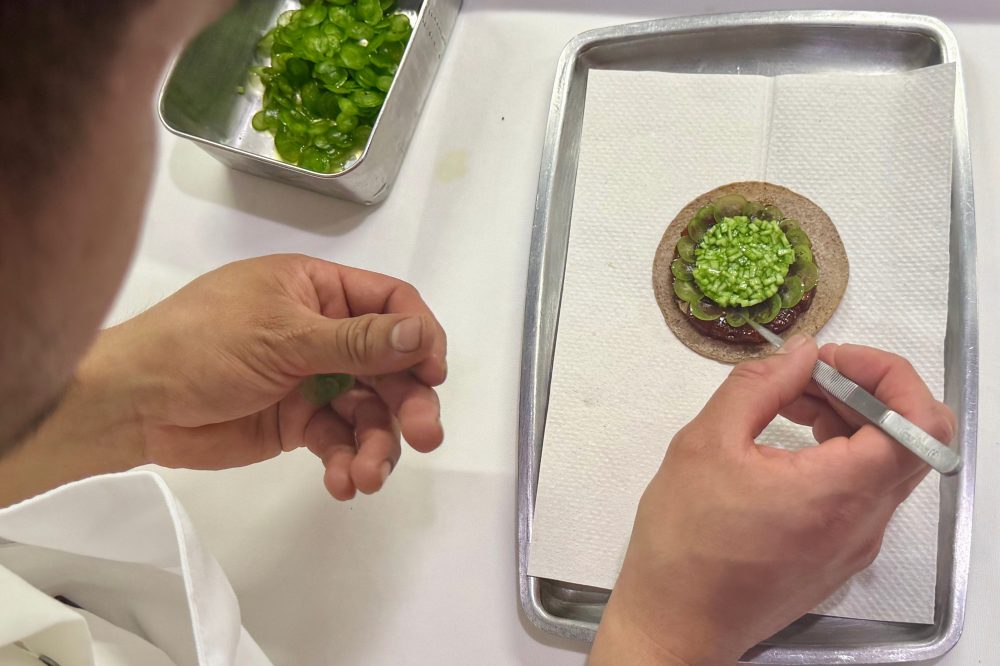
From the very first course, diners at Californios experience the Texas-born Cantú’s fusion of Mexican culinary tradition with California-grown ingredients. A meal begins with a sope — a small, hand-shaped masa cake made from white corn and beans sourced from a farm in nearby Santa Rosa — topped with caviar produced in collaboration with a Sacramento sturgeon farm, carefully applied with a spatula.
“It’s just really, really delicious and kind of feels like a warm hug,” Cantú said. “It feels comforting.”
Michelin’s inspectors were equally impressed. One of five inspectors said Californios earned its three-star promotion for dishes consistently “executed with such precision, refinement and clarity without losing the Mexican identity — things like kombu or the matsukasa yaki fish taco.”
Cantú and his staff would sometimes try to figure out whether a particular diner might be a Michelin inspector. He said the exercise served as a useful reminder that “every guest gets the same quality of presentation and hospitality.”
In recent years, Michelin has recognized a growing number of Mexican restaurants, including a tiny 10-by-10 foot taco stand in Mexico City. But this recognition is arriving during a tense period for immigration policy and the treatment of immigrants — including those in the country legally.
Cantú, who generally keeps politics out of his food, said he could not look away from ongoing headlines about federal immigration enforcement operations — some of which have resulted in deaths, including a Mexican man in Houston and a Colombian man in Maine earlier this month. He described immigrants as “the backbone of all these dish pits and kitchens” and has shown his support through action, including a collaborative “anti-ICE” fundraising dinner held in March.
“The culinary world is like a huge supporter of immigrants and the need for immigrants and the need to treat people with respect,” Cantú said. “It’s hard for me to say much more.”
As a restaurant operating in a blue state, Cantú believes the majority of Californios’ customers likely share that view.
Food writer and journalist Gustavo Arellano, who is also Mexican American, says the growing popularity of Mexican cuisine helps put a human face on the immigration debate.
“You see this especially like in small Southern towns where the rhetoric is ‘I’m against illegal immigrants. I don’t want too many Mexicans,’” Arellano said. “But, then they look at the Mexican restaurant in town and they’re like ‘Well, not them.’”
Cantú grew up watching his father and uncle run a Mexican restaurant and tortilleria in Texas. As he worked his way through high-end kitchens in Austin and San Francisco, he kept asking himself why no one was treating Mexican cuisine with the same level of serious attention and care.
Inspired by the Bay Area, he chose the name Californios as a tribute to the descendants of Spanish and Mexican settlers who made their homes in what is now California during the 1700s and 1800s.
When Californios launched with a $57 four-course tasting menu, the backlash was swift.
“There was a ton of like, ‘This is not Mexican cuisine,’” Cantú recalled. “Even from our families, you know, trying to explain a contemporary cuisine to a lot of people is totally foreign because people kind of think that cuisine exists in a cookbook and that it doesn’t change.”
Californios is considered a leader in what some refer to as “alta California” cuisine — a style in which children of Mexican immigrants, or immigrants themselves, apply classical culinary training to Mexican flavors. The term draws from the name of the former Spanish province north of Baja California. Arellano describes it as an “ideology” that was born in California and has since spread across the United States.
Higher flavor profiles and higher prices tend to invite skepticism. Arellano argues that some of this resistance stems from an effort to keep Mexican food confined to a narrow definition.
“There’s always going to be a knee-jerk reaction,” Arellano said. “It goes to this myth that Mexican food should be cheap because Mexicans, all of us are supposedly working class that cannot afford higher-end stuff. That’s classist.”
Cantú has no plans to slow down. A cookbook is currently in the works, and he intends to keep shining a spotlight on his Mexican-California approach to fine dining.
“Mexican cuisine is one of the most diverse and complex cuisines in the world,” Cantú said, “and there’s countless Mexican immigrants in the United States and Latin immigrants who have their own ideas and concepts of what things can be.”