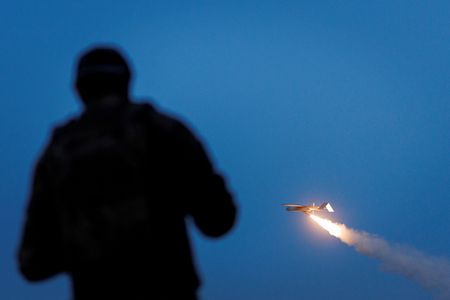

From an undisclosed location in southern Ukraine, soldiers penned sarcastic messages on a sleek grey attack drone before sending it out over the Black Sea to hunt Russian vessels — the latest move in Ukraine’s expanding effort to isolate Crimea and undermine Russia’s war machine.
Operating well behind the front lines across Ukraine’s open steppe, these drone units have struck more than 180 ships and other waterborne targets near the peninsula in just three weeks, effectively opening a new chapter in the conflict.
The strikes began in the Sea of Azov and have since expanded into the Black Sea. Their purpose is to drive up the price Russia pays for holding Crimea and to shift momentum toward Kyiv as the war enters its fifth year of full-scale fighting.
“We work day and night, every day, without time off,” said the battalion commander known by his call sign “Ray,” who leads a unit of Magyar’s Birds — a brigade playing a central role in the campaign. As is standard in the Ukrainian military, he declined to use his real name.
During a recent visit by reporters, Ray’s team was launching drones every few minutes. The unit reported hitting a cargo ship, a floating crane in the Black Sea, and a power substation in southern Crimea — though those claims could not be independently confirmed.
These Ukrainian strikes are unfolding alongside a broader intensification of fighting at sea. Russia has responded by ramping up its own attacks on Ukrainian ports and international shipping vessels.
Ukraine’s agriculture minister announced Thursday that ship operators had temporarily halted vessel arrivals at Ukrainian Black Sea ports used for grain exports, citing the surge in attacks.
The Battle Over Crimea
Crimea has emerged as a focal point for Ukraine’s drone campaign. The peninsula functions as a key transit and military hub for Russian forces, and Kyiv has spent recent months targeting road and rail connections linking it to mainland Russia — territory Moscow seized and annexed in 2014, years before its full-scale invasion in 2022.
Those strikes have triggered fuel shortages and a declared state of emergency in Crimea, with energy and gas infrastructure also coming under repeated attack.
The latest phase now includes hits on oil tankers, dry cargo ships, and other vessels — a broadening of Kyiv’s strategy to choke off resources reaching Russian forces.
Since this new phase kicked off in July, drone forces under commander Robert “Magyar” Brovdi have been averaging roughly six vessel strikes per day, with Brovdi documenting the hits in sarcastic, emoji-filled dispatches.
The campaign has severely disrupted Russian shipping through the Sea of Azov, which connects to Russia’s southern grain-producing heartland via the Don River.
Brovdi’s forces also reported that the Kerch ferry crossing — linking eastern Crimea to Russia’s Krasnodar region — has lost approximately 75% of its capacity, though Reuters was unable to independently verify that figure.
Brovdi told reporters the goal of the strikes was to shatter what he called the “myth” of Russian dominance and to establish Ukrainian control over its own territorial waters.
The operation has been given the name “Molochko” — a word that sounds like the Russian word for “milk” but is actually an acronym for the phrase “Moscow will collapse because of Crimea.”
A senior fellow at the Royal United Services Institute think tank in London said Ukraine’s earlier success in disrupting Russian overland supply routes had pushed more traffic onto sea lanes through the Azov, creating more targets for drone attacks. He described the current maritime campaign as “a logical continuation” of Ukraine’s broader Crimea strategy.
Russia Strikes Back at Ukrainian Ports
As Ukraine targets Russian ships, Russia has intensified its bombardment of southern Ukraine — especially the city of Odesa and the ports that ship the country’s grain through a maritime corridor to global markets.
On Sunday, 10 sailors were killed when Russian forces struck a Guinea-Bissau-flagged vessel carrying corn out of the port of Odesa, according to Ukrainian officials.
The previous week, at least three people died in attacks on Odesa and Mykolaiv, another major port city.
In just the first two weeks of July, Russia struck Ukrainian ports 23 times and hit civilian vessels 17 times, according to Ukraine’s seaports authority — leaving traders dealing with severe logistical disruptions.
Agricultural exports, including grain and vegetable oils, represent Ukraine’s largest source of foreign currency, with more than 90% shipped through ports in the Odesa region via the maritime corridor.
Russia has maintained that its strikes target infrastructure used to store military cargo and fuel.
Always on the Move
The Ukrainian-made FP-1 and FP-2 drones used by Ray’s battalion fly autonomously to their target zones before remote pilots take control to deliver the final strike.
Moments after launching their last propeller-driven drone using a small jet-assisted catapult, the crew quickly packed up their equipment and prepared to relocate. No launch site is ever used twice, and teams are frequently dispatched to new positions with only a few hours’ warning.
Though advances in technology now allow them to operate more than 100 kilometers — about 62 miles — behind the front lines, these units remain high-priority targets for Russian drone hunters.
“This is a constant war — a continuous struggle of measures and countermeasures,” said Ray, who commands the brigade’s ninth battalion, known as Kairos.
A squadron commander who goes by the call sign Panama said the “tangible results” of their operations kept him and his fellow troops motivated.
“It’s great that our tempo is so high,” he said, “but we still need to sustain it.”