
American stock futures dropped while several Asian markets posted gains Monday following the Supreme Court’s decision to overturn the majority of President Donald Trump’s comprehensive tariff policies.
Markets in Tokyo remained closed due to a holiday observance.
Hong Kong’s market led the regional rally with the Hang Seng index climbing 2.2% to reach 27,003.47. However, Shanghai’s Composite index declined 1.3% to 4,082.07.
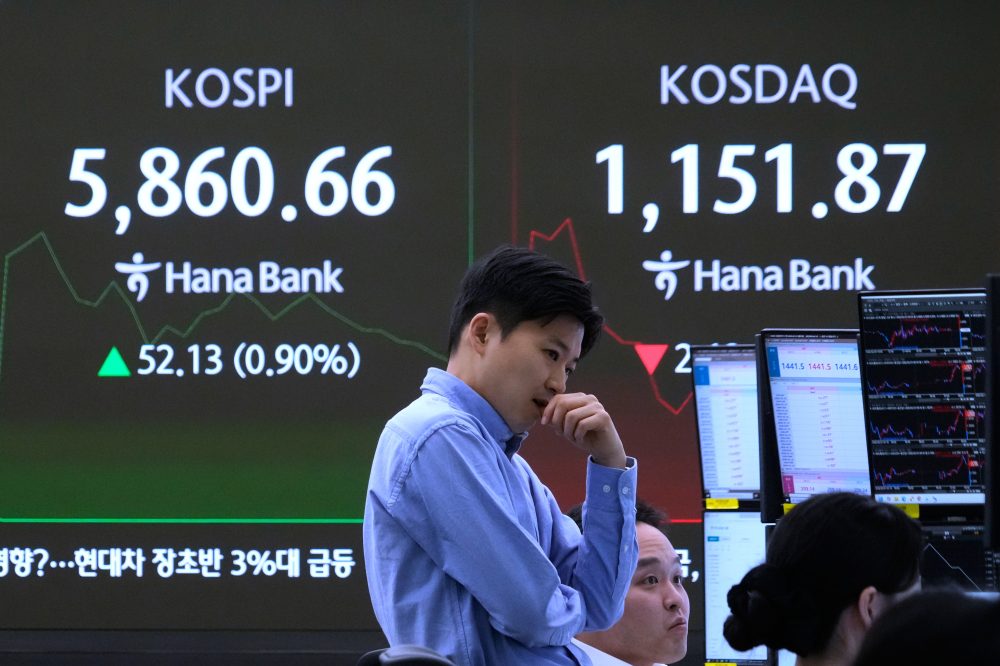
South Korea’s Kospi index advanced 1.1% to 5,873.07, while Australia’s S&P/ASX 200 dropped 0.4% to 9,041.00. Taiwan’s Taiex posted a strong 1.4% increase.
These varied market responses reflect “the winners-and-losers effect of shifts in tariff policy that has just delivered a boost to countries who previously had a comparatively bad deal,” Benjamin Picton of Rabobank explained in his market analysis.
“U.S. tariff policy will continue to be a source of uncertainty for markets as traders attempt to price in the implications of what is still a movable feast,” Picton noted.
American futures contracts showed declines across the board, with the S&P 500 future falling 0.7%, the Dow Jones Industrial Average future dropping 0.6%, and the Nasdaq composite future declining 0.8%.
Last Friday, Wall Street maintained stability despite the Supreme Court’s decision against Trump’s extensive tariff program, which had caused significant market volatility when initially announced last year.
The S&P 500 increased 0.7% to 6,909.51, after fluctuating between modest gains and losses prior to the court’s announcement. This movement came amid disappointing economic data showing reduced U.S. growth and rising inflation rates.
The Dow Jones Industrial Average gained 0.5% to 49,625.97, while the Nasdaq composite advanced 0.9% to 22,886.07.
Despite the court’s ruling, tariff policies will persist in some form. Trump announced Monday afternoon his intention to pursue alternative methods for imposing import taxes on foreign goods, describing the court’s decision as “terrible.”
“Just so you understand, we have tariffs, we just have them in a different way,” Trump explained to reporters during an afternoon press conference. He indicated plans to sign an executive order implementing a 10% worldwide tariff under legislation that could restrict its duration to 150 days, later increasing that figure to 15%.
The president also mentioned exploring additional tariff options through other channels, including measures requiring Commerce Department investigations.
Market responses have remained cautious due to ongoing uncertainty about Trump’s future actions.
On Wall Street, Akamai Technologies experienced one of the day’s steepest declines, falling 14.1%. The cybersecurity and cloud computing firm reported fourth-quarter 2025 results exceeding analyst expectations but provided profit projections for the coming year that disappointed investors.
Akamai announced plans to allocate a larger portion of its revenue toward equipment and other investments in the upcoming year, serving as another potential sign of how computer memory shortages from the AI surge are impacting businesses across the economy.
Disappointing economic reports showing slower U.S. growth and accelerating inflation generated relatively subdued investor reactions.
These reports highlight the challenging position facing the Federal Reserve as it determines interest rate policy, though they didn’t significantly alter trader expectations for Fed actions. Market participants continue anticipating at least two rate reductions this year, based on CME Group data.
Reduced interest rates could stimulate economic activity and boost investment values, but they also carry the risk of exacerbating inflation. Federal Reserve officials indicated at their most recent meeting their desire to see further inflation decreases before supporting additional rate cuts.
In early Monday trading, U.S. benchmark crude oil decreased 53 cents to $65.95 per barrel, while Brent crude, the international benchmark, fell 51 cents to $70.79 per barrel.
The U.S. dollar weakened to 154.11 Japanese yen from 154.99 yen, and the euro strengthened to $1.1828 from $1.1780.
Gold prices increased 1.9%, while silver prices jumped 5.5%.