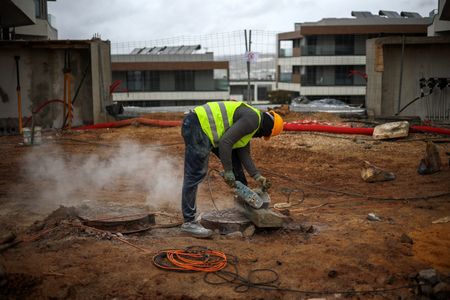

Jose Simao traveled from Angola to Portugal in 2022 to work as a bricklayer, joining a broader wave of immigrants who had become a vital lifeline for the country’s severely understaffed construction industry. Now, his future in the country is uncertain.
“I did everything the authorities asked of me, and I’m here legally. But the government changed the rules. I’m afraid they’ll send me back,” Simao told Reuters.
Portugal’s increasingly strict immigration policies — driven in part by the government’s effort to blunt the rise of a growing far-right movement — are cutting off the labor supply that construction companies depend on, even as those same companies race to address one of the worst housing crises in Europe.
The country’s centre-right coalition government says it wants to put a stop to what it calls “uncontrolled inflows” of migrants while ensuring that those already living in Portugal have adequate living conditions. But construction executives and industry organizations say the new measures have deepened an already serious worker shortage, threatening efforts to build affordable housing and putting at risk a sector that accounts for nearly 8% of the national economy.
“The government has restricted immigration too much and too quickly given the country’s needs,” said Oscar Afonso, an economics professor at the University of Porto. “It was a political choice, but immigrants are essential to the economy.”
The roots of Portugal’s immigration boom stretch back to 2017, when the previous centre-left government allowed foreign workers to enter without work visas and later apply for residency after a year of employment with documented social security contributions. Between 2021 and 2025, the number of foreign residents more than doubled, reaching a record 1.6 million — about 14% of the total population.
These workers filled a critical gap in construction, a sector that had seen many of its Portuguese employees leave for higher-paying jobs in wealthier European Union countries. Today, foreign workers account for roughly 30% of the construction workforce.
But the surge in immigrant numbers also fueled the anti-immigrant Chega party, whose rising popularity traditional Portuguese political parties have found difficult to counter. In 2024, Portugal followed the lead of many other European nations and tightened its immigration rules after a shift toward a centre-right government, with one cabinet minister declaring at the time that “the time for an irresponsible policy is over.”
A study by the Bank of Portugal found that the new restrictions had already cut net immigration roughly in half, down to about 6,200 people per month in 2025 compared to the year before. Experts expect the numbers to fall further.
For the construction industry, the timing is especially difficult. Portugal faces a severe housing shortage, with new rental lease costs nearly doubling since 2017. The country’s central bank estimates a deficit of 300,000 homes across the nation — equivalent to the entire housing stock of the capital, Lisbon.
Portugal has committed to building 150,000 affordable homes by 2030 through a €9 billion ($10.3 billion) program backed by the European Union. But even with a 34% jump in construction jobs between 2020 and 2025, the industry is still short on workers.
Portugal’s largest construction association, AICCOPN, estimates the sector needs at least 80,000 more workers just to keep existing projects moving. Albano Ribeiro, head of the Construction Workers’ Union, warned the shortfall could grow to 120,000 jobs as major projects get underway — including Lisbon’s planned new airport, which alone is expected to require 10,000 workers.
The government introduced a fast-track visa program last year to help companies hire workers from abroad. However, firms are required to offer employment contracts and arrange adequate housing for incoming workers before they arrive. So far, only 5,000 construction visas have been issued under the program.
“The sector needs workers to build homes … yet builders must now secure housing for incoming immigrants,” said Joao Sousa, chief executive of JPS, one of Portugal’s largest developers. “If there are no homes for those already here, how can we provide housing for people coming to Portugal?”
About 90% of JPS’s workforce of roughly 700 to 800 people are foreign nationals. Smaller companies, builders and union officials say, have even less ability to arrange dormitory-style housing near often remote job sites.
The stricter rules are also threatening the status of many workers already living and working in Portugal, like Simao. Although he has an employment contract, his two-year residence permit is set to expire in August. Under the updated regulations, he must now present a formal rental contract to renew it.
Simao rents a room in Lisbon for €380 a month through an informal arrangement, but his landlord is unwilling to provide official payment receipts — leaving his renewal in jeopardy.
“I came here to improve my life and hoped to one day bring my mother to Portugal,” he said.
Meanwhile, other European countries facing similar labor shortages — including Spain and Italy — are moving in the opposite direction, working to regularize undocumented migrants or expand work visa programs.
JPS’s Sousa said he supports expanding training programs and raising wages to draw more Portuguese workers into the industry, but acknowledged that foreign labor remains essential. “Many projects could be delayed or cancelled unless the government adopts exceptional measures, as other countries have, to attract and retain migrants,” he said.