
Sri Lanka is fighting its worst dengue fever outbreak in close to a decade, and the government has turned to the nation’s armed forces — including air force drones — to help bring the mosquito-borne disease under control.
The military response includes drones scanning rooftops for pools of standing water left behind by monsoon rains, while military and police personnel assist public health workers in inspecting homes, construction sites, and schools to eliminate places where mosquitoes breed.
Since the outbreak began in January, 53 people have died and 76,044 infections have been recorded. A more aggressive strain of the virus has accelerated its spread, pushing the numbers closer to the toll of more than 100,000 cases seen during a 2017 outbreak.
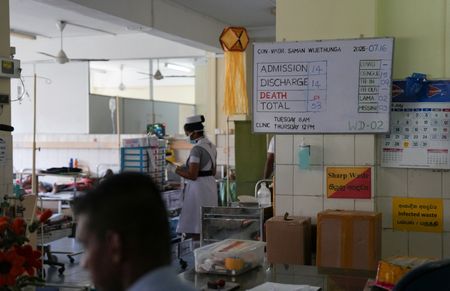
“It’s challenging for the doctors because it’s a rapid increase in patients,” said consultant Lalindra Dias, based in Negombo — one of the hardest-hit areas, located roughly 35 kilometers (22 miles) north of the major city of Colombo. His district general hospital treated nearly 1,800 patients in less than two months since June, compared to about 1,050 in 2025.
Hospitals have been scrambling to add beds, repurpose wards, and extend working hours for medical staff. More than 18,000 cases were recorded in just the first two weeks of July alone, according to health authorities.
June saw 21,537 infections — more than double the May total. The illness typically causes high fever, body aches, and loss of appetite. Sri Lanka has not yet introduced a dengue vaccine.
The outbreak has been made worse by the aftermath of Cyclone Ditwah, described as the country’s most destructive natural disaster, which severely damaged infrastructure and health facilities in late November. The World Bank estimated losses from the storm at $1.4 billion.
Kapila Kannangara, acting director general of the National Dengue Control Unit, said public health workers were “stretched to their limit.” He noted that approximately 75% of cases are tied to the more dangerous DENV-2 strain, adding, “The number of patients is high, and the severity of the cases is high.”
Health officials believe infections will begin to slow as monsoon rains taper off in August, but they caution that case numbers could rise again starting in November when the island’s second annual monsoon season begins.
On Thursday, the government launched a targeted cleanup of the most severely affected regions, sending teams to inspect everything from private homes to religious institutions in search of mosquito breeding grounds. Nearly 11,000 such sites have been cleared this month, and fines have been issued at more than 4,000 locations found to be harboring them, according to the health ministry.
Air force drones are also being used to help short-staffed workers at some public hospitals monitor patients, in addition to their role identifying water collection points on rooftops.
To ease the burden on hospitals, doctors are advising patients with mild symptoms to recover at home. “The doctor asked me to stay at home because my platelet count had not fallen too much,” said 23-year-old Shalini Aloka Perera. “Then I did my treatment at home because there are too many patients in the hospitals.”
Officials are also weighing the possibility of introducing a dengue vaccine, though experts have cautioned that its effectiveness may be limited given the complexity of the virus and the multiple strains currently circulating.
At the Negombo hospital, Dr. Dias said case numbers are expected to level off before declining in August, but acknowledged that the unusual pattern of this outbreak makes predictions difficult. “So we cannot exactly say when it will stop, by the end of July. Sometimes it will be a little longer than that.”