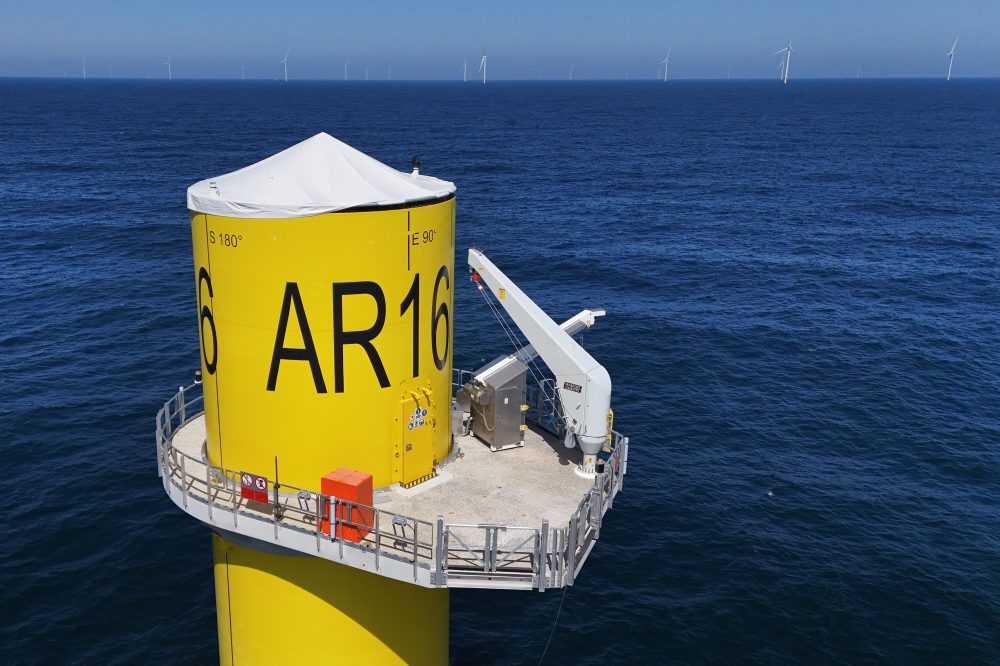

Since late last year, President Donald Trump’s administration has been working to shut down offshore wind energy development, arguing the projects represent a threat to national security.
Construction on several major projects was frozen, and the government has been buying back offshore wind leases — all while pointing to national security concerns as the driving reason. Interior Secretary Doug Burgum has stated that a classified report from Defense Secretary Pete Hegseth confirms offshore wind poses a genuine national security threat.
The push to stop wind development comes as the Republican president has long expressed opposition to wind turbines and has prioritized expanding fossil fuel production to achieve what he calls “energy dominance” in global markets. National laboratory estimates indicate that turbines placed along U.S. coastlines could generate more than enough electricity to meet the entire country’s annual power needs.
Wind turbines are known to interfere with radar systems — but this is not a new challenge. The Pentagon already reviews wind farm construction proposals and has the authority to declare certain areas off-limits. Radar technology upgrades also exist to reduce the impact of turbines on detection systems.
Burgum has specifically raised concerns about autonomous drones potentially flying through offshore wind installations undetected due to radar interference. He also said the vibration produced by wind towers could disrupt undersea sonar systems.
The Department of Energy notes that radar systems can be adjusted to raise detection thresholds, though doing so may cause actual targets to be missed.
Kirk Lippold, a national security expert and former commander of the USS Cole, said radar operators are trained to distinguish real targets — whether boats, submarine periscopes, drones, or incoming missiles — from background interference. If drones aren’t being caught before they reach a wind farm, he said, “we have bigger national security issues.”
According to the Department of Justice, defense officials provided the Bureau of Ocean Energy Management with classified information in November 2025 outlining new national security concerns tied to offshore wind projects.
Just days before Christmas, BOEM halted construction on five large East Coast wind projects. Burgum said the action was necessary to address the rapid advancement of adversary technologies and the vulnerabilities these projects create near major East Coast cities. The move came after courts had already blocked the administration’s earlier attempts to stop wind development through executive orders.
Sweden is also raising national security concerns about offshore wind. Officials there announced Thursday they are approving two offshore wind farms but rejecting 11 others.
Green Power Sweden CEO Nils Grunditz questioned why Sweden is scaling back its offshore wind plans when radar interference solutions are already in use elsewhere in the region. Denmark has been at the forefront of wind energy since constructing the world’s first offshore wind farm in 1991.
In March, the UK government announced it purchased new air defense radar systems capable of handling anomalies caused by offshore wind farms, calling it technology that allows air defense and offshore wind to coexist. The independent climate think tank E3G has argued that turbines in the North Sea could actually serve as a defense asset by incorporating surveillance and monitoring equipment.
Wind energy developers affected by the construction freeze, along with several states, filed lawsuits. The DOJ argued that national security considerations take priority and that federal courts should not second-guess military officials’ risk assessments.
Federal judges reviewed the classified materials and ultimately allowed all five wind farms to resume construction.
At the U.S. District Court for the District of Columbia, Senior Judge Royce Lamberth raised concerns that the national security reasoning offered by the administration may have been “pretextual” — used to disguise the real motivation behind stopping offshore wind development.
When reinstating a major wind project serving Rhode Island and Connecticut called Revolution Wind in January, Lamberth pointed out that the government had not applied its newly stated security concerns specifically to that project, that Burgum had publicly criticized offshore wind around the time of the stop-work order for reasons having nothing to do with national security, and that BOEM waited until December to act on information it had received back in November.
The administration’s actions extend beyond offshore wind — the Pentagon is also delaying the development of onshore wind farms, and emergency orders have been used to keep fossil fuel power plants running.
Meghan Greenfield, a partner at Jenner & Block LLP in Washington, said the administration has leaned so heavily on national security arguments across so many different situations that “it has caused increased skepticism by the courts.”
In buying back offshore wind leases — including those off the California coast — the Interior Department again cited national security concerns.
Retired U.S. Navy Vice Admiral Dennis McGinn, who once commanded the fleet overseeing naval operations across the eastern and northern Pacific Ocean, said there is no “showstopping national security issue” that would undo years of analysis done on those lease areas.
McGinn said he believes the administration is exaggerating the risks and costs of offshore wind while downplaying its benefits, all to justify pushing more fossil fuels — and that “it doesn’t pass commonsense tests.” He noted that offshore wind generates electricity without pollution, while oil, coal, and natural gas all release carbon emissions when burned.
McGinn, who also served as an assistant secretary of the Navy, said radar interference from turbines was recognized early on and has been adequately addressed, pointing to thousands of turbines already operating across Europe and Asia.
“National security and offshore wind are compatible, if it is done right, in the right locations,” McGinn said.
Not everyone agrees. Economist Diana Furchtgott-Roth, a distinguished fellow at the Energy Policy Research Foundation, said defense concerns related to wind turbines have been recognized for decades, that the military’s perspective deserves serious weight, that the country should not rely on Chinese-manufactured turbines, and that gas, coal, and nuclear energy provide affordable and dependable power. She said the administration is acting prudently.
Democratic U.S. Sen. Jack Reed of Rhode Island said he attended a classified briefing on the matter months ago and did not find the security rationale convincing. Reed, who serves as the ranking member of the Senate Armed Services Committee, is pushing to include a provision in the defense bill that would require a military office known as the siting clearinghouse to evaluate wind projects and explain its conclusions within 180 days.
“They have to be able to produce a thoughtful and thorough analysis which justifies their decision,” Reed said Wednesday. “That’s the way to go.”
Even so, Reed acknowledged that this administration finds many ways to block things it opposes, and he expects the effort to stop wind energy development to continue.