
Even as military strikes between the United States and Iran grow more intense over the Strait of Hormuz, the door to a diplomatic resolution has not fully closed.
Pakistan’s Foreign Ministry pushed back Thursday against reports that it had stepped away from its role as a mediator between Washington and Tehran. Pakistan had brokered an initial ceasefire agreement last month, but that deal has since broken down.
“Let me dispel the impression that Pakistan has done hands up, and this is not the case,” ministry spokesperson Tahir Andrabi told reporters at a news conference. He added that the two sides eventually “will have to come to the negotiating table to settle all outstanding issues.”
Senior officials from both countries have also signaled they haven’t abandoned the idea of talks. In a podcast interview with Joe Rogan that aired Wednesday, Vice President JD Vance said the Trump administration is “not going to bomb and bomb and bomb” and acknowledged that “you’ve got to actually be willing to talk and to try to figure out the problem.”
“We’re going to try to use our military force as one of the many tools that we have to solve the problem,” Vance said, calling diplomacy “another tool.”
Regional officials, speaking anonymously due to the sensitivity of the ongoing negotiations, said mediators from Pakistan, Qatar, and Egypt have been working to restart talks. Those officials noted that neither side has formally notified Pakistan that it is withdrawing from or terminating the initial ceasefire agreement.
Those behind-the-scenes efforts have been overshadowed by a sharp escalation in fighting. The U.S. military on Thursday launched strikes deeper inside Iran and fired on a vessel it accused of attempting to break through its naval blockade of Iranian ports. Iran responded by firing missiles and drones at American allies in the region and warned that future attacks could target “all the infrastructure in the region.”
Naysan Rafati, a senior Iran analyst at the Washington-based International Crisis Group, described the current moment as delicate and potentially pivotal, saying it “leaves open the possibility of moving up the escalation ladder.”
Andrabi, Pakistan’s foreign ministry spokesperson, acknowledged that mediating between the two countries has grown significantly harder, but maintained that peace efforts are still alive.
“It can be put on the backburner, but it stays,” he said, adding that “whenever the parties exhaust the logic of escalation, the formula for peace is there.”
Regional officials involved in the mediation said work to salvage a deal continued this week. They acknowledged that the 60-day negotiating window outlined in the interim agreement has stalled, but said mediators are pushing both sides to return to talks.
The central dispute involves control of the Strait of Hormuz, a critical energy shipping route that represents Tehran’s strongest bargaining chip. The language in the interim deal is ambiguous — Iran claims authority over how ships transit the strait, while the U.S. maintains the waterway should be open to free passage and has explored an alternate shipping route along Oman’s coastline.
In his interview with Rogan, Vance suggested diplomacy may ultimately be the only real path forward. “I’m very frustrated by the Americans and frankly by people in other countries who are like, ‘You cannot negotiate with the Iranians,’” he said. “Well, then what is your proposal to get people to stop shooting at ships in the Strait of Hormuz?”
The conflict reignited over Iran’s refusal to allow oil tankers and other commercial ships to pass freely through the strait — a route through which roughly 20% of the world’s oil normally flows. Iran has been attacking commercial vessels that ignored its rules, disrupting global energy markets and pushing up prices in a way that could create political headaches for Republicans ahead of November’s midterm elections.
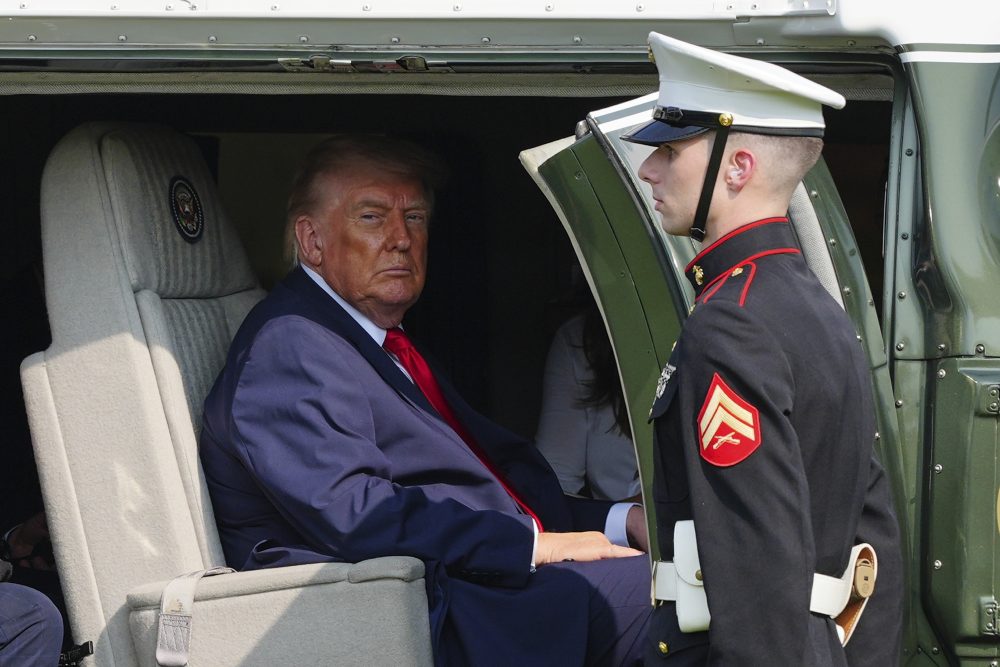
When reporters have asked Trump in recent days whether he remains open to negotiations, he has repeated threats that Iran coming back to the table is the only way to prevent U.S. strikes on civilian infrastructure such as bridges and power plants. However, Trump said he would not set a specific deadline.
“I don’t like giving deadlines, but they pretty much know, they know the story,” Trump said Wednesday in Pennsylvania. “They better behave.”
Shortly before Trump’s remarks, Iran’s parliament speaker and lead negotiator, Mohammad Bagher Qalibaf, said Iran is not declaring the interim deal void. But he made clear that Iran’s commitment to the agreement depends on the United States following through on its obligations. If Washington fails to do so, he argued, Iran would have no reason to remain bound by it.
The original June 17 agreement called for a permanent end to hostilities, a reopening of the strait, and launched a 60-day negotiating clock aimed at reaching a final deal on Iran’s nuclear program and other unresolved issues.
Qalibaf also indicated that Iran does not intend to keep the Strait of Hormuz closed indefinitely. He said Tehran’s goal is to maintain what he called “Iranian arrangements” governing navigation through the waterway while allowing maximum safe passage of commercial shipping under those rules.
To counter Iran’s attacks on shipping, Trump has ramped up military strikes and reinstated a Navy blockade of Iranian ports to apply economic pressure.
However, Bradley Bowman, a former Army helicopter pilot and scholar at the Foundation for Defense of Democracies, a hawkish Washington think tank, said it would be unrealistic to expect the U.S. to wipe out Iran’s missile and drone capabilities anytime soon.
“Unfortunately, Iran only needs to hit a ship every now and then to create serious problems and dilemmas for insurers and ship captains and reduce the flow of traffic in the strait,” Bowman said. “That reduced flow exerts significant economic and political pressure on Washington, especially as midterm elections approach. Iran understands the leverage it now has — and so does Trump.”
Bowman and other experts also question whether more strikes and economic pressure will actually bring Iran back to the table. Mark Cancian, a retired Marine colonel and senior defense adviser with the Center for Strategic and International Studies, put it bluntly: “We’re doing things that have not affected Iranian behavior in the past. So why would it affect Iranian behavior now?”