The British Broadcasting Corporation announced Wednesday that Matt Brittin, a veteran Google executive, will serve as its new director-general during a turbulent period marked by legal challenges from President Donald Trump and uncertainty over the network’s funding future.
The 57-year-old Brittin brings nearly 20 years of experience from Google, where he most recently served as president overseeing operations across Europe, the Middle East, and Africa. Despite lacking traditional broadcasting experience, he will assume leadership of the century-old public broadcaster.
“Now, more than ever, we need a thriving BBC that works for everyone in a complex, uncertain and fast changing world,” Brittin stated, calling the 104-year-old institution “an extraordinary, uniquely British asset.”
Brittin will begin his role on May 18, succeeding Tim Davie, who stepped down in November following controversy over the broadcaster’s handling of Trump’s January 6, 2021 Capitol speech.
The legal dispute stems from a documentary that aired shortly before the 2024 presidential election, which combined three separate quotes from Trump’s speech to create what appeared to be a single statement encouraging supporters to march with him and “fight like hell.”
Trump has filed a defamation lawsuit in Florida federal court seeking $10 billion in damages, alleging the BBC presented a “false, defamatory, deceptive, disparaging, inflammatory, and malicious depiction” of him in “a brazen attempt to interfere in and influence” the 2024 election.
While the BBC’s chairman has issued an apology to Trump, acknowledging the edit created “the impression of a direct call for violent action,” the broadcaster denies defaming the president and is fighting the lawsuit.
BBC attorneys have petitioned the Southern District of Florida court to dismiss the case, arguing it could create a “chilling effect” on aggressive journalism covering public figures and events. The network also contends the lawsuit lacks merit since the documentary never aired in Florida or anywhere else in the United States.
Beyond the Trump litigation, the BBC confronts its once-per-decade charter renewal process, which determines its public funding levels. The broadcaster currently operates on revenue from an annual license fee of 174.50 pounds ($230) that all UK households must pay to watch live television or BBC programming.
Opposition to the license fee system has intensified in the streaming era, with critics including commercial broadcasters arguing the traditional model is outdated as viewers abandon conventional television schedules and equipment.
The current center-left Labour government has pledged “sustainable and fair” BBC funding but hasn’t eliminated the possibility of replacing the license fee with alternative financing methods.
Acknowledging the challenges ahead, Brittin described the situation as “a moment of real risk, yet also real opportunity.”
“The BBC needs the pace and energy to be both where stories are, and where audiences are,” he explained. “To build on the reach, trust and creative strengths today, confront challenges with courage, and thrive as a public service fit for the future. I can’t wait to start this work.”
WASHINGTON — In a unanimous decision Wednesday, the U.S. Supreme Court delivered a victory to Cox Communications in a major copyright dispute with music industry giants over customers’ illegal downloading activities.
The nation’s highest court determined that the internet service provider cannot be held responsible for copyright infringement committed by its subscribers, overturning both a jury’s decision and previous appellate court findings.
The legal battle originated from a lawsuit spearheaded by Sony Music Entertainment, which argued that Cox failed to take adequate measures to prevent or disconnect users who illegally downloaded copyrighted music without payment.
The 4th U.S. Circuit Court of Appeals had previously supported portions of the jury’s ruling against Cox.
Originally, a jury had determined Cox owed more than $1 billion in damages, though the 4th Circuit later dismissed the monetary penalty amount.
Cox Communications serves internet connectivity to over 6 million residential and commercial customers across more than a dozen states nationwide. The company had cautioned that an unfavorable Supreme Court ruling could lead to massive service disruptions.
According to Cox, the company might have been forced to cut off internet access to homes, medical facilities, educational institutions, and local businesses based on just “a couple accusations of infringement.”
Congressional representatives will receive a briefing from Homeland Security officials at 10 a.m. Wednesday as airport disruptions continue to escalate during the ongoing department shutdown.
While Senate negotiators work toward an agreement that would restore funding for most department operations, including pay for Transportation Security Administration employees, immigration enforcement programs remain a sticking point in the negotiations.
In testimony prepared for the House Committee on Homeland Security hearing, TSA’s acting chief Ha Nguyen McNeill will report that worker absences have jumped dramatically since the shutdown began. Daily no-show rates have climbed from 4% to 11% across the country, with some airports recording absence rates exceeding 40%.
The staffing crisis has created wait times stretching beyond four hours at certain airports, leading to significant security concerns and causing travelers to miss their flights. The timing coincides with increased spring break travel, adding pressure to an already strained system.
President Donald Trump has directed Immigration and Customs Enforcement personnel to assist with airport security duties due to the TSA staffing shortage, a move that has raised concerns among some members of Congress. Department records show that 458 TSA officers have resigned entirely since the shutdown began.
McNeill’s prepared testimony will highlight the financial hardships facing security workers who continue reporting to duty without paychecks. Some employees have received eviction warnings, accumulated late payment penalties, and fallen behind on loan obligations.
“TSA employees are dedicated public servants that want to continue to keep the traveling public safe and secure, but they are running out of options to keep a roof over their head and put food on the table,” McNeill said.
The acting administrator will appear alongside other Homeland Security agency leaders to discuss how the funding gap has affected their operations.
The University of Maryland Eastern Shore women’s golf team secured an eleventh-place finish at the William & Mary Tribe Invitational held at Kingsmill Resort.
The Hawks competed in the multi-day tournament alongside other collegiate teams in the invitational event hosted by the College of William & Mary.
The tournament took place at the Kingsmill Resort golf course, where UMES golfers faced challenging conditions throughout the competition.
This finish represents another competitive showing for the Hawks women’s golf program as they continue their season schedule against regional opponents.
MOSCOW – Russia’s nuclear energy agency removed another 163 workers from Iran’s Bushehr nuclear facility on Wednesday, according to reports from Moscow-based media.
The head of Rosatom, Russia’s state nuclear corporation, Alexei Likhachev, indicated that approximately 300 company employees are still working at the Bushehr site, though additional departures are planned.
The Russian government originally constructed the nuclear facility at Bushehr, and Rosatom has been working on expanding the site with new reactor units. However, construction activities have been halted since military conflicts involving the United States and Israel began with Iran last month.
The globe’s leading lithium manufacturer, Albemarle Corporation, announced Wednesday that it has launched environmental assessment procedures in Chile for its inaugural Direct Lithium Extraction facility.
According to company officials, this innovative technology will enable the recovery of approximately double the amount of lithium while simultaneously decreasing the volume of brine removed from underground sources compared to traditional mining methods.
The comprehensive development carries an estimated price tag of $3.1 billion and is projected to remain operational until 2045, according to documents submitted to Chile’s environmental evaluation authority.
“The initiative aims to move toward more efficient and sustainable production in the Salar de Atacama,” company representatives stated, referring to the location recognized as among the planet’s most abundant sources of the critical mineral used in electric vehicle battery production.
The proposed facility would feature a Direct Lithium Extraction plant situated within Albemarle’s current mining lease territory, incorporating up to six processing units positioned in Chile’s expansive salt flats, along with the installation of electrical transmission infrastructure.
Environmental documentation indicates that brine removal rates would decrease from 442 liters per second to 342 liters per second when operating a single extraction unit, and could drop as low as 142 liters per second when all six processing trains are functioning.
Water resources surrounding the massive Atacama salt flats, including both freshwater and mineral-rich brine, have historically created tensions for mining companies working in this arid region. Indigenous populations have expressed concerns that mining activities are depleting limited freshwater and lithium-containing brine supplies, potentially reducing availability for local communities and desert wildlife.
BUDAPEST – A man who once hung a photograph of Viktor Orban on his childhood bedroom wall is now positioned to end the Hungarian leader’s grip on power after more than a decade and a half.
Peter Magyar was just nine years old when Hungary emerged from communist rule in 1990, and he decorated his family home in Budapest with pictures of prominent political leaders of the era. Among them was Orban, then a young attorney who had gained national recognition for boldly calling for Soviet forces to withdraw from Hungary in 1989.
“There was a surge of energy around the regime change that swept me up as a child,” Magyar shared during an appearance on the Fokuszcsoport podcast last year.
Today, surveys indicate Magyar’s center-right, pro-European Union Tisza party holds an advantage over Orban’s nationalist Fidesz party heading into Hungary’s April 12 parliamentary contest.
Magyar, whose surname translates to “Hungarian,” emerged as a political force two years ago following a scandal involving his former spouse, Judit Varga, who had served as Orban’s justice minister. Varga stepped down from all political positions after public outrage over a controversial pardon in a sexual abuse case.
Following the incident, Magyar separated himself from the ruling party and leveled accusations of corruption and propaganda against it, explaining that he had grown disenchanted with Fidesz.
Magyar’s political ascent has been remarkably swift. Within just four months of his first major interview on the YouTube channel Partizan, his newly formed party captured 30% of the vote in the June 2024 European elections, placing second behind Fidesz while overwhelming other opposition groups.
The upcoming election carries weight beyond Hungary’s borders, with potential ramifications for Europe and the continent’s populist far-right movements.
Since 2010, Orban has worked to establish what he terms an “illiberal democracy,” implementing restrictions on press freedom and non-governmental organizations while diminishing judicial independence.
The Hungarian leader has cultivated relationships with Russian President Vladimir Putin and U.S. President Donald Trump, while frequently clashing with the European Union. Brussels has frozen billions of euros in funding over concerns about Hungary’s democratic institutions.
Magyar has committed to restoring Hungary’s Western alignment and eliminating Russian energy dependence by 2035 while maintaining “pragmatic relations” with Moscow. He has also vowed to secure the release of suspended EU funding, which could help jumpstart Hungary’s sluggish economy.
However, Magyar is proceeding cautiously to avoid alienating more conservative voters.
While he doesn’t categorically oppose Ukraine’s potential EU membership like Orban does, Tisza’s platform doesn’t endorse expedited entry for Kyiv. Similar to Fidesz, Tisza rejects EU migrant quotas and would maintain the border barrier constructed under Orban to prevent illegal immigration.
Experts suggest that tensions between Budapest and the EU – intensified by Orban’s blocking of a 90 billion euro aid package for Ukraine – might diminish under Tisza leadership.
“Orban has lost faith in the current form and direction of European integration, and is pursuing a policy of vetoes and obstruction,” explained Botond Feledy, a geopolitical analyst at Red Snow Consulting.
“Tisza has no objection in principle to integration and would pitch its battles at a practical level.”
Magyar has adopted elements of Orban’s political strategy, conducting a grassroots campaign that has penetrated Fidesz’s traditional rural strongholds.
His events prominently display Hungarian flags, mirroring Orban’s approach to appealing to voters’ patriotic sentiments.
Gabor Toka, a senior research fellow at the Vera and Donald Blinken Open Society Archives, credits Magyar’s rapid ascent to his consistent messaging and effective social media strategy.
“Many people are also reassured by the story of someone who has irrevocably come into conflict with the system, and has no way back,” Toka noted, referencing Magyar’s split with Orban.
Current polling shows Tisza leading Fidesz by 8-12 percentage points among committed voters, though government-aligned pollsters report the ruling party ahead.
Born in 1981 to a family of attorneys, Magyar pursued legal studies himself. He wed Varga in 2006, and when her career brought her to Brussels, Magyar entered Hungary’s diplomatic service, focusing on EU legislation. Upon returning home, he worked at a state bank before leading a student loan organization.
Magyar and Varga, who finalized their divorce in 2023, share three children.
Magyar characterizes himself as a person of faith who enjoys preparing meals and playing soccer with friends and his sons.
When asked in December about how politics had changed him, Magyar referenced media descriptions of his temper, responding: “Now I count to 10.”
BUDAPEST, March 25 – Hungarian Prime Minister Viktor Orban, who describes himself as a country boy and helped establish Hungary as a stronghold of right-wing populism, confronts his most challenging electoral battle in his 16-year tenure against a one-time ally seeking to remove him from power in the April 12 national vote.
The 62-year-old Orban has secured support from former U.S. President Donald Trump and several prominent European conservative figures, yet most polling data indicates his nationalist Fidesz party is trailing behind Peter Magyar’s center-right, pro-European Union Tisza party amid Hungary’s economic struggles.
Once a passionate anti-Communist activist during the Cold War era, Orban has become the EU’s most tenured current leader and maintains hero status among his supporters. However, domestic and international critics charge him with steering Hungary toward authoritarian governance.
Orban entered the world in 1963 in a rural community outside Budapest, pursued legal studies, spent time studying political philosophy at Oxford University, and even competed in semi-professional football before assuming the prime minister role initially in 1998 at the young age of 35.
Under Orban’s leadership, Hungary became a NATO member, though he was voted out in 2002. Following eight years as opposition leader, he achieved a decisive electoral triumph in 2010, which allowed him to restructure Hungary’s constitution and enact significant legislation designed to establish what he termed an “illiberal democracy.”
His concentration of executive authority, new restrictions on non-governmental organizations and press freedoms, plus the undermining of judicial independence have sparked confrontations with the European Union regarding democratic principles, resulting in the suspension of billions of euros in Hungarian funding.
When Europe faced its 2015 migration crisis, Orban positioned himself as the protector of Hungary’s national character and Christian values, rejecting EU requirements to accept asylum seekers, primarily Muslims from Middle Eastern and other regions. His administration has systematically worked to diminish LGBTQ+ protections.
His uncompromising stance on immigration and initiatives to boost Hungary’s declining birth rates have garnered approval from fellow conservative leaders, including Trump.
Orban, who also achieved overwhelming electoral victories in 2014, 2018, and 2022, has received backing this election cycle from Italian Prime Minister Giorgia Meloni, France’s National Rally leader Marine Le Pen, and Alternative for Germany’s Alice Weidel.
Trump has also given his support to Orban, stating that U.S.-Hungary relations have achieved “new heights” through their leadership following years of tension under Democratic administrations in Washington.
“Core Fidesz supporters will be heartened by their prime minister rubbing shoulders with Trump,” analysts at think tank Eurasia Group said.
“But while there has been a flurry of trade deals in areas such as defence and energy, there appears to be no additional concrete political aid for the election (from Trump).”
Orban has preserved strong relationships with Russia, a crucial energy provider, and China, whose companies are constructing significant electric vehicle and battery manufacturing facilities in the landlocked Central European nation.
He has attempted to characterize the election as a decision between “war or peace,” implying that Tisza seeks to involve Hungary in the conflict occurring in adjacent Ukraine, which the party vehemently rejects.
“For peace, Fidesz is the safe choice,” Orban said on the campaign trail in February. He has repeatedly clashed with Ukrainian President Volodymyr Zelenskyy and angered Hungary’s EU allies by obstructing a 90 billion euro assistance package for Kyiv.
However, polling data suggests Hungarian citizens are more focused on domestic matters like healthcare and the economy, which has remained stagnant for three years.
Hungary endured the EU’s most severe inflation spike after Russia’s February 2022 Ukraine invasion, which pushed food costs near EU average levels, while Hungarian salaries remain the third-lowest among the 27-member bloc.
Even with generous family-friendly policies, including affordable loans and tax advantages, Orban seems to have alienated younger voters as he has shifted further rightward.
With Zavecz Research polling showing only one in five voters under 40 supporting Fidesz, Orban appealed to parents at a campaign event to emphasize the election’s importance to their adult children.
“I know young people like to turn against their parents and this can cause political problems,” said Orban, a father of five and a grandfather.
Despite participating in numerous campaign rallies and maintaining constant interviews and social media activity, he offered a rare insight late last year into the campaign’s potential impact after so many years in leadership.
“When I was a soldier (doing military service), they told us a soldier cannot be cold, he can only perceive the cold,” he said. “I am the same. I am not tired. It is just that my strength is running out.”
Motorists traveling on northbound Route 9 are facing a complete road closure at the Reedy Point Bridge as inspection crews conduct necessary bridge maintenance work.
Delaware Department of Transportation officials have shut down the northbound lanes to allow for thorough structural inspections of the bridge. The closure began earlier today and is scheduled to continue until 4 PM this afternoon.
Drivers are advised to seek alternate routes and expect delays in the area. The southbound lanes of Route 9 remain unaffected by the inspection work.
DelDOT has not indicated whether the closure may extend beyond the 4 PM timeframe, but motorists should check traffic conditions before traveling through the area.
Ocean City, MD – The Town of Ocean City announced March 25, 2026 that it is now reviewing grant requests for complimentary plants aimed at enhancing local environmental efforts.
Property owners have two options available through the municipal program. The first provides Beach District vegetation specifically designated for secondary dune restoration projects. The second option supplies pollinator garden plants designed to help residents establish new gardens or expand existing ones on properties that are not directly beachfront.
Municipal officials indicated they will approve a restricted number of applications within each plant grant category due to limited availability.
High pressure currently positioned off the Northeast coast will continue to influence the Delmarva region through today, delivering dry conditions and a gradual warming trend. As this system shifts offshore tonight, a return flow will develop, allowing temperatures to climb closer to seasonal averages today and well above normal by Thursday.
Expect increasing cloud cover through the day, but temperatures will still respond nicely. Highs this afternoon will reach the mid to upper 50s across Delmarva, followed by a much warmer day on Thursday with highs surging into the upper 60s to near 70 degrees.
This brief stretch of mild weather will be interrupted by an approaching cold front tied to a low pressure system tracking through the Great Lakes into eastern Canada. Rain showers will begin to move into the region Thursday evening, initially across western areas, before spreading southeastward overnight into Friday morning. Rainfall totals are expected to range between a quarter to a half inch.
There is also a slight chance for a rumble of thunder as modest elevated instability develops along the front, though severe weather is not expected at this time.
Winds will become a factor as well. A breezy southwest wind develops Thursday ahead of the front, with gusts increasing to 25 to 35 mph. Behind the front, winds shift to the northwest on Friday, maintaining gusty conditions and ushering in a much cooler air mass.
Temperatures will actually fall through the day on Friday due to strong cold air advection, setting the stage for a chilly start to the weekend. Highs on Saturday will struggle to reach the 50s across Delmarva.
Looking ahead, conditions improve by Sunday as high pressure builds back into the region. Skies will remain dry, and temperatures will moderate closer to seasonal norms.
The New Castle County Police Academy has announced the completion of training for its 54th recruit class, with six new officers ready to begin their law enforcement careers.
The graduating officers who will be joining the New Castle County Police Department include Abdulla Abdulla, Madison Arnold, Christopher Berry Jr., Nicholas Classie, Rachel Craine, and Jackson Dean.
The graduation ceremony marks the successful completion of police academy training for these new recruits, who will now begin serving the New Castle County community as sworn law enforcement officers.
GRAPEVINE, Texas — The nation’s conservative movement kicks off one of its biggest yearly conferences Wednesday amid challenging times for President Donald Trump and sharp disagreements within Republican ranks about his military engagement in Iran.
Though Trump retains strong backing from conservative voters, the Iranian conflict presents significant challenges for supporters who rallied behind his “America First” promises to avoid foreign military entanglements. Recent polling from AP-NORC reveals approximately 59% of Americans believe the Iranian military operation goes too far. This disagreement will simmer beneath the surface — and likely emerge in public discussions — as thousands of political activists, social media influencers and GOP legislators convene for the Conservative Political Action Conference beginning Wednesday near Dallas.
The conference also follows Tuesday’s Democratic victory in a Florida state legislative race in the district containing Trump’s Mar-a-Lago residence.
This year’s atmosphere differs dramatically from last year’s triumphant gathering, when Trump had just resumed the presidency and promised to “forge a new and lasting political majority” while Elon Musk brandished a chainsaw to represent the Republican administration’s cuts to government jobs and regulations.
Neither Trump nor Vice President JD Vance appears on this year’s announced speaker list. However, prominent MAGA movement figures who hold opposing positions on the Iran conflict are scheduled to address attendees.
“This is obviously going to be a hot topic,” explained John Gizzi, a longtime CPAC attendee and Newsmax columnist, highlighting concerns about expanded U.S. military involvement for an undetermined duration.
Steve Bannon, a longtime Trump supporter, headlines the four-day conference schedule. During his “War Room” podcast earlier this month, Bannon warned that if the conflict becomes “a hard slog,” Republicans could lose conservative voters before the midterm elections.
“We are going to bleed support,” Bannon predicted.
Texas Senator Ted Cruz, who backs the military action, also appears on the program at the Gaylord Texan Resort and Convention Center.
“I think President Trump was exactly right to act to protect Americans,” Cruz stated during a recent CBS News appearance.
Former Florida Representative Matt Gaetz’s speaking appearance highlights disagreements among some conservatives regarding the U.S. military partnership with Israel against Iran.
Gaetz, who hosts a program on One America News Network, has criticized America’s close relationship with Israel, joining conservative voices like Tucker Carlson in questioning the traditional conservative alliance with that nation. This stance has drawn accusations of antisemitism from GOP organizations, including pro-Israel Republican groups.
Additional speakers include Trump’s border enforcement leader Tom Homan and former Republican National Committee head Michael Whatley, who seeks a U.S. Senate seat in North Carolina.
Twelve months after Trump led the organization’s celebratory conference following his return to the presidency, his political position has shifted considerably.
With ongoing military operations while economic and employment concerns persist, his approval ratings have declined. His primary domestic initiative to strengthen election laws before November’s midterm contests has stalled despite Republican congressional control, while the House GOP majority faces threats and Senate Republican prospects appear less secure than previously.
Nevertheless, Trump maintains strong support from his party’s conservative wing. February AP-NORC polling showed 86% of conservatives approve of the president’s performance.
While Trump’s base remains loyal, some within the most conservative groups suggest the Iran division could spell trouble for Republicans in November elections.
Texas Representative Steve Toth, planning to attend CPAC, believes Trump’s conservative support stays strong but acknowledges Republican war messaging could improve.
“From MAGA people, for the most part, I don’t hear frustration with the president,” said Toth, who defeated incumbent Republican Representative Dan Crenshaw in Texas’ March 3 primary. “I don’t know that we’re doing a great job at communicating the full ramifications.”
Texas’ unsettled Senate primary race provides another reminder of this year’s contrasts with 2024, creating particular political complications for Trump.
Texas Attorney General Ken Paxton, challenging four-term GOP Senator John Cornyn, not only attends the conference but receives one of its most prestigious speaking opportunities — Friday evening’s Ronald Reagan Dinner. Cornyn will not attend the Texas gathering.
Three weeks ago, Trump promised to soon endorse either candidate after Paxton trailed Cornyn narrowly in the March 3 primary, though neither secured enough votes to prevent a May 26 runoff election.
Trump urged the non-endorsed candidate to withdraw from the race, posting on social media that the contentious battle “cannot, for the good of the Party, and our Country, itself, be allowed to go on any longer.”
Last week’s deadline for candidates to withdraw from the May 26 runoff passed as both Paxton and Cornyn intensified their attack advertisements against each other.
WASHINGTON — A majority of Americans think recent U.S. military operations against Iran have been too aggressive, while growing numbers express concern about gas prices, a fresh AP-NORC survey reveals.
The poll from The Associated Press-NORC Center for Public Affairs Research shows that as the conflict enters its fourth week, President Donald Trump’s approval ratings remain stable, though the ongoing military engagement may become a significant political challenge for his Republican administration.
With Trump sending additional naval vessels and military personnel to the Middle East, approximately 59% of Americans consider U.S. military operations in Iran to be excessive.
At the same time, 45% express being “extremely” or “very” worried about gas affordability in upcoming months, a notable increase from 30% in an AP-NORC survey taken shortly after Trump’s reelection victory, when he pledged to strengthen the economy and reduce living costs.
Americans do show substantial backing for one of the president’s stated goals: stopping Iran from acquiring nuclear weapons. Roughly two-thirds believe this should rank as an “extremely” or “very” crucial foreign policy priority for the United States. Yet they’re equally likely to consider preventing increases in domestic oil and gas prices as important — creating a challenging balance for the White House.
Approximately 4 out of 10 American adults continue backing Trump’s presidential performance, showing no change from the previous month. His foreign policy approval rating, though somewhat lower than his overall numbers, also remained largely unchanged.
Trump has provided unclear signals regarding his future Iran strategy. While making escalating threats, he’s simultaneously indicated that diplomatic negotiations might end the conflict. Americans generally remain skeptical about Trump’s capacity to make sound decisions regarding overseas military force deployment, and they largely reject more aggressive measures like sending ground troops.
Maintaining affordable fuel costs represents a rare objective that brings together Americans from both major parties.
Roughly three-quarters of Republicans and approximately two-thirds of Democrats consider preventing U.S. oil and gas price increases highly significant.
Nevertheless, current concerns aren’t equally distributed. Only about 3 out of 10 Republicans report being “extremely” or “very” anxious about gas affordability in coming months, while roughly 6 out of 10 Democrats share this worry.
Trump’s emphasis on Iran’s nuclear capabilities also resonates more strongly with Republicans than Democrats. While about two-thirds of Americans believe the U.S. should focus on preventing Iran from obtaining nuclear weapons, approximately 8 out of 10 Republicans consider this at least “very” significant, compared to roughly half of Democrats.
The conflict has intensified political discussions about Israel’s role in American foreign policy, particularly since Israeli Prime Minister Benjamin Netanyahu strongly advocated for attacking Iran. Only about 4 out of 10 U.S. adults consider preventing Iranian threats to Israel a high priority.
Removing Iran’s current leadership ranks as slightly less significant. Only about 3 out of 10 say it’s at least “very” crucial for the U.S. to install an Iranian government more favorable to American interests.
While Trump sends conflicting signals about whether the Iran conflict will conclude soon, approximately 9 out of 10 Democrats and about 6 out of 10 independents believe the Iranian attacks have “gone too far.”
Republicans show more division. About half consider the U.S. military response “about right,” though relatively few want escalation. Only about 2 out of 10 Republicans believe the military action hasn’t been sufficient, while roughly one-quarter think it’s been excessive.
Previous AP-NORC surveys found that about 6 out of 10 Americans say Trump has “gone too far” across various issues, including his tariff policies and use of presidential authority. This figure, which broadly mirrors his overall approval, suggests that while Trump’s Iran actions are unpopular, they’re still comparable to other divisive presidential decisions.
Deeper U.S. involvement in the conflict could alter this dynamic, depending on future developments. About 6 out of 10 Americans “somewhat” or “strongly” reject deploying U.S. ground forces against Iran, including roughly 8 out of 10 Democrats and approximately half of Republicans. Just under half oppose airstrikes on Iranian leadership and military installations, while about 3 out of 10 support such actions and roughly 3 out of 10 remain undecided.
About half of U.S. adults have “only a little” confidence or “none at all” in Trump regarding overseas military force decisions, consistent with February AP-NORC polling.
About 34% of U.S. adults endorse Trump’s foreign policy management, similar to February’s 36%. This metric has remained steady despite numerous controversial actions, including disputes over Greenland and a Venezuela attack, that have sparked domestic and international criticism.
This closely matches Trump’s Iran-specific approval in the new survey, which found 35% of Americans view his handling of that situation positively.
The AP-NORC poll surveyed 1,150 adults from March 19-23 using NORC’s probability-based AmeriSpeak Panel, designed to represent the U.S. population. The sampling error margin for all adults is plus or minus 4 percentage points.
German lawmakers are set to vote Friday on legislation that would impose taxes on sugar-laden beverages and prohibit the sale of energy drinks to anyone under 16 years old, as officials seek stronger measures to address rising obesity rates and associated health problems.
The Bundesrat, Germany’s assembly of regional states, will consider the proposal that would launch the formal legislative process for these health-focused restrictions. While the measure doesn’t outline specific tax structures, it suggests using generated revenue to fund public health programs.
Daniel Guenther, who leads Schleswig-Holstein and spearheaded the initiative, explained the rationale behind the proposed levy. “Manufacturers should have an incentive to revise their recipes and reduce sugar content. So far they have had no such incentive,” Guenther stated.
The legislation also targets energy drinks specifically due to their concentrated levels of caffeine, taurine and sugar. “Energy drinks are not harmless, trendy beverages,” Guenther emphasized. “They can become a real burden, especially for young people.”
According to World Health Organization data, over 100 nations currently impose taxes on sugar-sweetened beverages, including approximately half of European Union member countries like Belgium, France and Portugal. However, the EU lacks a unified policy, leaving individual governments to implement their own approaches.
Political support for the measure has grown beyond party lines, despite initial resistance from Guenther’s own conservative CDU party in February. Green Party representative Johannes Wagner endorsed the plan, arguing that beverage companies lack motivation to voluntarily reduce sugar content. “Anyone making profits from heavily sugared drinks must also contribute more to financing the resulting costs,” Wagner said.
Social Democrat Sabine Dittmar described the proposed tax as “sensible, necessary and long overdue,” advocating for a tiered system where beverages with higher sugar concentrations face steeper taxes than lower-sugar options.
Public opinion appears to favor stricter measures, with a February Forsa poll showing approximately 60% of Germans supporting taxes on high-sugar soft drinks.
Research from the Technical University of Munich in 2023 projected significant health and economic benefits from implementing a sugar tax similar to Britain’s model. The study estimated such a policy could decrease daily sugar consumption by 2-3 grams per person, prevent or postpone up to 244,000 type 2 diabetes cases over two decades, and generate savings of up to 16 billion euros ($17.3 billion) during that timeframe.
Industry representatives have pushed back against the proposal. Germany’s sugar industry association WVZ argues that imposing what they call a “punitive tax on sugar” might simply encourage manufacturers to substitute artificial sweeteners without delivering real health improvements.
WVZ Director General Guenter Tissen challenged the scientific basis for the policy. “A sugar tax creates the false impression that a single ingredient is to blame for the development of obesity. There is no scientifically reliable evidence for this,” Tissen said.
The seafood industry is taking an unusual approach to win over American consumers: making fish products that look nothing like fish at all.
Companies are now creating tuna nuggets that mimic fried chicken, shrimp formed into burger patties, and salmon processed into salami-style strips. This transformation was on full display at the recent Seafood Expo North America held in Boston.
Jack Chi, representing Taiwan-based Tuna Fresh, explained their strategy. “Our Taiwanese magic is making tuna taste like fried chicken,” Chi said. His company produces tuna as fried “nuggets” and breaded strips resembling chicken tenders. “We wanted to be able to engage in the U.S. market, and we found that fried foods are the way.”
Justin Rogers from SK Food Brands in Los Angeles has noticed this shift gaining momentum. “It’s been a big trend for the last couple of years,” Rogers said. His company now offers shrimp burgers in both small and large sizes. “It makes it more palatable to people who aren’t big seafood fans. Especially with things like these sliders, it gives them an entry point.”
The strategy targets a significant market opportunity. Americans consume approximately 19 pounds of seafood annually – a figure that has remained relatively unchanged for a century. This pales in comparison to the worldwide average of 45 pounds, with some European nations reaching 90 pounds per person yearly. Iceland tops the list at roughly 200 pounds per capita.
While disguising seafood isn’t completely novel – frozen fish sticks and McDonald’s Filet-O-Fish have existed for decades – today’s products represent a more dramatic departure from traditional presentation.
Holly Phillips from Seattle-based Harbor Bell Seafoods described their salmon snack strips, which come in smoked, lemon-pepper, mango, and original varieties. “It looks like a Slim Jim by design,” Phillips explained. “It doesn’t smell fishy. It doesn’t taste fishy.”
However, not everyone supports this camouflaged approach to seafood marketing.
“Eat fish that looks like fish!” declared Niaz Dorry, coordinating director of the North American Marine Alliance, which advocates for sustainable seafood practices. “The likelihood that that fish came from a community-based, scale-appropriate entity is much higher if that fish still looks like what it was when it was swimming in the water. Factory scale and fake are the two F-words I tell everybody to avoid.”
This transformation comes during challenging times for the seafood industry. The $24 billion market has remained stagnant for years, with growth limited to sushi sales and price increases. Remarkably, just 10% of consumers account for nearly half of all seafood purchases.
Steve Markenson, vice president of research and insights for consumer marketing firm FMI, sees parallels between sushi’s success and these new products, citing convenience and novelty as key factors. However, he remains skeptical about the strategy’s effectiveness.
“The non-seafood folks — which is about 40% of the population — I don’t know that this is really going to be appealing to them,” Markenson said. “They’re not looking to necessarily add seafood into their diet.”
Even dedicated seafood consumers might not embrace these alternatives. “They love what they love about it,” Markenson noted. “They might want it seasoned up a little, but they want that full-blown salmon.”
Joshua Bickert, a seafood market reporter and analyst for Expana, believes children might be the most receptive audience. “If you package it like hot dogs and hamburgers and chicken tenders, you maybe change that mindset at a younger age,” he suggested.
Mike Simon, owner of Florida-based Surfsnax, focuses on making unfamiliar foods more approachable. “We want to put it in a format that people are used to eating,” Simon said while demonstrating his salmon salami. “But it’s not hiding that it’s salmon.”
Among the most unusual offerings were fish spareribs made from Brazilian tambaqui, a substantial freshwater fish with a build suitable for creating pork-like ribs. Friocenter Pescados spokesman Danillo Souza Alves emphasized that tambaqui provides a better meat-to-bone ratio than traditional pork ribs.
“It’s a finger food. You can easily eat it in stadiums for football, baseball and hockey,” Alves claimed.
The trend extends to snack foods as well, with various seafood being transformed into chips, crackers, and crunchy sticks. Ina Park, representing the expo’s Korean pavilion, promoted Balance Grow’s Fried Calamari Snack, which resembled potato sticks.
DES MOINES, Iowa — A Dutch researcher whose groundbreaking work revolutionized global food safety standards has been selected as this year’s World Food Prize recipient, with officials crediting his innovations for preventing countless foodborne illnesses and cutting food waste worldwide.
Huub Lelieveld from the Netherlands received the prestigious recognition after spending 60 years developing improved food safety techniques and promoting international trade policies that help distribute safe food more efficiently across the globe, the organization revealed Wednesday.
“I just did what I thought was right,” Lelieveld told The Associated Press during an interview. “I want everybody to have enough food but … it should also be safe.”
When Lelieveld started his research career at Unilever, he found the existing food manufacturing safety protocols to be “illogical,” he explained.
At that time, food products underwent sterilization or chemical treatment only after being produced, and manufacturing equipment required shutdowns for cleaning one to two times daily — a process that was both challenging and lengthy. The processed products also depended heavily on preservatives, salt, sugar and acids to minimize contamination risks, which compromised both taste and nutritional value.
“I realized very soon that they did things in the wrong way, in my view,” Lelieveld explained. “From the beginning, I’ve been working on … convincing people that you should do it in a different way.”
Working alongside his team, Lelieveld created sanitary production techniques and machinery that made food manufacturing more streamlined and reduced dependence on chemical additives.
Once he had successfully implemented and validated these processes at Unilever, Lelieveld said the corporation allowed him to share his findings publicly for worldwide adoption.
“My philosophy was: You should not compete on food safety,” Lelieveld stated. “Spreading the technology, the hygienic technology, was very important.”
According to World Health Organization data, contaminated food results in 600 million cases of foodborne illness and 420,000 fatalities annually.
The World Food Prize, headquartered in Iowa, was established by Norman Borlaug, who won the Nobel Peace Prize in 1970 for his contributions to dramatically boosting agricultural production and combating hunger in numerous nations. This agricultural science recognition comes with a $500,000 prize.
Following 40 years with Unilever, Lelieveld established the Global Harmonization Initiative in 2004 to encourage unified food and trade standards worldwide. Using a network of several thousand scientists globally, this nonprofit also tackles major food security issues and supports food safety training programs.
The GHI “is extremely useful because it has this enormous pool of knowledge about food safety and food protection,” Lelieveld noted.
According to Lelieveld, obstacles to widespread access to safe food and water remain, and he envisions a future where communities can create safe food and water locally, even when international trade faces restrictions.
“You can’t stop the transport of water through the air, with the clouds,” he explained. “You can produce safe water everywhere, but we need to distribute this knowledge to the people that need it and that is the biggest challenge.”
America’s longest-standing civil rights organization has brought on board a former official from the Biden administration’s Justice Department to spearhead its legal advocacy efforts.
The NAACP announced Wednesday that Kristen Clarke, who formerly directed the DOJ’s Civil Rights Division, will take on the role of general counsel for the organization.
In an announcement first revealed to The Associated Press, Clarke will be responsible for directing the NAACP’s legal framework and day-to-day operations while spearheading court battles involving voting access, redistricting manipulation, and First Amendment protections, along with additional civil rights and social justice matters.
“The NAACP has stood on the front lines of justice for over a century, and I’m deeply honored to join this historic organization at this critical moment in our democracy,” Clarke said in a statement.
“Our communities are under relentless attack — from the ballot box to their wallets — and this moment demands that we use the full weight of the law to promote justice and accountability,” she said.
NAACP President and CEO Derrick Johnson described Clarke as “the legal mind this moment demands.”
“As we face unprecedented attacks on voting and civil rights, having Kristen Clarke at the helm of our legal operations brings strategic vision, disciplined leadership, and innovative advocacy,” he said in a statement.
The civil rights organization emphasized that Clarke’s hiring demonstrates its commitment to assembling significant “legal firepower” to counter Republican initiatives aimed at dismantling voting protections established during the Civil Rights Movement, when Black Americans fought to overcome legal barriers and intimidation tactics, particularly throughout southern states.
Nearly a year ago, the NAACP filed a lawsuit contending that President Donald Trump’s executive directive requiring citizenship verification for voter registration infringed upon states’ constitutional authority to manage elections and created discriminatory barriers for voters of color. A federal judge struck down that directive in June, agreeing with Democratic state attorneys general who also contested its legality.
Clarke made history as both the first woman and first Black woman to helm the DOJ’s Civil Rights Division. During her tenure from 2021 to 2024, she pursued police department reforms addressing misconduct, including in Memphis following the 2023 fatal beating of Tyre Nichols. She also participated in the DOJ’s prosecution of a white supremacist for hate crimes following a shooting that claimed 10 Black lives at a Buffalo, New York grocery store in 2022.
Prior to her Justice Department role, Clarke obtained her education from Harvard University and Columbia Law School, and held leadership positions as president and executive director of the Lawyers’ Committee for Civil Rights Under Law, an organization established over six decades ago to fight racial segregation.
After completing her federal service, she joined the faculty at Howard University School of Law, a position she will maintain alongside her new responsibilities with the NAACP.
In an emotionally charged television interview, NBC Today Show co-host Savannah Guthrie made a heartfelt plea for anyone with information about her missing mother to step forward and “do the right thing.”
Speaking through tears to her NBC colleague Hoda Kotb during a segment that aired Wednesday, Guthrie described the family’s ordeal. “We are in agony,” the longtime television host said, explaining how she awakens nightly consumed by thoughts of her mother’s experience.
Nancy Guthrie, 84, vanished from her Arizona residence and was reported missing February 1st. Law enforcement officials have determined from surveillance video that the elderly woman was likely kidnapped or forcibly removed from her home.
The emotional exchange between the two television personalities left both women in tears during the brief clip shown Wednesday. Kotb has stepped back into her previous role on the morning program while her former co-anchor remains with family.
Despite the overwhelming pain of imagining her mother’s fear, Guthrie expressed determination to continue the search. “Those thoughts demand to be thought. And I will not hide my face. But she needs to come home now,” she stated.
The veteran broadcaster has anchored NBC’s flagship morning program since 2012 and plans to return eventually, though the network has not announced a specific timeline as she focuses on family matters.
The case remains largely stagnant despite the family’s offer of a substantial $1 million reward for useful information. Over the weekend, Guthrie’s relatives reached out directly to Arizona residents, urging them to recall any potentially relevant observations from the time period. The family emphasized that “no detail is too small” for investigators.
Describing her colleague’s current state, Kotb noted Wednesday that Guthrie displays “a desperation and a steeliness” as she maintains hope that someone will provide crucial information to authorities.
NBC announced that complete portions of the interview will be broadcast on Today Show episodes Thursday and Friday, marking Guthrie’s first public comments since her mother’s disappearance.
A major oilfield services corporation announced Wednesday it’s strengthening its collaboration with technology giant Nvidia to create specialized artificial intelligence systems for energy companies seeking to implement advanced technology solutions.
SLB revealed the enhanced partnership will focus on building AI infrastructure and specialized models tailored for the energy sector, as businesses across the industry work to integrate these emerging technologies into their operations.
The collaboration between the two companies has deep roots, starting in 2008 when SLB first adopted Nvidia’s high-performance computing technology. The relationship evolved further in 2024 when both firms began working together on generative AI applications specifically designed for energy sector use.
This latest development addresses the energy industry’s growing challenge of rapidly analyzing massive amounts of geological, production, and infrastructure information. Companies are under pressure to reduce operational costs, enhance system reliability, and decrease their environmental impact.
Meanwhile, oilfield service providers like SLB are exploring new revenue streams by supplying equipment, turbines, and data management solutions to data centers and AI infrastructure projects, particularly as traditional drilling activity experiences a downturn.
The enhanced collaboration will position SLB as a design partner for modular AI data centers powered by Nvidia’s technology. Together, the companies plan to establish what they’re calling an “AI Factory for Energy” – a comprehensive platform designed to help oil and gas producers along with power companies utilize AI to process vast amounts of operational information.
“Building AI Factory infrastructure and domain models is needed to turn massive amounts of energy data into actionable insights and accelerate more efficient and sustainable energy systems,” said Vladimir Troy, vice president of AI Infrastructure at Nvidia.
A British government-commissioned investigation released Wednesday calls for strict limits on political donations from overseas contributors and a temporary ban on cryptocurrency gifts to political parties.
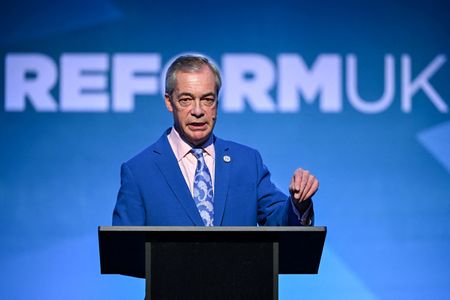
The independent assessment suggests these changes could significantly affect Nigel Farage’s Reform UK party, which has become a major political force in Britain.
British officials launched this investigation following last year’s imprisonment of a former Reform UK politician who accepted payments to deliver pro-Russian statements and speeches.
Reform UK made history as Britain’s first political party to welcome bitcoin donations, and foreign contributors provided roughly two-thirds of the party’s total fundraising last year.
Under Farage’s leadership, the party has surged ahead of the ruling Labour Party in recent polling and outpaced competing parties in fundraising efforts. Farage, known for his Brexit advocacy and friendship with U.S. President Donald Trump, has transformed Reform into a significant political player.
The investigation, conducted by Philip Rycroft, a former high-ranking government administrator, proposes setting yearly donation limits for British citizens residing abroad at between 100,000 and 300,000 pounds ($402,390). Additionally, the review suggests suspending cryptocurrency donations until proper regulatory frameworks can be established.
“The threat of foreign financial interference in our politics is real, persistent and sustained,” Rycroft stated, noting that while current impacts on British democracy remain limited, the dangers will continue. “The government must act quickly to further limit the risk of foreign financial interference in our politics.”
Currently, British law places no restrictions on political party donations from individuals registered to vote in the UK or from British-registered companies and organizations, including labor unions.
According to Rycroft’s findings, Britain continues facing ongoing attempts by foreign nations, particularly Russia, China and Iran, to influence and weaken the country’s democratic processes.
However, the review identified an additional concern beyond these hostile state activities: a “potential new threat: an emerging willingness of foreign actors and private citizens, including from allies like the United States, to interfere in, and influence, politics abroad in pursuit of their own agenda.”
To address these challenges, the review also suggests establishing a specialized police unit dedicated to investigating foreign political interference allegations, lowering evidence requirements for related criminal charges, and considering stricter penalties for violations.
The chief executive of investment giant BlackRock issued a stark warning this week that crude oil could climb to $150 per barrel and trigger a worldwide economic collapse if Middle Eastern tensions continue to threaten global trade routes.
Larry Fink delivered the cautionary message during a BBC interview released Wednesday, focusing on potential long-term impacts even after current conflicts subside.
“If there is a cessation of war, and yet Iran remains a threat, a threat to trade, a threat to the Strait of Hormuz, a threat to this peaceful coexistence of the GCC region, then I would argue that we could have years of above $100 closer to $150 oil which has profound implications in the economy,” Fink stated during the Big Boss Interview podcast.
When pressed about the consequences of sustained $150 oil prices, Fink was direct: “We will have global recession.”
Energy markets have experienced significant turbulence and sharp increases since the U.S.-Israeli conflict with Iran commenced. Yet crude prices dropped approximately 4% Wednesday following news reports that the United States had presented Iran with a comprehensive 15-point plan designed to halt hostilities and potentially establish a ceasefire.
The ongoing conflict has effectively stopped oil and liquefied natural gas shipments through the critical Strait of Hormuz waterway. This vital shipping channel normally handles roughly 20% of global gas and crude oil transportation. The International Energy Agency has characterized the current situation as the largest oil supply disruption in history.
Six Flags Entertainment has installed new leadership at the top of its board following mounting pressure from investors who want the amusement park company to consider selling itself.
The company announced Wednesday that Richard Haddrill will take over as executive chairman, replacing Marilyn Spiegel, who had only held the position since January. Spiegel will now serve as lead independent director, a role she’ll fill while continuing as a board member since joining in 2023.
The leadership shuffle comes after activist investment firm Jana Partners sent a letter to Six Flags demanding immediate changes. The hedge fund specifically called for new board leadership and urged the company to begin exploring potential buyers.
Haddrill brings significant gaming and entertainment industry experience to the role, having previously worked as executive vice chairman at Scientific Games and served as CEO of Bally Technologies.
Jana Partners expressed approval of the appointment, with a company spokesperson stating Wednesday morning that “This change in board leadership is an important step in the right direction.”
According to previous reporting, Jana’s managing partner Scott Ostfeld had written to Six Flags expressing doubts about the current board’s capacity to “deliver” value for shareholders and pushed for engagement with potential acquirers.
While Jana has voiced support for CEO John Reilly, who joined the company in November, the investment firm had grown frustrated with board effectiveness after months of behind-the-scenes discussions. Investors face an approaching deadline to potentially launch a proxy battle by putting forward their own director candidates.
Six Flags shares have gained 10% so far this year, though they remain down 56% over the past year. In February, Reilly acknowledged that 2025 performance fell short of company goals but emphasized that “the work completed over the past year has strengthened the foundation of our enterprise.”
The CEO highlighted improvements to park facilities, new ride additions, technology upgrades, and enhanced dining options. He expressed confidence these efforts would “restore profitable growth that is sustainable over time.”
Jana isn’t the first activist investor to target Six Flags for changes. Last October, around the time Jana’s stake became public, the company added an executive from activist hedge fund Sachem Head Capital Management to its board. Sachem Head holds approximately 5% of Six Flags shares.
WASHINGTON – The cost of goods brought into the United States climbed sharply in February, reaching levels not seen in nearly four years as energy expenses soared amid growing tensions in the Middle East, according to federal data released Wednesday.
The Bureau of Labor Statistics reported that import costs rose 1.3% during February, marking the steepest monthly climb since March 2022. This surge followed a revised 0.6% increase in January. Financial analysts had predicted a more modest 0.5% rise, significantly lower than the actual figures.
Over the full 12-month period ending in February, import costs climbed 1.3%, representing the largest annual increase since February 2025 and a sharp jump from January’s 0.3% yearly gain.
The February spike adds to mounting evidence that inflation pressures are building. Federal officials reported last week that producer costs also jumped by their largest margin in seven months during February, with both goods and services seeing widespread price increases.
A Tuesday survey from S&P Global revealed that companies faced higher costs for materials in March and responded by raising their own prices, citing soaring energy expenses and supply chain problems. Oil prices have climbed more than 30% since the U.S.-Israeli conflict with Iran began in late February, while fertilizer costs have also increased, threatening to drive food prices higher.
These war-related pressures compound existing challenges from import duties that companies continue to gradually shift to consumers.
Fuel import costs bounced back 3.8% in February after falling 1.2% the previous month.
Motorists traveling on North Main Street should expect periodic delays today as construction crews continue their work in the area.
According to DelDOT, flagging operations are being conducted intermittently on the southbound lanes of North Main Street between West Glenwood Avenue and Providence Drive. The traffic control measures are scheduled to remain in place until 3 PM this afternoon.
Drivers are advised to allow extra travel time when using this route and to exercise caution when approaching the construction zone.
Delaware Department of Transportation officials have implemented a lane closure on southbound Route 1 at Hudson Road due to construction activities.
The right lane of Coastal Highway heading south has been blocked off to traffic, with the restriction expected to last until 6:30 PM this evening.
Motorists traveling in the area should anticipate potential delays and consider alternate routes if possible. DelDOT advises drivers to exercise caution when approaching the work zone and to merge safely into the remaining open lanes.
Motorists traveling through Dover will need to find alternate routes or expect significant delays on Frederica Road today.
Delaware Department of Transportation crews are conducting construction work that has forced the closure of the southbound lane on Frederica Road. The affected stretch runs from Market Street to East David Street.
The lane restriction is scheduled to remain in place until 4 PM today. Drivers are advised to allow extra travel time or consider using alternate routes to avoid the construction zone.
DelDOT continues to monitor the situation and will reopen the lane once work is completed safely.
American families seeking roomy vehicles with three rows of seating often turn to midsize SUVs, avoiding the higher costs of larger models and the reputation concerns that come with minivans. Two standout options in this segment are the Ford Explorer and Nissan Pathfinder, both offering established reputations and multiple trim options, including versions built for light off-road adventures. Automotive specialists at Edmunds conducted detailed testing to determine which vehicle provides better value for families.
Explorer comfort varies significantly based on your chosen trim and seating position. The front seats provide excellent cushioning and can include cooling and massage features, but passengers in rows two and three will find insufficient padding and uncomfortable headrests. The performance-focused ST variant delivers a stiffer ride, while other Explorer versions handle road imperfections smoothly.
While the Pathfinder offers comparable ride smoothness, it surpasses the Explorer in overall comfort features. The Nissan stands out with its highly customizable seating position, user-friendly controls, and ample passenger room. Additional strengths include an effective climate system and exceptionally quiet interior. Passengers will find all three seating rows more spacious and comfortable compared to the Ford option.
Winner: Pathfinder
Families wanting dynamic performance from their three-row vehicle will find the turbocharged Ford Explorer delivers impressive results. It provides quicker acceleration and superior handling compared to competitors, with the sport-tuned ST version offering particularly responsive driving. The Explorer also maintains pleasant characteristics during routine daily use.
The Nissan Pathfinder provides excellent visibility and strikes a good balance between comfort and stability. However, its performance capabilities in both acceleration and cornering fall short of the Explorer’s abilities. While family SUVs don’t require sporty characteristics, the Explorer’s engaging driving experience enhances daily commutes and errands.
Winner: Explorer
The 2026 Nissan Pathfinder introduces a new 12.3-inch touchscreen display, providing considerably more viewing area than previous versions, with intuitive software design that makes finding functions simple. The system includes wireless Android Auto and Apple CarPlay connectivity. However, additional USB charging ports would better serve families’ device needs.
Ford’s Explorer features a larger 13.2-inch touchscreen plus a standard digital gauge cluster for a modern appearance. The Explorer surpasses the Pathfinder with additional USB ports and Google Built-In technology, incorporating onboard Google Maps and voice assistant capabilities.
Winner: Explorer
Both vehicles offer comparable cargo capacity. Each provides roughly 16 cubic feet behind the third row – sufficient for grocery runs or small luggage. Folding both rear seat rows creates approximately 80 cubic feet in the Pathfinder and 85 cubic feet in the Explorer.
The Explorer handles up to 5,000 pounds when properly equipped for towing, and now offers a Tremor trim enhancing off-road capability with elevated suspension, all-terrain tires, and a limited-slip differential that optimizes the all-wheel-drive system’s power distribution. The Pathfinder’s towing package increases capacity to 6,000 pounds. Nissan’s Rock Creek trim competes with the Tremor but provides less comprehensive off-road enhancements.
Winner: Tie
The 2026 Ford Explorer offers extensive trim and option combinations, allowing buyers to find configurations matching their specific needs. Base 2026 Explorer pricing begins at $40,260 including destination charges. This entry price provides solid equipment levels, though premium features require substantial additional investment. The top-tier ST commands premium pricing due to performance upgrades, while the Platinum trim costs $52,760.
The 2026 Pathfinder’s redesigned interior represents a significant improvement over earlier models, with updated exterior styling adding to its attractiveness. Entry-level Pathfinder SV pricing starts at $41,445, with the premium SL trim reaching $51,945. While not achieving luxury status, the Pathfinder provides slightly better value justification for its pricing.
Winner: Pathfinder
These two SUVs present a close competition. Nissan has successfully revitalized the Pathfinder through comprehensive 2026 updates, with its roomy cabin particularly benefiting second and third-row occupants. However, buyers seeking a three-row SUV combining driving enjoyment with practical versatility will find the current Ford Explorer takes the victory in this comparison.
This report was provided to The Associated Press by automotive website Edmunds. Bradley Iger contributed to this analysis.
Pope Leo XIV announced Wednesday his selection of an Australian bishop to fill a crucial Vatican position as the Holy See’s top legal advisor.
Bishop Anthony Randazzo, who currently leads the diocese of Broken Bay, will head the Dicastery for Legislative Texts. This department handles the creation and interpretation of Catholic canon law while offering legal guidance on various issues, including matters concerning Vatican City State.
The 59-year-old Randazzo replaces Archbishop Filippo Iannone, who was reassigned by Leo in September to his former position overseeing the Vatican department that reviews episcopal appointments.
Prior to his episcopal appointment, Randazzo earned his canon law degree from the Jesuit Pontifical Gregorian University and spent five years working within the Vatican’s Congregation for the Doctrine of the Faith. This department handles clergy sexual abuse cases from around the globe.
The Australian Catholic Church faces a troubled history regarding clergy abuse scandals and institutional cover-ups.
During his tenure as a young bishop within the Congregation’s office, Randazzo handled the aftermath of these crises, including the period when Australia’s Royal Commission investigated decades of child sexual abuse by priests and subsequent episcopal cover-ups. The commission’s findings revealed that 7% of Australian Catholic clergy faced abuse allegations from 1950-2010, with 4,444 individuals reporting victimization.
Leo himself holds expertise in canon law, making his choice of an English-speaking legal specialist knowledgeable about the church’s serious failures in abuse crisis management potentially significant. Though Leo has not signaled intentions for reform, canon law experts, survivors, and outside observers have criticized the canonical framework and its role in these problems.
Additionally, a recent Vatican financial case involving a cardinal has exposed weaknesses in the city state’s antiquated criminal and procedural legal codes.
Randazzo expressed appreciation for Leo’s confidence in a Wednesday Facebook statement, noting he will spend the next three months in Australia before relocating to Rome.
HONG KONG (AP) — Authorities in Hong Kong have reportedly detained the owner of an independent bookstore along with three employees on charges of distributing prohibited publications, including a biography of imprisoned pro-democracy leader Jimmy Lai, raising additional alarm about diminishing civil liberties in the territory.
In a related development Tuesday, government officials ordered the removal of three business entities connected to Lai’s former newspaper, Apple Daily, from Hong Kong’s corporate registry. According to an official statement, these companies have been dissolved and designated as “prohibited organizations,” with authorities cautioning that any association with them would breach national security legislation enacted in 2024.
Both Lai and the three recently deregistered entities — Apple Daily Limited, Apple Daily Printing Limited, and AD internet Limited — received convictions in December for conspiring to collaborate with foreign entities to threaten national security. Additional convictions were handed down for conspiring to distribute seditious materials under separate sedition statutes.
Last month, Lai received a 20-year prison sentence while each of the three companies faced fines exceeding 3 million Hong Kong dollars (approximately $384,000).
Opposition voices argue that these recent government actions related to Lai have created an even more restrictive atmosphere in the former British territory, which was guaranteed certain civil rights when sovereignty transferred to China in 1997.
Multiple local news organizations, including TVB broadcaster and the South China Morning Post, reported Tuesday that Pong Yat-ming, who operates an independent bookstore, and three workers from his establishment, Book Punch, were detained on suspicion of distributing seditious materials. These reports, citing unnamed sources, indicated that national security officers had conducted searches of the bookstore and that “The Troublemaker,” Lai’s biography, was among the questioned publications.
Law enforcement officials declined to verify the detentions, stating only that they “will take actions according to actual circumstances and in accordance with the law.” The bookstore has not yet provided a response.
When The Associated Press visited Wednesday, the bookstore remained shuttered, displaying a sign at its entrance that read: “Taking a day off due to an unexpected situation. Sorry for any inconvenience.”
Independent bookshops, commonly viewed as venues providing politically sensitive literature not readily available in public libraries or major retailers, have encountered numerous operational difficulties.
Pong faces separate charges related to his other bookstore operations. In January, he entered a not guilty plea to accusations of operating an unlicensed educational facility by permitting Spanish language instruction at his store.
Hunter Bookstore, another independent book retailer, previously reported frequent visits from officials regarding complaints about matters such as conducting unlicensed events.
On Wednesday, Hunter raised questions about how book retailers could distinguish which publications authorities consider seditious under national security laws. The store posted on social media expressing hope that officials would create an online registry, promising to cease selling any titles listed as seditious.
“Books and publishing are not independent enterprises. They are the cultural foundation of the entire society,” the store stated.
Officials justified Tuesday’s dissolution of the three Apple Daily-linked companies as essential for protecting national security.
The now-closed publication, established by Lai and recognized for its critical reporting on Hong Kong and Beijing administrations, ceased operations nearly five years ago after key management personnel were arrested under national security legislation Beijing implemented in 2020 to suppress widespread anti-government demonstrations in 2019.
The three dissolved companies served as the newspaper’s official publisher, printing operation, and website domain owner.
Several local media sources reported Wednesday that police had entered the vacant offices of Next Digital, Apple Daily’s parent organization.
Beyond Lai, six former Apple Daily employees who accepted guilty pleas in the case received prison sentences ranging from six years and nine months to 10 years.
Lai’s sentencing has prompted international condemnation, with numerous critics arguing that the national security case demonstrates the deterioration of press freedom in Hong Kong. City officials maintain the case is unrelated to press freedom and assert that both security laws are essential for maintaining stability.
On Monday, local authorities modified implementation guidelines for the 2020 security law, indicating intensified national security enforcement efforts.
Customs officials now possess authority to confiscate any materials they reasonably believe contain seditious content.
The updated guidelines also permit police officers to demand passwords or other decryption methods from specific individuals during national security investigations. Those who refuse compliance could face up to one year imprisonment and fines of 100,000 Hong Kong dollars (approximately $12,800) upon conviction.
Security Secretary Chris Tang informed legislators Tuesday that the new guidelines do not authorize police to randomly request mobile device passwords. He explained that officers must obtain court-issued warrants based on national security grounds before searching electronic equipment.
WASHINGTON — Dr. Casey Means’ bid to become the nation’s top doctor has hit a wall in the Senate, where lawmakers from both parties continue to express concerns about her qualifications and stance on vaccines more than a month after a contentious confirmation hearing.
The 38-year-old wellness advocate and Stanford-trained physician has seen her nomination stall despite intense lobbying efforts by the White House and Make America Healthy Again supporters, highlighting deep divisions over health policy even as Congress has largely backed President Trump’s other priorities.
Means, who left traditional medicine before completing her surgical residency, faces questions about her limited experience and her close ties to Health Secretary Robert F. Kennedy Jr. Her alignment with Kennedy’s push to reduce vaccine recommendations has drawn fire from lawmakers across the political spectrum and much of the medical establishment.
For her nomination to move forward, Means needs unanimous support from Republicans on the Senate Health, Education, Labor and Pensions Committee. However, two key GOP senators — Lisa Murkowski of Alaska and Susan Collins of Maine — indicated after last month’s hearing that they still have unanswered questions.
When asked Tuesday about her position, Murkowski told reporters “I’m just in the same spot” regarding her reservations about supporting Means. Collins and committee chairman Bill Cassidy, a Louisiana physician who grilled Means about vaccines during the hearing, have not responded to requests for comment about the holdup.
White House spokesperson Kush Desai defended the administration’s choice, saying they’ve had “productive conversations with the Senate” about advancing her nomination. He emphasized that her “elite academic credentials, research background and advocacy on America’s chronic disease epidemic will make her a critical asset for President Trump’s push to Make America Healthy Again.”
Kennedy spokesman Andrew Nixon backed Means, stating she has “communicated a vital public health message that people voted for, that we need to fundamentally transform our health care system” to focus on healthy lifestyle choices rather than “sick care.”
The charismatic speaker and author champions ideas central to the MAHA movement, arguing that Americans receive too much medical intervention and that dietary and lifestyle modifications should be the foundation of efforts to combat widespread chronic illness.
However, critics have targeted her for maintaining an inactive medical license, occasionally not revealing financial ties to health-related brands she endorses, and some of her previous statements on medical issues.
During her hearing, senators pressed Means to clarify her position on Kennedy’s sweeping efforts to reduce vaccine recommendations and how she would communicate with Americans about these changes if confirmed.
Both Murkowski and Cassidy questioned Means about her previous skepticism regarding the hepatitis B vaccine given at birth, which the CDC stopped recommending for all children last year before a federal judge temporarily reversed that decision. Means described the hepatitis B vaccine as important and life-saving but maintained that parents should make their own choices after consulting with physicians.
Cassidy also asked whether she would encourage Americans to get flu and measles vaccinations during current outbreaks nationwide. Rather than making that commitment, she stressed the importance of informed consent.
Collins inquired about Means’ past support for therapeutic psychedelic mushroom use. Means, who has spoken positively about her personal experiences with these substances, explained that her comments as a private citizen differed from what she would say as a public health official and that she wouldn’t recommend psychedelics to the general public.
After it became clear that Murkowski and Collins were hesitant, MAHA activists launched a campaign encouraging supporters to flood the senators’ offices with phone calls.
“Please call both of them. Call them time after time. Get your friends to call them,” Tony Lyons, leader of the Kennedy-affiliated group MAHA Action, urged supporters during a recent call. “This is critical. We need to get this done.”
During the month-long delay, opposition to Means’ nomination has grown louder. Dr. Jerome Adams, who served as Trump’s surgeon general during his first term, has repeatedly used social media to argue she’s unqualified due to her inactive medical license. In an interview, he said Republicans in Congress and the Trump administration have privately expressed disapproval of the selection but view it as Kennedy’s decision.
“What I keep hearing from folks is, ‘This is what Bobby wants,’” Adams said.
Although federal law doesn’t mandate that surgeons general hold active medical licenses, they must join the U.S. Public Health Service Commissioned Corps, which requires current licenses for membership.
During her confirmation hearing, Means explained that she voluntarily made her Oregon medical license inactive because she wasn’t treating patients and noted that Admiral Brian Christine, who oversees the Commissioned Corps, had confirmed her eligibility for the position.
Even if Means clears the committee, she may struggle to win confirmation from the full Senate, where she can only afford to lose three Republican votes if all Democrats oppose her. Republican Senator Thom Tillis of North Carolina, who has announced he won’t run for reelection, told The Associated Press he’s inclined to vote against Means if her nomination reaches the Senate floor.
“Her resume already puts me on alert — and then I don’t think she did herself any favors in the hearing,” Tillis said.
At nearly 300 days since her May nomination, Means’ confirmation timeline has stretched almost twice as long as the typical presidential appointee in Trump’s second term, according to Partnership for Public Service data. The organization reports that Trump’s nominees have averaged 157 days from nomination to confirmation during the first 400 days of his presidency.
Some confirmations have moved much faster. Markwayne Mullin, the new Homeland Security secretary who was sworn in Tuesday, completed his confirmation hearing, floor vote, and swearing-in within one week.
Part of the delay in Means’ case stems from the birth of her son last October, which occurred on the same day as her originally scheduled confirmation hearing. The hearing wasn’t rescheduled until February, four months later.
Chris Piper, who manages public policy and stakeholder engagement at the Partnership for Public Service, noted that the extended period following Means’ rescheduled hearing is also uncommon. He said nominees typically advance from committee within a week of their hearing.
“A monthlong delay following a hearing is atypical for most nominations, particularly at this level of position,” he said.
WASHINGTON – The Defense Department announced Wednesday it has finalized agreements with three major defense contractors to significantly increase weapons and ammunition manufacturing as the military adopts what officials describe as a “wartime footing.”
The agreements involve BAE Systems, Lockheed Martin, and Honeywell, with the Pentagon stating that Honeywell Aerospace will dramatically increase manufacturing of essential components for the nation’s ammunition reserves through a $500 million investment spanning multiple years.
Additionally, BAE Systems and Lockheed Martin have committed to increasing production of guidance systems for the Terminal High Altitude Area Defense interceptor by four times current levels. A separate agreement with Lockheed Martin will speed up manufacturing of the company’s Precision Strike Missile system, according to Pentagon officials.
These production increases were announced more than three weeks following the start of military operations against Iran by the United States and Israel under President Donald Trump’s direction.
SAO PAULO, March 25 – A new survey from AtlasIntel and Bloomberg reveals that Brazil’s current President Luiz Inacio Lula da Silva and Senator Flavio Bolsonaro would be locked in a statistical dead heat if they faced off in the country’s next presidential election. The Wednesday poll results show Bolsonaro holding just a one-point advantage over the incumbent.
In hypothetical first-round voting scenarios, the leftist Lula consistently captured around 46% support across five different matchup simulations. His right-wing opponent Flavio Bolsonaro showed strength ranging from 36% to 42% across four separate scenarios. These numbers represent gains for Bolsonaro compared to February polling, when he registered between 33% and 40% while Lula held steady at 43% to 47%.
The runoff simulation presents an even tighter contest, with Flavio Bolsonaro edging ahead at 47.6% compared to Lula’s 46.6%. However, this narrow margin falls completely within the survey’s one percentage point error range, making it essentially a tie. February’s polling had shown the two candidates in a virtual dead heat as well.
Financial markets have been closely monitoring these electoral polls ever since imprisoned former President Jair Bolsonaro endorsed his son Flavio in December, causing Brazil’s currency and stock markets to decline. The 80-year-old Lula, who successfully defeated the elder Bolsonaro in 2022, is positioning himself for what would be his fourth non-consecutive presidential term.
Brazil’s electoral system requires a candidate to secure more than 50% of valid votes to avoid a runoff election. Since 2002, every presidential race has required this second round of voting between the top two finishers. The AtlasIntel poll gathered responses from 5,028 Brazilian voters between March 18 and March 23, with results carrying a one percentage point margin of error.
Libyan maritime authorities have successfully removed a crippled Russian natural gas tanker that had been floating without a crew in Mediterranean waters for several weeks, according to officials from the Tripoli-based Government of National Unity.
The vessel, identified as the Russian-flagged Arctic Metagaz, had been transporting liquefied natural gas from Russia’s Arctic port of Murmansk when it sustained damage in early March. Russian transportation officials reported the ship was struck by Ukrainian naval drones, leaving it without operational crew.
The unmanned tanker eventually floated toward the coastline near Zuwara, a western Libyan port city, raising serious environmental concerns across the region.
Nine European Union nations, including Italy, France, and Spain, sent an urgent letter to the European Commission warning that the vessel represented “an imminent and serious risk of a major ecological disaster.”
Video footage released Tuesday by the GNU’s Hakomitna media outlet captured a military frigate pulling the tanker through Mediterranean waters using heavy rope.
Coast guard operations commander Omar Mohamed Omar Al-Tuwair confirmed in the video that maritime forces had successfully moved the abandoned vessel away from Zuwara’s coastline.
“We assure our people throughout Libya in general, and the western coastal areas in particular, especially Zuwara and Sabratha, that the relevant authorities are making every effort to deal with the situation,” Al-Tuwair stated.
Officials have not revealed where the tanker will ultimately be taken for repairs or disposal.
Russian transportation ministry representatives claimed the drone attack originated from Libyan territory. Both Ukrainian and Libyan officials have remained silent regarding the incident’s details.
For half a decade along the U.S.-Mexico border, Rev. Brian Strassburger has witnessed dramatic shifts in his ministry — from conducting religious services for packed asylum-seeker shelters to now offering Mass to detained and deported migrants.
Despite significant decreases in border crossings during President Donald Trump’s current term, the Jesuit priest maintains his calling centers on sharing the Christian belief “that God is accompanying you on your journey.”
“And the journey, whether it’s northbound or southbound, involves a lot of suffering,” Strassburger added. “We have a faith that speaks to us amid that suffering. We have a God who says, ‘I want to be one of you.’”
Working from Texas’s Rio Grande Valley, Strassburger leads Del Camino Jesuit Border Ministries, where three Jesuits have delivered Mass and religious sacraments to migrants across both sides of the U.S.-Mexican frontier since 2021.
During that earlier period, thousands of migrants filled basic shelters each day before and after making border crossings that reached unprecedented levels.
Statistics show almost 2.5 million individuals either crossed illegally or entered legally through humanitarian protection systems between May 2023, when Joe Biden’s administration lifted COVID-19 asylum restrictions, and January 2025, when Trump announced a border national emergency beginning his second presidency.
Strassburger conducted Mass in crowded McAllen, Texas shelters and across the Rio Grande in Reynosa, Mexico, where thousands lived in temporary tent facilities while hundreds more waited outside hoping to enter the United States, even as the Biden administration began implementing new restrictions.
He ministered at a Catholic nun-operated shelter the day following the Trump administration’s cancellation of all border appointments that prospective asylum-seekers had scheduled through a mobile application to gain U.S. entry.
Following Mass, he inquired how people were handling the announcement. Most expressed feelings of devastation, fear and betrayal. However, one woman stood and declared in Spanish, “The last thing we lose is hope.”
“Sandra, she doesn’t place her hope in a smartphone app or in a presidential administration or in a government. She puts her hope in the Lord, and that is a hope that doesn’t disappoint, even in the midst of the despairing moments of life,” Strassburger recalled. “If Sandra can say that, in that day and in that moment, how can I lose hope in my own ministry here on the border?”
The 41-year-old clergyman describes his path to priesthood and border work as driven more by divine guidance than deliberate planning.
Growing up in Colorado with Catholic parents, he envisioned becoming a father, mathematics instructor and basketball coach at a Jesuit high school similar to his alma mater. During post-college volunteer work with Augustinians — where he encountered the future Pope Leo XIV — he first contemplated religious calling, particularly while caring for AIDS patients at a South African hospice.
“I’d always thought a religious vocation or a priesthood was like this cross that you bear because God tells you you have to. He’s like, ‘Sorry, Brian, you’re one of those ones who has to be a priest.’ And you’re like, ‘OK, God,’” Strassburger said. “I started to think, what if the life of priesthood isn’t this great burden, but actually the way for me to be my best self?”
He joined the Jesuit novitiate in 2011, and five years later, despite lacking Spanish language skills, was assigned to Nicaragua for over two years. Returning as a bilingual speaker, he spent a summer at the Kino Border Initiative serving both Nogales communities — the Arizona and Mexico cities separated by border fencing.
There he discovered his calling, finding the perfect environment for his bilingual capabilities and role as a cultural bridge. Following ordination, his supervisor requested he establish Jesuit operations in the Rio Grande Valley, literally at the nation’s edges where Pope Francis had encouraged church outreach.
“I couldn’t have said yes fast enough,” Strassburger said, adding that the local bishop then assigned him and another Jesuit a simple mission. “He said, ‘Read the reality and respond to it.’ And that’s what we’ve been trying to do since then. And we identified very quickly the need for pastoral accompaniment of the migrant population.”
With current immigration enforcement intensifying, Strassburger has concentrated on conducting regular Mass at two major Texas detention facilities and Mexican shelters.
One facility in Matamoros serves people deported by Mexican officials — including individuals who lived in the United States for decades, such as a mother of six U.S. citizen children ages 6 to 19. Authorities arrested her after 29 years in America, just before Christmas during a routine immigration court appearance.
“She’s like, ‘I just keep thinking, was it a mistake for me to even try to regularize my status? Like, if I had not gone to court that day, would I be celebrating Christmas with my six kids?’” Strassburger recalled. “That’s the kind of thing we encounter every day.”
William Cuellar was sent back to Mexico five years ago after leaving his birth country at age 4. He currently lives in a Matamoros shelter, which borders Brownsville, Texas, allowing visits from his mother and adult children still in the United States.
He began attending Strassburger’s services six months ago and views him more as a friend than clergy.
“When I met Father Brian, I was like, ‘Cool, I can communicate in English with someone else,’” Cuellar said. “He provides me with the time to hear me out.”
Beyond religious sacraments including Mass, confession and baptisms, Strassburger and fellow Jesuits provide crucial consoling and listening support that helps migrants most, according to Sister Carmen Ramírez, who operates Casa del Migrante shelter in Reynosa with another Catholic nun.
“They bring hope to people,” Ramírez said. “These men, they bring the Gospel, a glance of empathy, of compassion.”
The facility currently houses approximately two dozen residents primarily from Honduras and Mexico. During twice-weekly Jesuit visits, another 50 families attend Mass and participate in mother-and-children focused activities, mostly Haitian families.
“Father Brian is a man who knows how to relate to children. I imagine Jesus when I see them running to hug him,” Ramírez said. “His apostolate is of listening, of sitting down to listen, looking at people straight in the face, saying that there is a God who loves them through this encounter.”
JOHANNESBURG (AP) — Anti-corruption authorities in South Africa have taken into custody 12 high-ranking law enforcement officials on charges of fraud and corruption, according to prosecutors who announced the arrests Wednesday.
The detained officials made their court appearance later that day in Pretoria, the nation’s capital city.
These detentions occur as investigations continue examining claims of widespread corruption among South Africa’s top police leadership. President Cyril Ramaphosa initiated these inquiries and also removed the police minister from office last year.
Parliamentary investigators are conducting a separate probe into accusations that high-level police officials maintained corrupt ties with suspected crime leaders and allegedly accepted bribes in exchange for special treatment.
According to a statement from the National Prosecuting Authority’s anti-corruption division, the dozen officers were detained in connection with a fraudulent agreement for providing health and wellness services to law enforcement personnel. Authorities also arrested a 13th individual who served as a company executive.
The police officials appeared in court Wednesday along with Vusimuzi “Cat” Matlala, who owns Medicare24, the business that received the disputed contract and who investigators suspect has connections to organized criminal activity.
Matlala is currently detained at a high-security facility facing separate attempted murder allegations.
Each of the arrested officers filed sworn statements requesting bail, and prosecutors told the Pretoria Magistrates Court they would not contest their release on bail.
Prosecutors revealed Wednesday that several of the arrested officials had served on the evaluation panel that reviewed and approved the contract, alleging they should have rejected the company’s proposal.
COPENHAGEN, Denmark — A Danish foreign minister and his centrist political party will likely determine the leadership of the Scandinavian nation’s upcoming government following Tuesday’s parliamentary vote that produced no decisive winner among any party or coalition.
Prime Minister Mette Frederiksen, representing the center-left, may continue serving a third term despite lackluster election results. However, forming a new coalition will require successful negotiations with the influential Foreign Minister Lars Løkke Rasmussen.
Domestic economic concerns dominated the election campaign rather than tensions surrounding President Donald Trump’s interest in acquiring Greenland.
The existing government plans to step down Wednesday after losing its parliamentary majority. Party leaders will engage in discussions and meet with King Frederik X to determine the nation’s political direction.
Denmark’s unicameral legislature, known as the Folketing, serves four-year terms. Of the 179 total seats, Danish representatives occupy 175, while Greenland and the Faroe Islands each receive two seats for their semiautonomous territories.
Voter turnout reached nearly 84% among the more than 4.3 million eligible citizens in the country of 6 million residents.
Election results revealed that Frederiksen’s center-left Social Democrats experienced losses compared to their 2022 performance, along with their two governing coalition partners.
As anticipated, no individual party secured a parliamentary majority. Denmark’s proportional representation electoral system typically creates coalition governments formed by multiple parties from either the leftist “red bloc” or rightist “blue bloc” following extensive negotiations.
Frederiksen’s departing government marked the first administration in decades to bridge the traditional left-right political divide. While she expressed willingness to continue as prime minister for a third term, her Social Democrats maintained their position as the largest single party. However, Defense Minister Troels Lund Poulsen, representing the center-right Liberal party and Frederiksen’s primary challenger, indicated his party would not rejoin a Social Democrat-led government.
Danish political analyst Rune Stubager predicts Frederiksen will retain her prime ministerial role.
“Whether it will be in a new centrist coalition or a government based mostly on votes from the red bloc, that is up to the negotiations,” said Stubager, who co-directs the Danish National Election Study.
The 48-year-old Frederiksen has gained recognition for her robust support of Ukraine against Russian aggression and her strict immigration policies, maintaining Denmark’s established political approach to migration issues.
With neither left nor right political blocs achieving majority control, Løkke Rasmussen now wields kingmaker influence. His centrist Moderate party’s 14 parliamentary representatives in the 179-seat legislature can determine whether Frederiksen secures a third term leading this European Union and NATO member nation. A governing majority requires 90 seats.
Løkke Rasmussen urged political opponents from both sides to moderate their campaign positions and “come and play with us.”
Without Moderate party backing, neither bloc can establish a governing majority, positioning them as the election’s sole clear victors. Stubager noted they can demand compromises from other parties’ campaign pledges to achieve their objective of centrist governance.
“As far as I can see it, it’s not possible to form a government if all these tripwires are intact,” Stubager explained. “So somebody will have to go back on a promise in order for there to be a government.”
The Moderates’ electoral success partly stems from the Trump-Greenland controversy, according to Stubager. Despite poor polling numbers late last year, the party gained significant momentum through Løkke Rasmussen’s diplomatic efforts to ease U.S.-Denmark tensions, including a high-profile Washington visit.
“Donald Trump put up a stage on which Lars Løkke could perform, and he performed well in the eyes of most Danes,” Stubager observed.
Frederiksen also attempted to capitalize on the Greenland situation. Her polling numbers improved earlier this year, prompting her February election call several months ahead of schedule. She apparently believed her firm stance during the diplomatic standoff would appeal to voters.
The early election timing wasn’t necessarily a strategic mistake, as Social Democrat support had been weaker before the international crisis emerged.
In January, Frederiksen declared that American control over Greenland would effectively destroy NATO. However, the diplomatic crisis has since cooled considerably.
Trump withdrew his threats to impose tariffs on Denmark and other European nations opposing U.S. control of the Arctic territory. Subsequently, the United States, Denmark, and Greenland initiated technical discussions regarding an Arctic security agreement, with talks continuing.
BUDAPEST, Hungary (AP) — Hungarian Prime Minister Viktor Orbán announced Wednesday that his nation will progressively halt natural gas deliveries to Ukraine unless Russian oil shipments through the Druzhba pipeline are restored.
Ukraine relies heavily on Hungarian natural gas imports to meet its energy requirements as the country continues fighting a war with Russia that has now entered its fourth year.
Oil deliveries from Russia to Hungary and Slovakia through the pipeline have been suspended for almost two months following what Ukrainian authorities describe as Russian drone strikes that caused damage to the infrastructure running through Ukrainian land. Ukrainian officials say ongoing attacks put repair crews at risk.
Both Hungary’s and Slovakia’s populist leadership have blamed Ukraine for intentionally blocking Russian oil shipments. Ukrainian President Volodymyr Zelenskyy stated earlier this month that he has reservations about permitting Russian oil to continue flowing through his nation.
Speaking in a social media video Wednesday, Orbán characterized the oil supply interruption as “Ukrainian blackmail,” stating: “As long as Ukraine does not supply oil, it will not receive gas from Hungary.”
The Hungarian leader indicated his country would redirect the gas to build up its own strategic reserves instead.
Ukrainian officials had not immediately responded to the announcement, and a Hungarian government representative did not reply to Associated Press requests for comment.
Data from Ukrainian energy consulting firm EXPRO shows that Hungary supplied approximately 45% of Ukraine’s total gas imports in the previous year, though this figure declined to 38% by January.
This latest action represents another in a sequence of retaliatory steps Hungary has implemented following the disruption of Russian oil deliveries.
Just last week, Orbán — who is commonly regarded as Russia’s strongest supporter within the European Union — prevented a 90-billion euro ($106 billion) EU financial package for Ukraine due to the oil interruptions and promised to block future pro-Ukraine measures until oil transportation resumes.
The Hungarian prime minister has previously stopped diesel exports to Ukraine and opposed new EU sanctions targeting Russia.
As Orbán prepares for next month’s elections where he confronts an unusually strong center-right challenger, he has intensified his anti-Ukraine rhetoric, labeling the country Hungary’s “enemy” and claiming Zelenskyy is attempting to create an energy crisis to influence the April 12 election.
He has also positioned military personnel at critical energy facilities throughout Hungary, alleging Ukrainian plans to cause disruptions without offering supporting evidence.
Both Hungary and Slovakia currently operate under a temporary EU exemption allowing Russian oil imports, which was granted when Moscow began its military campaign against Ukraine in February 2022.
CLEVELAND, Ohio — Far beneath the streets of Cleveland, workers are toiling in an underground world that most people never knew existed, mining the essential mineral that keeps winter roads safe — salt.
Cargill’s Whiskey Island mining operation, situated deep under Lake Erie, is working to supply road salt throughout the Northeast and Great Lakes regions, where this winter’s unusually cold and snowy conditions have created unprecedented demand. According to Cargill representative Emily Tangeman, many local governments have already depleted salt stockpiles that normally would carry them into spring.
“Our teams have been working overtime since September to support customers across the snowbelt,” Tangeman explained, adding that the early arrival of persistent winter conditions has increased demand industry-wide.
This underground facility, ranking among the largest salt mines globally, typically generates between 3 million and 4 million tons of salt each year, though even this massive output sometimes cannot satisfy demand during particularly severe winters.
Positioned 1,800 feet below the surface, workers reach the mine through Whiskey Island, an industrial district adjacent to downtown Cleveland’s waterfront. Operations began in the 1960s, running continuously throughout the year as crews use drilling and explosive techniques to harvest salt from expansive tunnels carved through deposits left by an ancient sea that evaporated millions of years ago.
The mine’s interior resembles a labyrinth of roughly square-shaped chambers featuring white, chalky surfaces that stretch for miles. Lighting is minimal, often completely dark except for workers’ headlamps and industrial floodlights. The sound of heavy equipment and conveyor systems fills the air while small all-terrain vehicles transport miners through the passages.
George Campbell, who oversees maintenance operations, explained that mining continues without interruption, using any downtime for equipment servicing and repairs to maintain consistent output. Cargill officials say they are focusing on shipping priorities to deliver salt where it’s most urgently needed as winter conditions persist in various regions. Tangeman noted that frequent smaller storms increase salt usage, requiring multiple applications and creating distribution challenges.
The return of severe weather patterns throughout the Eastern United States has led several cities — including Boston, Bangor, Maine, and Ithaca, New York — to endure their coldest winters in over ten years. With winter conditions continuing in many areas, operations at the Cleveland facility remain at full capacity.
Campbell indicated that salt reserves will support mining operations for many years to come.
“I think that we have enough reserves to continue to keep people working for a long time,” Campbell stated.
WASHINGTON — A majority of Americans think recent U.S. military operations against Iran have been excessive, while growing numbers express concern about gas affordability, a new AP-NORC survey reveals.
The poll from The Associated Press-NORC Center for Public Affairs Research shows that as the conflict enters its fourth week, it may become a significant political challenge for President Donald Trump’s Republican administration, even as his approval ratings remain stable.
With Trump sending additional warships and military personnel to the Middle East, approximately 59% of Americans view U.S. military operations in Iran as excessive.
At the same time, 45% express being “extremely” or “very” worried about gas affordability in upcoming months, a jump from 30% in an AP-NORC survey taken shortly after Trump’s reelection victory, when he pledged to strengthen the economy and reduce living costs.
Americans do back at least one presidential goal: stopping Iran from developing nuclear weapons. Roughly two-thirds consider this an “extremely” or “very” crucial foreign policy priority for the United States. Yet they’re equally likely to prioritize keeping domestic oil and gas costs low — creating a challenging balance for the White House.
Approximately 4 out of 10 American adults continue supporting Trump’s presidential performance, matching last month’s numbers. His foreign policy approval, though slightly below his overall rating, also remained relatively stable.
Trump hasn’t clarified his future Iran strategy. While making escalating threats, he’s also hinted that diplomatic negotiations might end the conflict. Americans generally doubt Trump’s military decision-making capabilities regarding overseas force deployment, and they largely reject more aggressive measures like ground troop deployment.
Maintaining low fuel costs represents a rare bipartisan priority.
Roughly three-quarters of Republicans and about two-thirds of Democrats consider preventing U.S. oil and gas price increases highly significant.
Yet current concerns vary by party affiliation. Only about 3 in 10 Republicans report being “extremely” or “very” concerned about gas affordability in coming months, compared to approximately 6 in 10 Democrats.
Trump’s emphasis on Iran’s nuclear capabilities resonates more with Republicans than Democrats. While about two-thirds of Americans support prioritizing prevention of Iranian nuclear weapons, roughly 8 in 10 Republicans call this at least “very” significant, versus about half of Democrats.
The conflict has intensified political discussions about Israel’s role in U.S. foreign policy, particularly since Israeli Prime Minister Benjamin Netanyahu strongly advocated attacking Iran. Only about 4 in 10 American adults consider preventing Iranian threats to Israel a high priority.
Removing Iran’s leadership ranks slightly lower in importance. Just about 3 in 10 consider replacing Iran’s government with one more favorable to U.S. interests at least “very” significant.
While Trump sends mixed signals about when the Iran conflict might conclude, roughly 9 in 10 Democrats and about 6 in 10 independents believe the Iranian attacks have “gone too far.”
Republicans show more division. About half consider U.S. military action “about right,” though few want escalation. Only about 2 in 10 Republicans think U.S. military action hasn’t gone far enough, while roughly one-quarter believe it’s excessive.
Previous AP-NORC surveys found about 6 in 10 Americans saying Trump has “gone too far” on various issues, including tariff policies and presidential authority. This figure, broadly reflecting his overall approval, suggests that while Trump’s Iran actions are unpopular, they’re comparable to other controversial presidential decisions.
Deeper U.S. involvement in the war could alter this dynamic, depending on future developments. About 6 in 10 Americans “somewhat” or “strongly” oppose deploying U.S. ground forces against Iran, including roughly 8 in 10 Democrats and about half of Republicans. Just under half oppose airstrikes on Iranian leadership and military installations, while about 3 in 10 support such actions and roughly 3 in 10 remain undecided.
About half of American adults have “only a little” or “no” confidence in Trump’s military decision-making regarding overseas force deployment, consistent with February AP-NORC polling.
Approximately 34% of American adults support Trump’s foreign policy approach, similar to February’s 36%. This measure has remained steady recently despite numerous controversial actions, including Greenland disputes and Venezuelan attacks, generating domestic and international criticism.
This closely matches Trump’s Iran-specific approval in the current poll, where 35% of Americans view his handling of that issue positively.
The AP-NORC survey of 1,150 adults was conducted March 19-23 using NORC’s probability-based AmeriSpeak Panel, designed to represent the U.S. population. The sampling error margin for all adults is plus or minus 4 percentage points.
WASHINGTON — A congressional Democrat has unveiled new allegations that President Donald Trump displayed classified materials aboard a private aircraft during a 2022 journey to his New Jersey golf resort, according to federal prosecutors’ internal communications made public Wednesday.
Maryland Representative Jamie Raskin, who serves as the ranking Democrat on the House Judiciary Committee, disclosed details from a Justice Department internal document dated January 2023. The memo provides additional insight into the federal probe examining Trump’s possession of sensitive government materials at his Mar-a-Lago property in Florida.
According to Raskin’s correspondence, the prosecutorial memo describes a June 2022 flight to Trump’s Bedminster golf facility where the former president allegedly brought classified materials with him. Federal investigators wrote they “identified a classified map that we believe Trump may have shown to individuals on board,” Raskin’s letter states. The memo indicates that Susie Wiles, who would later become Trump’s White House chief of staff, was present during the flight and observed the incident.
Special counsel Jack Smith’s investigation into classified document handling resulted in federal criminal charges against Trump, accusing him of stockpiling highly sensitive records and interfering with FBI attempts to retrieve them. The indictment contained claims that Trump displayed classified military operation maps in 2021 and bragged about retaining Pentagon strategic documents from his presidency.
Trump has maintained his innocence throughout the proceedings and argued he had authority to retain the classified materials upon departing the White House in 2021. He has also asserted, without supporting evidence, that he had removed their classified status.
The White House dismissed Raskin’s allegations, with spokesperson Abigail Jackson calling them unreliable. “It’s pathetic that Democrats with zero credibility like Jamie Raskin are still clinging to deranged Jack Smith and his lies in 2026,” Jackson stated. “President Trump did nothing wrong, which is why he easily defeated the Biden DOJ’s unprecedented lawfare campaign against him and then won nearly 80 million votes in a landslide election victory.”
Following Trump’s November 2024 electoral victory, prosecutors dropped the case, citing established Justice Department policy against prosecuting sitting presidents. Judge Aileen Cannon, appointed by Trump, has kept special counsel Smith’s final investigation report sealed after making several rulings that favored the former president during case proceedings.
Raskin revealed the memo’s contents in correspondence to Attorney General Pam Bondi, seeking additional details about the prosecutorial allegations, including passenger identities on the Bedminster flight and the geographic region shown on the classified map.
In his letter, Raskin stated that the Trump administration’s Justice Department provided the memo to Congress this month among a selective collection of materials from both the classified documents probe and a separate investigation into Trump’s attempts to challenge the 2020 election outcome against Democrat Joe Biden.
The Justice Department has shared investigation records with Congress in an apparent effort to undermine their credibility. However, Raskin warned Bondi that her eagerness “to find any scrap of evidence that could be twisted and distorted” to attack Smith has resulted in her overlooking “damning evidence about your boss’s conduct.”
“It is now clear that DOJ is in possession of evidence that President Trump has already endangered national security to further the interests of Trump family businesses,” Raskin wrote. “It is time for you to stop the cover-up and allow the American people to know what secrets he betrayed and how he may have cashed in on them. Our country is at war, American lives are at stake, and the answer to these questions has never been more pressing.”
American Express rolled out a fresh commercial credit card Wednesday and announced plans for a second launch later in 2024, part of the financial giant’s ongoing effort to strengthen its grip on small and medium-sized business customers.
The credit card company recognizes that business clients typically generate higher spending volumes, making them valuable targets for financial institutions. Although American Express already holds a commanding position in this market, these new offerings could help cement its competitive advantage.
The newly launched Graphite Business card carries a yearly fee of $295 and provides customers with 2% cash back on qualifying purchases, plus 5% back on airline tickets and prepaid hotel reservations booked through the company’s travel booking system.
American Express has also scheduled the debut of an additional corporate cashback card for autumn, though specific pricing information will be revealed closer to that launch date.
“The two new cashback cards are a continuation of a strategy that we’ve been executing for a long while,” said Raymond Joabar, group president of AmEx’s global commercial services.
“Our customers need partners who understand the complexities of their business as they grow from small operations to mid-sized firms and potentially, multinational companies.”
The competitive landscape shifted in January when Capital One, a major American Express competitor, announced a $5.15 billion acquisition of Brex, a technology company specializing in corporate credit cards and expense management solutions.
This purchase is anticipated to expand Capital One’s presence in the business spending sector. However, during a recent earnings discussion, AmEx CEO Stephen Squeri emphasized that his company remains “three times larger than anybody else.”
Recognizing the growing popularity of artificial intelligence tools, American Express also revealed it will reimburse up to $300 annually for ChatGPT Business subscription fees for customers holding its U.S. Business Platinum and Business Gold cards.
Additionally, the company plans to launch new expense management software within the year, designed to help businesses better track and control their spending.
KYIV, March 25 – Ukrainian military leaders are preparing to counter Russia’s latest springtime military campaign targeting fortified eastern cities, as diplomatic efforts toward peace remain at a standstill.
Russian forces are concentrating their assault on what military analysts call the “Fortress Belt” – a series of heavily defended urban areas in Ukraine’s eastern Donetsk region that Moscow has consistently demanded Ukraine surrender as part of any peace agreement.
Recent Russian military activity includes a battalion-sized attack northeast of Sloviansk, the belt’s northern stronghold, along with smaller operations near Pokrovsk and Kostiantynivka at the southern perimeter, according to the U.S.-based Institute for the Study of War. These moves appear designed to establish favorable conditions for a larger offensive push.
The deteriorating security situation became evident Friday when Sloviansk officials ordered the evacuation of children as Russian troops moved to within 20 kilometers east of the city.
Despite being outnumbered by Russian forces, Ukraine’s enhanced tactical operations and expanding drone warfare capabilities could help limit Moscow’s territorial gains, according to Rob Lee, a senior fellow at Philadelphia’s Foreign Policy Research Institute.
“Russia still has enough manpower to keep advancing this year,” Lee stated. “How far they’re going to get is an open question.”
Ukrainian forces began spring operations after reclaiming some southeastern territory in a rare victory last month, aided by Elon Musk’s restrictions on Russian use of his Starlink internet service, which disrupted Moscow’s military communications.
Ukraine reports it has begun eliminating more enemy troops than Russia can recruit – a central component of new Defense Minister Mykhailo Fedorov’s technology-focused, data-driven military strategy. Russia disputes Ukrainian casualty claims.
The escalating conflict coincides with Middle Eastern warfare that has shifted U.S. focus away from mediating peace discussions and boosted Russia’s treasury through rising oil prices.
The Middle East conflict is also depleting U.S. air-defense weapon supplies that Ukraine depends on to protect its cities, energy systems, and military installations.
Ukraine’s financial situation has become precarious after Hungary blocked a 90 billion euro EU loan this month, while the military continues struggling to recruit sufficient soldiers for frontline service.
MULTIPLE BATTLEFRONTS
Russia’s winter campaign resulted in the capture of nearly all of Pokrovsk, a former eastern logistics center, where Ukrainian officials reported Moscow advanced despite heavy casualties.
Yevhen Lasiychuk, commander of Ukraine’s 7th Rapid Response Corps supervising the area, reported no immediate evidence of Russia preparing a major new assault there.
However, he explained that any offensive targeting the Fortress Belt would likely coordinate attacks around Pokrovsk with sieges of nearby Kostiantynivka and Sloviansk to pressure multiple fronts simultaneously.
“They’ll try to break our battle formations, rupture them where there’s a weak point, and then exploit that,” Lasiychuk explained in a recent interview.
“The tactics haven’t changed – we understand them.”
President Volodymyr Zelenskyy announced Sunday that Russia was exploiting warmer weather conditions to intensify offensive operations.
Ukraine’s General Staff reported Russian forces conducted over 600 assaults across multiple front sections during a four-day period last week, including 163 near Pokrovsk and 84 near Kostiantynivka.
Valery Gerasimov, Russia’s General Staff chief, declared last week that Moscow’s offensive was “underway in all directions” and targeted the cities of Sloviansk, Kramatorsk, and Kostiantynivka.
Emil Kastehelmi from Finland’s Black Bird Group security analysis team noted that recent northern Donetsk attacks involved substantial armored vehicle deployment, despite their increased vulnerability to drone strikes.
This indicated Russia’s intention to breach front lines and accelerate territorial gains, he added.
“Generally, it hasn’t been successful,” Kastehelmi observed, noting that battlefield drone dominance had neutralized armored advances. “Russia will probably continue advancing a few hundred square kilometers per month, but the general dynamics, I don’t see them changing.”
The Institute for the Study of War predicted in a recent analysis that Russia would achieve only “some tactical gains” around the Fortress Belt in 2026, rather than a significant breakthrough.
In southeastern Zaporizhzhia region, Moscow’s forces are slowly advancing across lowlands approximately 70 kilometers east of the regional capital, where Kyiv faces the challenging task of defending vast open terrain, unlike the densely built eastern cities.
“Zaporizhzhia is the steppe … where there are no geographic obstacles that might hinder the enemy’s advance or allow us to hide easily,” explained Oleh Shyriaiev, commander of the 225th Separate Assault Regiment, whose unit deployed around strategic Huliaipole this winter to help halt sudden Russian advances.
Russian troops are also attempting to advance through a narrow corridor just 20 kilometers south of heavily industrialized Zaporizhzhia city.
LIMITED GAINS AND EXTENDED STRIKES
Ukrainian territorial advances last month, totaling approximately 400 square kilometers according to government reports, were limited but delivered a significant message to Russia, said Vladyslav Urubkov, military department head at Come Back Alive, a prominent Ukrainian charity supporting army equipment.
Ukrainian officials reported that for the first time since summer 2024, Kyiv’s forces regained more territory last month than Russian forces captured. Russia claims to have captured 6,000 square kilometers total in 2025.
“It reminds them that they are not (an) absolute power and they have also weaknesses, and we see those weaknesses and we can use them,” Urubkov stated, citing what he described as low Russian troop morale and inadequate training.
He noted that Kyiv would need to concentrate larger, better-prepared forces to achieve more substantial breakthroughs elsewhere.
Lee, the FPRI analyst, said Ukraine’s counterattacks were primarily led by experienced units whose drone integration during assaults could provide broader lessons for exploiting Russian vulnerabilities.
Kyiv’s intelligence agencies, working with its Unmanned Systems Forces, have intensified long-distance strikes on strategic Russian targets including oil facilities and refineries, plus weapons and missile production sites.
Ukraine is also expanding mid-range drone strike capabilities, enabling battlefield units like those in Lasiychuk’s sector to target personnel and logistics at distances exceeding 50 kilometers.
“It doesn’t matter whether it’s an ammunition depot or food storage – both are critical targets,” Lasiychuk noted. “A soldier won’t fight without food.”
He added that improved coordination among drone units in his corps has enabled forces to plan more effectively and allocate targets with greater efficiency.
A decision that seemed questionable twelve years ago is now appearing brilliant for Delta Air Lines as aviation fuel costs skyrocket amid ongoing conflicts.
Back in 2012, Delta made an unconventional move by purchasing an older refinery facility near Philadelphia. While most airlines simply purchase jet fuel from external suppliers, Delta chose to own the entire operation that converts crude oil into aviation fuel and other petroleum products.
The acquisition aimed to reduce fuel expenses but also attracted criticism as airlines faced mounting pressure to reduce their environmental impact.
Today, with aviation fuel costs climbing more rapidly than crude oil prices during wartime conditions, the profit margins built into airline fuel expenses are expanding – making Delta’s strategic investment increasingly valuable.
While other carriers face higher costs when the gap between crude and jet fuel widens, Delta continues paying market rates for fuel transferred from its Monroe facility to airline operations.
However, by controlling the refinery, the profits from fuel processing remain within Delta rather than flowing to external suppliers, the company explained to Reuters.
UNDERSTANDING THE FINANCIAL PRESSURE
Aviation fuel costs have surged dramatically in recent weeks, expanding what industry experts call the crack spread – the price difference between crude oil and refined petroleum products.
During the March 20 week, North American jet fuel averaged approximately $179 per barrel, while Brent crude traded around $110, based on International Air Transport Association data. U.S. spot aviation fuel prices reached even higher levels, hitting about $4.56 per gallon on March 20, equivalent to roughly $192 per barrel, according to Airlines for America.
For carriers purchasing fuel through standard market channels, this spread gets built into their costs. When the gap expands, airline fuel expenses can spike rapidly even when crude prices remain relatively stable.
Alaska Air Group CEO Benito Minicucci revealed last week that his airline consumes approximately 100 million gallons monthly, meaning each $1 increase in jet fuel adds roughly $100 million to monthly expenses.
THE REFINERY ADVANTAGE
While Delta hasn’t disclosed how much Monroe could offset current price spikes, company filings demonstrate material cost containment during periods of expanded refining margins.
According to Delta’s reports, Monroe reduced average fuel costs by approximately 23 cents per gallon in 2022, 10 cents in 2023, one cent in 2024, and four cents in 2025. Considering disclosed fuel consumption, these savings translated to roughly $785 million, $393 million, $41 million, and $171 million respectively.
Monroe produced $777 million in operating income during 2022, when refining margins jumped following Russia’s Ukraine invasion that disrupted global fuel markets.
Throughout history, Delta’s fuel cost benefits increased when refining margins expanded and decreased when they contracted.
Morningstar analyst Nicolas Owens explained the structure helps cushion refining margin spikes.
“When crack spreads widen, Delta is essentially paying itself the crack spread for that portion of the fuel,” Owens noted. “It does mute the impact of the fuel price spike for Delta.”
However, the refinery can become problematic when refining margins shrink. Delta’s documents show Monroe recorded a $216 million operating loss in 2020, when the pandemic devastated jet fuel demand and disrupted refined product markets.
COMPETITIVE COMPARISON
The advantage became apparent during the previous major fuel price surge.
Delta’s average fuel cost increased to $3.36 per gallon in 2022 from $2.02 in 2021, raising its annual fuel expense to approximately $11.5 billion, representing 24% of total operating costs, up from 20% in 2021.
United Airlines, in contrast, paid an average $3.63 per gallon in 2022, rising from $2.11 in 2021, pushing its fuel bill to roughly $13.1 billion, or 31% of total operating expenses, compared to 22% in 2021.
Fleet composition, route structures, and other variables also influence airline per-gallon costs.
COMPETITORS STRUGGLE WITH RISING COSTS
Minicucci said Alaska has been redirecting fuel supply away from the U.S. West Coast – including transporting fuel from Singapore to Seattle – because refinery margins there have pushed jet fuel prices approximately 20 cents per gallon higher.
American Airlines reported that elevated fuel prices added about $400 million to its first-quarter fuel expenses since its late January update.
United CEO Scott Kirby cautioned employees last week that jet fuel prices had more than doubled within three weeks and, if maintained, could add approximately $11 billion to United’s annual fuel bill – exceeding twice the airline’s best-ever yearly profit.
“At the moment owning a refinery is almost like a hedge,” said Denton Cinquegrana, chief oil analyst at Oil Price Information Service.
CHALLENGES AND LIMITATIONS
The refinery doesn’t eliminate Delta’s vulnerability to higher fuel prices. Refining profits can vary with market conditions.
The facility also creates regulatory expenses. Delta reported its costs for U.S. Renewable Fuel Standard compliance increased to $312 million in 2025 from $203 million in 2024.
During years of narrow refining margins, these compliance costs can reduce Monroe’s financial benefits.
DELTA’S STRATEGIC POSITION
Delta CEO Ed Bastian said last week that rising jet fuel prices added approximately $400 million to the airline’s fuel bill in March.
However, he emphasized the refinery provides a “meaningful hedge” on refining margins between crude oil and jet fuel.
“It’s not going to cover the crack entirely,” he explained. “But (it) gives us a fairly significant hedge.”
Bastian indicated Monroe’s profits should begin contributing starting in the second quarter.
American fuel suppliers have delivered roughly 30,000 barrels of petroleum products to Cuban private businesses so far this year, according to shipping records and documents reviewed by Reuters. The deliveries represent a Trump administration strategy to support private enterprise while pressuring Cuba’s government.
The United States has maintained an effective fuel embargo against Cuba since January, attempting to cut off oil supplies and force government concessions from the longtime adversary.
However, Washington has carved out an exemption for Cuba’s small but important private business sector.
Secretary of State Marco Rubio explained that permitting these fuel shipments aligns with the Trump administration’s broader policy “entirely designed to put the private sector and individual private Cubans – not affiliated with the government, not affiliated with the military – in a privileged position.”
The fuel quantities imported by private companies since early February – totaling about 30,000 barrels or roughly 1.27 million gallons – represents just a small fraction of Cuba’s energy requirements. The island nation previously needed approximately 100,000 barrels daily to power electrical plants and meet transportation fuel demands.
However, shipping documentation indicates Rubio’s strategy is gaining momentum, with import volumes increasing each week.
Following Washington’s capture of Venezuelan leader Nicolas Maduro in January, the U.S. has prevented Venezuelan oil deliveries to Cuba’s government while threatening sanctions against other nations supplying fuel to the island.
Cuban President Miguel Diaz-Canel announced last week that the country had received no fuel shipments for three months, though he didn’t mention private sector imports.
Container vessels carrying diverse goods for private importers, including fuel, have made 61 trips to Cuba in 2026, frequently traveling between Cuban ports and destinations in the United States, Europe, and Caribbean islands.
The majority of these ships have unloaded cargo at Mariel port near Havana, with two additional vessels en route from Spain and Jamaica expected by month’s end. This represents a slight decrease from 75 container ships during the same timeframe last year, based on LSEG vessel tracking information analyzed by Reuters.
Data shows some Cuba-bound ships originated from major energy centers where coal, crude oil, and refined products are loaded, though most arriving vessels are classified as multi-purpose carriers transporting various goods.
Shipments from the U.S. Gulf Coast, particularly Louisiana’s Southwest Pass energy corridor, are increasing, though most American container ships to Cuba this year departed from Florida ports.
These new fuel flows have enabled some businesses to maintain operations despite the severe blockade affecting public transit, power generation, and tourism industries.
Three Cuban business owners told Reuters that fuel has started reaching private companies initially shut down by the embargo since early February when exports commenced.
Companies importing fuel include private bakeries, distributors serving small urban markets, and larger online retailers like Supermarket23, according to sources and reviewed documents.
Supermarket23 informed customers in February it was suspending orders due to fuel shortages. After importing fuel, the company resumed delivery operations, according to a source familiar with its activities.
The company didn’t respond to Reuters’ comment request.
The U.S. Bureau of Industry and Security issued February guidance authorizing exports of American gasoline and petroleum products to qualified Cuban private sector entities.
Cuba’s government announced it would permit private micro, small, and medium enterprises (MIPYMES) to import fuel for addressing the energy shortage.
Private companies are enforcing strict oversight to ensure compliance with U.S. program requirements, all three business sources confirmed.
Commercial resale is prohibited – fuel must be used exclusively by importing companies, another source noted.
Cuban officials have established safety regulations governing private sector fuel storage and distribution, a government source told Reuters.
Imported fuel arrives mainly in ISO tanks designed to safely hold and transport approximately 21,600 liters aboard container ships, according to reviewed documentation.
About 200 ISO tanks have been unloaded in Cuba, with diesel comprising the vast majority of imports and only 1% containing gasoline. Most shipments originated from the United States, shipping data confirms.
Gasoline’s higher flammability compared to diesel requires greater storage and handling precautions, limiting its practicality on an island with limited modern infrastructure.
Some businesses have positioned large white diesel ISO tanks next to existing facilities, while others have arranged to lease unused island infrastructure for storing larger fuel quantities while strictly limiting distribution to private sector companies only.
U.S. fuel exports to Cuban private firms come with explicit warnings.
“If we catch the private sector there playing games and diverting it to the regime or to the military company, if we find that they’re moving that stuff around in ways that violate the spirit and the scope of these permissions, those licenses will be canceled,” Rubio warned in February.
SRN News has launched a new daily audio program designed to keep listeners informed about religious developments worldwide. The feature, known as “Global Landscape,” offers a brief two-minute overview of the most important faith-related stories happening across the globe each day.
The program aims to give audiences quick access to current information about religious events, cultural changes, and significant happenings where spirituality intersects with world events. Listeners can tune in to receive daily updates on how faith communities and religious matters are influencing global news.
The segment represents SRN News’ effort to provide comprehensive coverage of religious affairs in an easily digestible format for busy audiences seeking to stay connected with spiritual and cultural developments around the world.
State representatives in areas with strict abortion laws are turning their attention to legislation targeting abortion medication access. South Dakota’s governor recently approved such legislation this month, while Mississippi legislators appear near completion of similar measures. This legislative push follows new research indicating that obtaining medication through remote healthcare services has surpassed interstate travel as the primary method for women in restrictive states to access abortion services.
Research conducted by the Guttmacher Institute reveals that in 2025, women in the 13 states with complete abortion bans accessed medication through telehealth services more frequently than traveling across state lines for procedures – marking the first time this trend has occurred.
In other developments, Dr. Kermit Gosnell, the abortion provider who received a life sentence for the deaths of three infants born alive, has passed away at 85 years old. His deteriorating West Philadelphia facility earned the notorious designation as a “house of horrors.” Former staff members provided testimony that he regularly conducted prohibited procedures beyond Pennsylvania’s 24-week restriction. Following the controversy, two senior state health department officials lost their positions. Prison officials report that Gosnell died at a medical facility outside the correctional system, having been most recently housed at the State Correctional Institution-Smithfield, located approximately 60 miles south of Pittsburgh.
California state representatives are reviewing proposed legislation to create protective zones around religious facilities, aimed at maintaining distance between protesters and worshippers. The proposed law would establish 100-foot boundaries around churches, synagogues, and mosques, prohibiting protesters from approaching congregation members without permission. The measure, backed by 40 Jewish organizations throughout California, stems from pro-Palestinian demonstrations targeting synagogues. Additionally, an incident in Minnesota where protesters opposing President Trump’s immigration policies disrupted a church service likely contributed to the bill’s development.
New research from the Pew Research Center examines the connection between religious affiliation and educational achievement across the United States. The study indicates that Hindu community members demonstrate the highest likelihood of obtaining bachelor’s degrees or higher education, with 70 percent achieving this level. Jewish individuals follow at 65 percent completion rates. The research also shows that 44 percent of Muslims hold degrees, along with 40 percent of Mainline Protestants. In contrast, fewer than one-third of Evangelical Protestants possess bachelor’s degrees, while less than one-quarter of Black Protestants have achieved this educational milestone.
Federal health officials are reporting a substantial decrease in deaths among pregnant women nationwide, with maternal mortality rates falling by almost 20% since 2022, according to new data from the Centers for Disease Control and Prevention.
The decline follows the Supreme Court’s decision to overturn Roe v. Wade in 2022, which returned abortion regulation authority to individual states. According to a LifeNews.com analysis, “The improvement flatly contradicts repeated warnings from abortion advocates that protective pro-life laws would trigger a maternal health crisis by forcing women to carry high-risk pregnancies to term.”
The CDC data also indicates improvements in additional public health indicators during the same timeframe, suggesting broader positive trends in maternal care outcomes across the country.
Fresh research from the Public Religion Research Institute reveals that roughly one in ten Americans identify as lesbian, gay, bisexual, or transgender. The comprehensive study shows that individuals between the ages of 18 and 29 represent the largest segment within this demographic group. According to the findings, LGBT Americans demonstrate a strong tendency toward Democratic voting patterns and typically align themselves with liberal political viewpoints. Additionally, the PRRI survey discovered that more than half of LGBT individuals – specifically 51% – report having no religious affiliation.
A federal employee who identifies as transgender has initiated legal action to challenge Trump administration policies that would prohibit access to women’s restrooms and locker rooms in federal facilities. The lawsuit seeks to block enforcement of these restrictions for transgender individuals working in government buildings.
Alliance Defending Freedom, a Christian advocacy organization, has submitted an amicus brief in opposition to the legal challenge. The group stated, “Women deserve privacy, safety, and dignity when they come to work. Our laws and legal system should reflect reality, not deny it.”
The case represents a significant legal test of federal policies regarding transgender rights in government workplaces and facilities access.
Christian congregations across the globe will commence Holy Week this Sunday by observing Palm Sunday, which commemorates Christ’s celebrated arrival in Jerusalem. However, observances in Israel will be subdued this year because of the ongoing conflict with Iran, leading officials to cancel Jerusalem’s traditional Palm Sunday procession as a security precaution.
Holy Week serves as the lead-up to Easter Sunday, which falls on April 5th this year. Many congregations will observe Maundy Thursday during the week, and the majority will conduct Good Friday services before reaching the Easter celebration.
FRANKFURT, Germany — European Central Bank leadership expressed concerns Wednesday that companies might accelerate price increases following oil market disruptions from the Iran conflict, drawing on painful lessons from the inflation crisis that followed Russia’s 2022 Ukraine invasion.
ECB President Christine Lagarde warned during a Frankfurt conference that if petroleum and natural gas costs keep climbing, “the response of firms and workers may be faster than last time.”
“We have a more recent memory of high inflation, which could affect how quickly costs are passed on and compensation is sought,” Lagarde explained.
Despite the ECB’s success in controlling the 2022 inflation surge through elevated interest rates, “that experience has left a mark,” she noted. “An entire generation has now lived through its first episode of high inflation — and it may not be as slow to react a second time.”
Countries using the euro currency saw inflation reach 10.6% in October 2022 after Russia’s invasion cut off most natural gas supplies and temporarily drove oil costs higher. By February, inflation had dropped to 1.9%, according to Eurostat data.
Lagarde emphasized that monetary policy cannot reduce oil prices directly, noting that central banks usually ignore temporary energy spikes without adjusting interest rates. Rate increases only become necessary when higher energy costs begin affecting other goods and worker wages, creating a price spiral.
“If the energy shock is seen to be limited in size and short-lived, the classical prescription of looking through should apply,” she stated, explaining that by the time rate changes take effect after months of delays, inflationary spikes typically disappear.
Central banks generally increase rates to combat inflation, cooling price growth by making borrowing more expensive for mortgages and business expansion projects.
She suggested the current oil price jump might prove less inflationary than expected, since the energy cost spike remains smaller than Europe’s 2021-2022 experience.
However, if inflation appears headed persistently above the ECB’s 2% goal, “the response must be appropriately forceful or persistent.”
Lagarde said determining the appropriate response remains premature. “We will monitor developments closely and set monetary policy as appropriate.”
The ECB maintained its key interest rate at 2% during its March 19 policy meeting.
Belarus President Alexander Lukashenko touched down in North Korea’s capital Wednesday for scheduled diplomatic discussions with Kim Jong Un.
Upon landing at Pyongyang’s airport, Lukashenko received a welcome from Kim Tok Hun, a high-ranking North Korean official who received a vice premier appointment this week, the Belarusian state news outlet Belta reported. While North Korea’s Korean Central News Agency had previously announced that Lukashenko would conduct an official visit following Kim’s invitation, they had not yet verified his touchdown.
The Belarusian leader, who has maintained authoritarian control over his nation for more than 30 years, maintains strong ties with the Kremlin. He permitted Russia to utilize Belarusian soil as a launch point for Moscow’s comprehensive attack on Ukraine beginning in February 2022, and subsequently approved the placement of Russian tactical nuclear arms within Belarus.
Kim has similarly strengthened connections with Russia in recent times, deploying thousands of soldiers and substantial weapon shipments to assist President Vladimir Putin’s Ukrainian conflict, while pursuing a more aggressive international strategy focused on building relationships with nations opposing Washington.
Speaking before North Korea’s ceremonial parliament Monday, Kim blamed the United States for worldwide “state terrorism and aggression,” seemingly referencing Middle Eastern conflicts, and urged Pyongyang to take a more prominent position in a coalition against Washington as anti-American feelings intensify.
Belta indicated that discussions between the two leaders will focus on strengthening bilateral relationships between North Korea and Belarus. The agency noted that Lukashenko previously met with Kim in Beijing last September and received an invitation to visit North Korea. Belarus Foreign Minister Maxim Ryzhenkov traveled to North Korea in 2024, stating that both nations plan to finalize a friendship and cooperation agreement during this visit.
Denmark’s Prime Minister Mette Frederiksen is set to submit her coalition government’s resignation Wednesday following a devastating electoral loss, though she may still find a way back to the top job through challenging negotiations in the weeks ahead.
Tuesday’s election delivered a crushing blow to Frederiksen’s Social Democratic Party, which secured only 38 parliamentary seats out of 179 total – a sharp drop from the 50 seats they held four years earlier. The party’s performance marked its poorest showing since 1903, as voters expressed frustration with immigration policies, rising living costs, and welfare concerns.
These pressing domestic challenges overshadowed public approval for Frederiksen’s firm response to U.S. President Donald Trump’s ongoing interest in purchasing Greenland, Denmark’s semi-autonomous territory, according to political observers.
Despite the electoral setback, the Social Democrats maintained their position as Denmark’s largest political party with 21.9% voter support, positioning Frederiksen as a strong contender for a third term as prime minister through what promises to be difficult coalition building.
Political analyst Noa Redington highlighted the unusual situation, stating: “That is the paradox of the election, that the huge loser, Mette Frederiksen, the prime minister, she is the favourite to become the next prime minister as well.”
The left-wing coalition secured 84 parliamentary seats compared to 77 for conservative parties, leaving both camps short of the 90 seats required for a governing majority.
This outcome makes the unaligned Moderates Party, led by Foreign Minister Lars Lokke Rasmussen, crucial power brokers with their 14 seats. The centrist group now holds the key to determining which side can form a government.
Wednesday’s schedule includes the customary post-election parliamentary debate, followed by individual meetings between party leaders and the king, who will receive recommendations for which candidate should attempt to form a new government first.
Frederiksen has governed since 2022 through a broad coalition including her Social Democrats, the center-right Liberal Party, and the Moderates. However, Liberal Party leader and Defense Minister Troels Lund Poulsen has indicated he no longer supports continuing the partnership with Frederiksen.
Speaking to supporters during a late-evening gathering, Frederiksen acknowledged the challenges ahead while expressing her determination. “I’m ready to take on the responsibility,” she declared. “It will be difficult.”
Shares of Arm Holdings surged almost 12% during pre-market trading Wednesday following the company’s announcement of a new artificial intelligence processor expected to bring in billions in yearly revenue.
This represents a significant strategic shift for the semiconductor company, which has historically focused on licensing its chip designs to major tech firms like Nvidia and Qualcomm, earning money through royalty payments tied to sales volume.
The company’s new AGI CPU differs from existing processors that primarily handle chatbot responses. Instead, this chip is designed to manage the computational demands of “agentic AI” – advanced systems capable of acting independently on users’ behalf with limited supervision.
Company CEO Rene Haas told Reuters in an interview that the data-center processor is projected to bring in approximately $15 billion in annual revenue within roughly five years.
Haas also indicated the company anticipates total revenue of $25 billion during that timeframe, along with yearly earnings reaching $9 per share.
Citigroup analysts praised the company’s bold approach, stating: “Arm has not taken a baby step, say the production of a die or a chiplet for its customers; it has jumped in with both feet, developing the highly performing and energy efficient Arm AGI CPU.”
The analysts added: “The industry move to inference and, in particular, agentic AI is showing the need for more CPUs.”
The growing demand for “agentic AI” technology has already boosted interest in comparable processors produced by manufacturers including Intel and Advanced Micro Devices.
Intel’s stock climbed 3.4% while AMD shares increased more than 1% following the news.
According to LSEG data, Arm currently trades at 63.08 times analysts’ forward earnings estimates, compared to AMD’s 26.64 multiple and Intel’s 71.27 ratio.
COPENHAGEN, March 25 – Denmark’s Prime Minister Mette Frederiksen formally stepped down Wednesday, presenting her government’s resignation to the monarch following a significant electoral loss for her three-party coalition, according to an official statement from the royal palace.
Political parties across Denmark are now preparing for what could be challenging and extended discussions to decide whether Frederiksen will retain leadership or if another party leader will take control of forming the next government.
TAOYUAN, Taiwan – Shipping giant United Parcel Service unveiled its newest and largest Asia Pacific logistics facility on Wednesday, a $100 million investment designed to capitalize on surging demand from technology companies.
The strategic location takes advantage of Taiwan’s position as headquarters to TSMC, the globe’s leading contract semiconductor manufacturer and primary producer of cutting-edge chips that fuel artificial intelligence advancement.
Located in Taoyuan in northern Taiwan, just minutes from the nation’s primary international airport, the new UPS facility will serve as an Asian distribution hub for Applied Materials, America’s biggest semiconductor equipment manufacturer.
“Around 80% of the freight is high-tech,” Lauren Zhao, president of UPS Asia Pacific Supply Chain Solutions and Freight Forwarding, explained to media during the facility’s opening.
“Everyone knows that Taiwan’s semiconductor industry is the most advanced in the world, and the manufacturing processes related to the semiconductor industry are also where Taiwan is leading the world,” she continued.
Currently, UPS operations are limited to Taoyuan airport, but Sam Hung, the company’s managing director for Japan, South Korea and Taiwan, indicated potential expansion to southern Taiwan’s Kaohsiung airport based on client needs.
The southern city of Kaohsiung hosts TSMC’s construction of a major new manufacturing plant, part of an expanding semiconductor hub being developed in Taiwan’s southern region.
A high-ranking Turkish official revealed Wednesday that his nation is serving as an intermediary, facilitating communication between Iran and the United States in an effort to promote peace negotiations and reduce regional tensions.
Harun Armagan, who serves as vice chair of foreign affairs for President Tayyip Erdogan’s ruling party, confirmed to Reuters that Turkey “is playing a role passing messages” between the two nations to encourage direct dialogue and de-escalation efforts.
While Armagan declined to provide specific details about the nature of these communications, he indicated that similar messages are being shared with Gulf nations, which have become involved in the expanding regional conflict triggered by U.S.-Israeli military actions against Iran.
The diplomatic revelation comes as Iran’s military contradicted President Donald Trump’s recent claims that the United States was actively engaged in peace negotiations to end the ongoing conflict.
As a NATO member, Turkey had attempted to facilitate discussions between the U.S. and Iran before hostilities escalated nearly a month ago, and has consistently advocated for an immediate cessation of military actions. Erdogan has pledged to utilize all available resources to achieve regional peace.
Turkish Foreign Minister Hakan Fidan has acknowledged that Ankara is providing “friendly” guidance to Tehran, urging restraint to prevent further conflict expansion, while maintaining contact with Washington officials to assess both sides’ positions.
According to a Turkish diplomatic source, Fidan engaged in conversations on Sunday with U.S. officials and Iranian Foreign Minister Abbas Araqchi, among other parties, to explore potential pathways to end the hostilities.
Since the conflict began, NATO air defense systems have intercepted three Iranian missiles that were headed toward Turkish territory.
Good morning, Delmarva! We’re looking at a pleasant spring day ahead with partly sunny skies and temperatures climbing to a comfortable 57 degrees. Light southerly winds up to 10 mph will keep things feeling nice and mild – perfect weather for getting outside and enjoying the midweek break.
Tonight, expect mostly cloudy skies as temperatures dip to around 44 degrees. It’s a great evening for a light jacket if you’re heading out.
Looking ahead to Thursday, we’ve got some really nice weather in store! Partly sunny skies will help push temperatures up to a lovely 71 degrees – feeling much more like spring should! However, keep an eye on Thursday night as clouds increase and rain showers become likely with lows around 60 degrees. You might want to grab that umbrella before heading out Friday morning.
Overall, it’s shaping up to be a beautiful couple of days here on the peninsula. Enjoy the mild conditions today and that warmup tomorrow! Stay weather-aware, Delmarva, and have a wonderful Wednesday!
An obscure sector of the lending industry has emerged as the leading capital source for small enterprises across the nation, but regulatory changes may be on the horizon.
Connecticut had previously granted merchant cash advance companies significant regulatory authority that set them apart from traditional lenders. However, state officials are now reconsidering these special powers amid growing concerns about industry practices.
The merchant cash advance industry operates differently from conventional business loans, offering quick funding in exchange for a percentage of future sales. While this arrangement can provide immediate relief for cash-strapped businesses, critics argue the terms can become predatory.
The potential regulatory shift in Connecticut could signal broader changes in how states oversee this rapidly expanding corner of business financing. Small business owners who have relied on these funding sources may soon see different terms and protections.
Federal agencies are purchasing massive amounts of personal information about Americans from commercial data companies without securing warrants, according to new reporting.
Companies that specialize in collecting data gather extensive information from mobile devices and internet browsers, which they typically package and sell to advertisers for targeted marketing campaigns. However, government agencies, including Immigration and Customs Enforcement, are also purchasing this same information.
The practice allows federal authorities to access detailed personal data about citizens without going through traditional legal channels that would require judicial approval. This information can include location tracking, browsing habits, and other digital footprints that people generate through their daily use of technology.
The revelation raises significant privacy concerns about how government agencies are circumventing warrant requirements by purchasing information from private companies rather than collecting it directly through law enforcement channels.
Data collection companies amass this information as people use their smartphones and browse the internet, creating detailed profiles that were originally designed to help businesses target advertisements more effectively to potential customers.
As the conflict with Iran enters its second month, the Trump administration is pursuing multiple strategies by developing a comprehensive peace proposal while simultaneously sending additional military forces to the region.
The White House has formulated a detailed 15-point strategy aimed at bringing the Iranian conflict to a close, according to reports. At the same time, officials have authorized the deployment of 2,000 paratroopers to the Middle East, demonstrating the administration’s commitment to maintaining both diplomatic and military pressure.
The parallel initiatives reflect the administration’s approach of keeping multiple pathways available as the war continues. The peace framework comes nearly four weeks after hostilities began, while the troop deployment signals continued military readiness in the volatile region.
The combination of diplomatic efforts and military reinforcement illustrates the complex balancing act facing policymakers as they navigate the ongoing crisis with Iran.
Swiss athletic footwear company On Holding announced Wednesday that co-founders David Allemann and Caspar Coppetti will assume leadership as co-chief executives beginning May 1, taking over from current CEO Martin Hoffmann.
Hoffmann is departing the company following a five-year tenure as chief executive. The outgoing CEO will continue serving in an advisory capacity until March 2027, according to the company’s announcement.
On Holding stated it plans to “implement a leadership structure that sustains close connectedness across the organization, unifying strategic intent, innovation, product, brand, and commercial execution.”
The executive transition follows the company’s announcement earlier in March forecasting slower annual revenue growth, news that led to a significant decline in the company’s stock price.
Japan’s Prime Minister Sanae Takaichi has urged the head of the International Energy Agency to prepare for another coordinated release of emergency oil reserves during their Wednesday meeting in Tokyo, as the nation braces for extended conflict in the Middle East.
The request follows Japan’s earlier commitment to participate in a historic release of strategic oil reserves coordinated by the IEA to compensate for disrupted Middle Eastern supplies. On Tuesday, Takaichi announced Japan would also tap into shared oil reserves co-owned with producing countries within Japanese territory.
Speaking from Australia earlier this week before a Group of Seven summit, IEA Executive Director Fatih Birol revealed the agency is in discussions with Asian and European governments about potentially releasing additional reserves “if necessary” as the Iran conflict continues to disrupt regional oil flows.
“In preparation for the possibility that the situation becomes prolonged, I asked that preparations be made for an additional coordinated release,” Takaichi wrote on social media. “We will continue to work closely with the IEA.”
The massive 400-million-barrel release approved on March 11 represents just one-fifth of the total oil and petroleum product reserves held by consumer nations under IEA coordination, Birol explained during his Tokyo visit Wednesday.
“If and when necessary, we are ready to move forward, but I very much hope that it will not be necessary,” Birol stated following his discussion with Takaichi.
The shipping industry continues to face significant challenges, with 45 vessels connected to Japanese operations remaining stuck in the Gulf region as the Strait of Hormuz stays blocked, according to Hitoshi Nagasawa. Nagasawa serves as chairman of the Japan Shipowners’ Association and leads NYK Group, among the world’s largest shipping corporations.
ISINYA, Kenya (AP) — The ongoing Middle East conflict is devastating Kenya’s flower industry, with growers reporting devastating weekly losses reaching $1.4 million as shipping routes face major disruptions and customer demand plummets.
According to the Kenya Flower Council, which represents the country’s cut flower and ornamental plant producers and exporters, the industry has sustained more than $4.2 million in total losses during the past three weeks since the conflict escalated.
“We are seeing a reduction in movement, delays in movement of produce, and longer routes, while pricing is extremely high. Last week, we were at $5.80 per kilo, which is the highest we’ve had in the last 10 years,” KFC Chief Executive Officer Clement Tulezi told The Associated Press.
The horticulture sector represents a crucial economic pillar for Kenya, generating more than $800 million in annual revenue according to Central Bank of Kenya data.
Operations at Isinya Flower Farms, situated 56 kilometers south of Nairobi, have been severely impacted, with export volumes plummeting by more than 50 percent, according to Marketing Manager Anantha Kumar.
“Previously, we used to export 450,000 stems per day, and currently we are doing about 150,000 to 200,000 stems a day. So we are discarding almost 50%,” Kumar told The Associated Press.
Under normal circumstances, Middle Eastern markets represent approximately 30 percent of Isinya Flower Farms’ business and 15 percent of Kenya’s national flower exports, while European buyers constitute the primary market at 70 percent.
Despite the Middle East not being Kenya’s dominant flower export destination, the regional conflict has severely disrupted cargo transportation to Europe, driving up costs while simultaneously reducing export capacity.
“With the current freight rates, customers are not able to buy. And while the freight rates are high, it is also difficult to get the freight. Only a few freights are operating, as mainly the Middle Eastern carriers have stopped, and the European carriers are charging about $5 per kilo, which is two times the normal rate,” Kumar said.
Industry leaders, including those at Isinya Flower Farms, are warning that prolonged conflict could trigger sector-wide deterioration reminiscent of the COVID-19 pandemic’s impact. This scenario threatens employment for up to 500,000 Kenyans who depend directly on the flower industry for their livelihoods.
The Kenya Flower Council is currently petitioning the national government to establish direct cargo flight services to Europe as a strategy to preserve European market access and provide relief to struggling flower producers.
LONDON — Authorities in London have taken two suspects into custody Wednesday following a destructive fire that targeted ambulances owned by a Jewish volunteer medical organization, an incident investigators are treating as motivated by antisemitic hatred.
The Metropolitan Police confirmed that both suspects, ages 45 and 47, were apprehended in London on charges related to arson with intent to cause harm to human life. Both individuals are currently being held and questioned at a London police facility.
According to Commander Helen Flanagan, who leads Counter Terrorism Policing London, these arrests represent “an important breakthrough in the investigation.” However, she pointed out that security footage from the scene indicates three individuals may have participated in the attack.
While authorities have not classified this as a terrorist incident, they are examining a responsibility claim made by an organization that may have connections to Iran.
The destructive fire occurred in the early hours of Monday in Golders Green, a London district home to many Jewish residents, and completely destroyed four emergency vehicles owned by Hatzola Northwest, a volunteer medical service. The intense flames caused oxygen tanks aboard the ambulances to detonate, damaging windows in a nearby residential building.
The attack has further damaged the community’s fragile sense of safety, which has already been weakened by ongoing Middle Eastern conflicts and what residents describe as increasing anti-Jewish sentiment.
British officials have previously accused Iran of employing criminal networks to carry out attacks across Europe, specifically targeting opposition media organizations and Jewish communities. According to Britain’s MI5 intelligence agency, authorities have prevented more than 20 “potentially lethal” Iran-supported plots in the twelve months leading up to October.
Investigators are examining a responsibility claim posted online by an organization identifying itself as Harakat Ashab al-Yamin al-Islamia, which means the Islamic Movement of the Companions of the Right.
Israeli officials have characterized this as a newly established group with suspected ties to pro-Iranian networks that has also taken credit for attacks on synagogues in Belgium and the Netherlands.
Metropolitan Police chief Mark Rowley stated that investigators are reviewing the claim but emphasized it is premature to connect the attack directly to the Iranian government.
Russia’s military intercepted 389 Ukrainian drones during what officials described as the most extensive nighttime assault since the conflict began more than four years ago, the Defense Ministry announced Wednesday.
The intercepted aircraft targeted 13 different Russian territories along with the Crimean Peninsula, which Russia seized from Ukraine in 2014.
The massive drone operation demonstrates Ukraine’s advancing abilities in creating and producing long-distance unmanned aircraft within its own borders.
This aerial assault followed Russia’s own major offensive just one day earlier, when Moscow launched nearly 1,000 drones and 34 missiles targeting Ukrainian civilian locations over a 24-hour period. The Russian bombardment extended beyond typical nighttime operations into daytime hours, marking one of the war’s most intensive air campaigns. Ukrainian officials reported at least 6 fatalities and approximately 50 wounded from the Russian strikes.
In the Leningrad region located north of Moscow, Governor Alexander Drozdenko confirmed that 56 drones were neutralized, with a resulting fire at the Baltic Sea port facility of Ust-Luga.
Ukrainian military forces also conducted a missile attack against the Belgorod region along the Ukrainian border during the overnight hours, causing damage to power infrastructure, according to Governor Vyacheslav Gladkov. The strike disrupted electrical service, water systems, and heating for residents in the area.
Russia’s Tuesday offensive involved launching 948 various types of drones against Ukrainian targets.
LONDON – Authorities in Britain have detained two suspects in connection with a fire attack that targeted four Jewish community emergency vehicles in northern London this week.
Law enforcement officials announced Wednesday that the suspects, ages 47 and 45, were taken into custody from locations in northwest and central London. Both individuals remain in police detention as the investigation continues.
The emergency vehicles were destroyed by fire during the early morning hours on Monday in what officials are treating as a hate crime. British Prime Minister Keir Starmer denounced the incident, describing it as a “deeply shocking antisemitic arson attack.” Authorities confirmed no one was injured in the blaze.
Investigators had previously indicated they were examining potential connections to Iran and stated their probe remains active. Security camera evidence suggests at least three individuals participated in the attack, according to police.
As a protective measure, law enforcement has maintained increased patrols in the affected northern London neighborhoods, officials said in their statement.
The incident occurs amid growing concerns across Britain regarding increased antisemitic incidents. Government officials have also raised alarms about threats from Iran, including potential surveillance and targeting of Jewish facilities. Iranian officials have rejected such claims.
BEIRUT – Lebanese government media reported Tuesday that an aerial bombardment struck the Christian community of Sahel Alma, located north of Beirut, marking the first time this particular region has been attacked during the intensifying conflict between Israel and the militant organization Hezbollah.
Officials indicated no immediate casualty reports emerged from Sahel Alma following the strike. Local residents in the vicinity informed Reuters that they witnessed multiple explosions and observed white smoke rising from the community.
BEIJING – Chinese officials declared Wednesday that Mexico’s recent trade restrictions, including significant tariff increases, create unfair barriers to commerce and investment, giving Beijing grounds to implement retaliatory measures.
According to China’s Ministry of Commerce, the tariff increases impact over $30 billion in Chinese goods shipped to Mexico and could result in approximately $9.4 billion in losses for China’s mechanical and electrical manufacturing sectors, based on the ministry’s investigation findings.
The automotive sector faces the steepest impact, with an estimated $9 billion in losses expected for China’s car and auto parts manufacturers. Mexico had become China’s largest vehicle export market in 2025, according to customs records and industry projections cited by the ministry.
In December, Mexico implemented dramatic tariff increases on imports from China and other nations without existing free trade partnerships with Mexico, raising duties as high as 35% on most products. Industry experts viewed this action as Mexico’s effort to appease the United States, where the president had imposed substantial tariffs on Chinese merchandise.
While Beijing has not yet unveiled specific retaliatory actions in response to the tariffs, commerce ministry officials have consistently stated that China reserves the right to implement protective measures for its economic interests.
The ministry noted that Mexico’s tariff policy would also damage Chinese exports in metals, chemicals, textiles, and light manufacturing sectors.
Additionally, various non-tariff trade policies Mexico has implemented in recent years, including complicated customs inspection procedures, may further limit Chinese companies’ ability to invest and conduct business in the Latin American nation, ministry officials indicated.
BAGHDAD – A deadly aerial bombardment struck an Iraqi military installation in western Anbar province on Wednesday morning, resulting in the deaths of seven soldiers and injuring 13 others, according to security officials and Iraq’s defense ministry.
The attack occurred around 9:00 a.m. local time, targeting a medical clinic and an adjacent engineering unit connected to Iraq’s Shi’ite Popular Mobilization Forces, which was located near an army medical center. Emergency response teams continued searching through the damaged area for any additional victims.
Iraq’s defense ministry issued a strong denunciation of the bombardment, characterizing it as a “blatant and serious violation” of international laws and standards that forbid attacks against medical facilities and healthcare workers. Officials described the incident as a dangerous escalation and demanded accountability for those behind the attack.
The ministry stated it maintains the right to take action within appropriate legal parameters in response to the incident.
The Philippines has declared a national energy emergency and is collaborating with the United States to secure special permissions that would allow oil purchases from nations currently under American sanctions, according to the country’s ambassador to Washington.
Ambassador Jose Manuel Romualdez confirmed that Manila is in discussions with the State Department regarding these arrangements. “We are working with the State Department to get waivers or exemptions to purchase oil from U.S.-sanctioned countries,” Romualdez stated in a Reuters interview conducted through phone messages.
When questioned about potential oil imports from Venezuela and Iran, the ambassador responded that “all options are being considered.” Regarding the State Department’s reaction to these requests, Romualdez described the situation as “work in progress.”
The Southeast Asian nation announced its state of national energy emergency on Tuesday as a response to complications stemming from the ongoing Middle East conflict, which has created significant challenges in oil acquisition. The Philippines depends almost entirely on fuel imports to meet its energy needs.
Government officials reported that as of March 20, the country maintains approximately 45 days worth of fuel reserves. Authorities are currently working to acquire an additional one million barrels to strengthen their emergency stockpile.
During a televised statement on Wednesday, Philippine President Ferdinand Marcos Jr. reassured citizens that fuel supplies would continue beyond the 45-day window. “We are exploring other sources not affected by the war,” Marcos explained. “Things are beginning to open up…we can be confident that after the 45 days we will have a flow of oil.”
The Philippines sources nearly all of its crude oil from Middle Eastern countries, with Saudi Arabia serving as its primary supplier. This heavy reliance makes the nation particularly susceptible to price fluctuations and supply chain interruptions in the region.
President Marcos characterized the emergency declaration as a “precautionary tool” designed to prepare the government “for whatever comes next.” The measure, which remains active for one year, grants authorities special powers including the ability to purchase fuel and petroleum products while making advance payments to ensure reliable and adequate supplies.
“We should not panic,” Marcos emphasized, while promising that his administration is taking comprehensive action to address the energy situation.
Despite government assurances, transportation workers, daily commuters, and consumer advocacy groups have organized a two-day protest beginning Thursday. The demonstration targets rising fuel costs and what organizers describe as inadequate government response from the Marcos administration.
In response to energy supply constraints, Manila has temporarily increased electricity generation from coal-fired plants and authorized limited use of Euro II fuel, which is less expensive but produces higher emissions, to maintain adequate supply levels.
Shipping data from Kpler indicates that at least two Russian ESPO crude oil shipments are en route to the Philippines this month. Additionally, a cargo of Abu Dhabi Murban crude is scheduled to reach the country’s Bataan terminal on April 8.
These Russian oil deliveries would mark the Philippines’ first imports of Russian crude in five years, made possible by a 30-day waiver granted by the United States.
The U.S. also issued a 30-day sanctions waiver on Friday for Iranian oil purchases already in transit. This waiver covers oil loaded onto vessels on or before March 20 and discharged by April 19, including tankers currently under sanctions.
Several significant national stories are unfolding today across different sectors.
In international news, Israeli officials are indicating plans for substantial military operations extending into Lebanese territory, marking a potential escalation in regional tensions.
On the domestic front, congressional discussions regarding funding for the Department of Homeland Security and maintaining full government operations are encountering difficulties, raising concerns about potential disruptions to federal services.
Meanwhile, the National Transportation Safety Board has released preliminary findings from their investigation into a recent crash incident at LaGuardia Airport, providing initial insights into the circumstances surrounding the event.
A new temporary housing initiative has launched in central Illinois, providing homeless individuals with private accommodations and secure storage options. The facility, known as The Bridge, represents the newest addition to the growing network of Shelter Villages across the region.
These innovative housing solutions are designed to offer people experiencing homelessness a safe place to rest while also giving them somewhere secure to keep their personal possessions. The concept serves as an intermediate step for individuals working toward finding stable, long-term housing arrangements.
Travelers passing through Houston’s pair of major commercial aviation hubs are encountering some of the nation’s most extensive security checkpoint delays due to Transportation Security Administration workforce challenges.
Both airport facilities have been grappling with exceptionally high numbers of TSA personnel calling out sick, resulting in security screening queues that rank among the most time-consuming nationwide over the past several days.
A former Transportation Security Administration chief recently discussed the impact of the Department of Homeland Security’s funding disruption and the assignment of Immigration and Customs Enforcement officers to airports nationwide.
John Pistole, who previously led the TSA, participated in an interview with NPR’s Michel Martin to address the current DHS operational suspension and the strategic placement of ICE personnel at multiple aviation facilities throughout the United States.
The conversation focused on how these developments affect airport security operations and federal immigration enforcement capabilities during the ongoing government funding standoff.
Federal transportation safety investigators have released preliminary findings from their probe into a fatal collision at LaGuardia Airport involving a commercial passenger aircraft and an emergency fire vehicle on the runway.
The National Transportation Safety Board’s initial investigation has identified potential safety concerns, including the absence of tracking equipment on the emergency vehicle and questions surrounding operational staffing protocols at the New York airport facility.
The collision between the passenger plane and fire truck has prompted investigators to examine whether proper safety measures were in place during the incident that resulted in fatalities.
NTSB officials continue their comprehensive investigation into the circumstances that led to the deadly runway accident, with the preliminary findings representing the early stages of what is expected to be a thorough examination of airport safety procedures.
Listen to the Morning Delmarva Farm Report Update — March 25, 2026
DELMARVA — Planting season is approaching fast across Delmarva, and soil conditions are improving with warmer temperatures this week. Delaware extension offices are reminding growers to test soil temps before putting corn seed in the ground. Growers will want at least 50 degrees at 2 inches deep for 3 consecutive days. The region is not quite there yet, but getting close. Most farms on the peninsula are wrapping up equipment maintenance and finalizing seed orders.
Markets
May corn futures opened this morning at $4.38 a bushel. July soybeans are trading at $11.12. May wheat is at $5.67. Local cash corn on Delmarva is running $4.25. Soybean bids are sitting at $10.90.
Forecast
Partly sunny skies are expected today with highs near 53 degrees. Light south winds 5 to 10 miles per hour. Tonight stays mostly cloudy with lows around 42. Thursday brings partly sunny conditions and a warmup to 67 degrees. But rain showers are likely Thursday night into Friday, so farmers should plan any field work accordingly. Growers will want to get spraying or spreading done before those showers arrive. Rainfall totals could reach 0.5 inches or more. Behind that system, conditions will clear out for the weekend with sunshine and highs in the upper 40s Saturday.
This article is based on the Delmarva Farm Report Update Morning Edition, March 25, 2026. Hosted by Tom Bradley.
TAIPEI, March 25 – Taiwanese leadership is expressing concern that China may capitalize on America’s military focus in the Middle East to intensify pressure on the democratic island nation.
The island democracy, considered one of the world’s most volatile potential conflict zones, continues to face mounting military threats from Beijing, which considers Taiwan part of its territory. China conducted its most recent military exercises around the island in December.
According to Taiwanese officials, Beijing has restarted major air force operations near Taiwan beginning March 14 and 15, following an unexpected reduction in such activities. Officials believe this timing coincides with U.S. military resources being shifted from East Asia to support Middle Eastern operations.
“This is a moment for China to exercise influence,” explained a high-ranking Taiwan security official who requested anonymity due to the sensitive nature of intelligence discussions.
“What China is trying to create is a sense that when the U.S. shifts forces away and Indo-Pacific strength is redirected to the Middle East, tension and instability should be manufactured,” the official added.
When contacted by Reuters, neither China’s Taiwan Affairs Office nor its defense ministry provided responses.
Taiwan’s defense ministry referenced recent statements by Defense Minister Wellington Koo, who noted that China’s “intention to annex us by force has always existed.”
However, the Taiwan security source noted that U.S. military resource allocation across different regions has historically maintained balance, making it unlikely to create an opening for Chinese aggression.
A State Department representative in Washington assured Reuters that America’s military capability to address multiple global threats simultaneously remains “formidable,” emphasizing U.S. dedication to maintaining peace and stability in the Taiwan Strait.
Chang Kuo-cheng, an international relations professor at Taipei Medical University, suggested that an extended conflict could drain American weapon supplies, shift focus from the Asia-Pacific region, and increase domestic opposition to war.
“All these factors may lead Xi Jinping to believe that, in exerting greater pressure on Taiwan or even using force against Taiwan, his position would be stronger than before this war began,” Chang explained.
He added that prolonged conflict provides China with additional insights into U.S. military strategies and potential response patterns for any future Chinese action against Taiwan.
Asian allies of the United States have similarly cautioned that the Iranian conflict might weaken defenses against Chinese aggression.
Taipei remains vigilant about Beijing’s use of the Middle East situation in its “cognitive warfare” propaganda campaigns against Taiwan. The government noted in an internal document reviewed by Reuters that AI-created online content following the conflict falsely claimed Taiwan faced a “devastating” energy crisis.
“They want people to think that one day, when Taiwan is again encircled by the Chinese military, the public will lose confidence in energy issues,” another Taiwan security official stated.
On Wednesday, China’s Taiwan Affairs Office promoted enhanced infrastructure as a benefit of “reunification,” proposing a “rapid transit link” that would include a Beijing-Taipei expressway.
This followed Beijing’s offer of energy security in exchange for the island accepting Chinese rule, which Deputy Economy Minister Ho Chin-tsang dismissed last week as additional cognitive warfare.
Chinese government media outlets view the Iranian conflict as relevant to potential future confrontation with Taiwan, despite the island’s lack of formal diplomatic relations with the United States, which remains its primary weapons supplier.
Liu Kuangyu, a researcher at the Institute of Taiwan Studies within the government-affiliated Chinese Academy of Social Sciences, suggested Taiwan’s radar installations might suffer the same fate as similar U.S. equipment reportedly destroyed in Iranian strikes.
Liu claimed Taiwan’s radar systems would be “instantly reduced to scrap metal” during “saturation attacks” by the People’s Liberation Army, according to remarks made last week on the Riyue Tantian website operated by China Media Group, the parent organization of state television.
However, the United States has not verified such Iranian attacks.
China’s state broadcaster military channel has emphasized alleged poor performance of certain U.S. weapons systems, pointing to a fire aboard the Gerald R. Ford aircraft carrier as evidence.
“From the outbreak of the war up to now, the real combat performance of U.S. weapons and equipment has differed markedly from the image widely perceived by the outside world,” the broadcaster stated on its WeChat platform March 16.
Todd Harrison, a defense analyst at the American Enterprise Institute in Washington, noted that the conflict provides China with valuable opportunities to study U.S. military operations, particularly advanced military equipment like the F-35 fighter aircraft.
“They’re also going to be collecting (data) on how well our air and missile defence systems work and how we employ them,” Harrison explained.
Taiwan, which has proposed additional defense spending of $40 billion, is also closely monitoring prospects for a U.S.-China leadership summit in Beijing, now delayed from early April.
Shen Yu-chung, a deputy minister at Taiwan’s Mainland Affairs Council responsible for China policy, said the government anticipated the discussions would address Taiwan but acknowledged having no means to influence them.
“However, we must … present a clear and consistent message to the outside world, that we are determined to rely on our own national defence to safeguard our sovereignty,” Shen stated.
Electrical service was disrupted for more than 212,000 Ukrainian residents Wednesday following Russian strikes on two power plants in the northern Chernihiv region, according to the area’s electricity distribution company.
The regional utility Chernihivoblenergo reported that approximately 150,000 customers in Chernihiv city and nearby areas lost electricity when Russian forces struck a power plant in the Chernihiv district.
A second assault on electrical infrastructure in the Nizhynskyi district left an additional 62,000 residents across three other districts without power, the company announced.
Ukrainian air defense forces reported intercepting or disabling 121 of the 147 drones that Russia deployed against the nation during overnight operations.
Energy infrastructure has remained a primary target for Russian forces throughout the ongoing conflict, resulting in widespread blackouts lasting multiple hours across Ukraine. Ukrainian forces have responded by striking Russian energy assets, including petroleum refineries, storage facilities and transportation hubs.
The Chernihiv area experienced severe power disruptions during winter months as Russia intensified its largest aerial bombardment campaign against Ukraine’s electrical system since the war began four years ago.
Power outages affected much of the region following another assault this past Saturday.
Morning strikes also temporarily cut electricity to nearly 21,000 people in Slavutych, a town located in the adjacent Kyiv region, according to the area’s governor posting on Telegram.
Essential infrastructure has been transferred to emergency power sources, the governor noted.
Edmonton Oilers superstar Connor McDavid reached a historic milestone Tuesday night, netting his 400th and 401st career NHL goals during a 5-2 victory over the Utah Mammoth in Salt Lake City.
The milestone marker came at a crucial moment, just eight seconds after Utah’s Lawson Crouse had evened the score at 2-2 with 11:59 remaining in the second period. McDavid capitalized on a 2-on-1 opportunity, banking the puck off the crossbar and into the net to restore Edmonton’s advantage.
Jack Roslovic contributed a pair of goals while Evan Bouchard recorded three assists for Edmonton (35-28-9, 79 points). The victory snapped a two-game losing streak and propelled the Oilers past the Vegas Golden Knights into second place in the Pacific Division. Matt Savoie added another goal, and goaltender Tristan Jarry turned away 16 shots.
Alexander Kerfoot found the net for Utah (37-29-6, 80 points), which had captured three victories in its previous four contests. The Mammoth maintain their grip on the first Western Conference wild-card position. Relief goalie Vitek Vanecek was perfect on 10 shots after replacing Karel Vejmelka, who surrendered four goals on 15 attempts through two periods.
Panthers 5, Kraken 4 (SO)
Vinnie Hinostroza delivered the decisive shootout goal as Florida defeated Seattle at home, while head coach Paul Maurice marked his 2,000th game behind an NHL bench. The 59-year-old Maurice now trails only Hall of Fame coach Scotty Bowman (2,141) for most games coached in league history.
Seattle mounted a dramatic comeback from a 4-1 deficit with under six minutes left, getting goals from Matty Beniers, Jordan Eberle and Bobby McMann to force overtime.
Panthers goalie Sergei Bobrovsky stopped 22 shots in regulation and made three crucial saves in the shootout. Nolan Foote, Eetu Luostarinen, Carter Verhaeghe and Noah Gregor provided Florida’s scoring. Defenseman Aaron Ekblad also hit a personal milestone, appearing in his 800th NHL game.
Avalanche 6, Penguins 2
Martin Necas found the net twice while Scott Wedgewood turned aside 30 shots as Colorado rolled to a road triumph over Pittsburgh.
Sam Malinski contributed a goal and assist for the Avalanche, who extended their winning streak to three games and points streak to four contests (3-0-1). Nathan MacKinnon, Parker Kelly and Ross Colton provided Colorado’s remaining offense.
Egor Chinakhov and Rickard Rakell scored for Pittsburgh, which dropped to third in the Metropolitan Division. The Penguins have struggled defensively, allowing 21 goals while going 1-2-1 over their last four outings. Arturs Silovs made 24 saves on 29 shots.
Canadiens 5, Hurricanes 2
Cole Caufield and Juraj Slafkovsky struck 3½ minutes apart in the middle frame, while Jakub Dobes made 41 saves to help Montreal rally past Carolina at home.
Oliver Kapanen, Ivan Demidov and Jake Evans also tallied for the Canadiens, who earned their sixth victory in nine games. The comeback marked Montreal’s 24th of the season, matching a franchise record.
Nikolaj Ehlers and Jordan Staal scored first-period goals for Carolina, ending the Hurricanes’ three-game winning streak. Frederik Andersen stopped 14 shots in the loss.
Maple Leafs 4, Bruins 2
Matthew Knies scored a pair of goals while William Nylander netted the game-winner and added an assist as Toronto defeated Boston on the road.
Max Domi also scored, John Tavares recorded three assists and Anthony Stolarz made 18 saves for the Maple Leafs, who overcame an early 1-0 deficit with two goals each in the second and third periods. The victory was only Toronto’s third since the Olympic break (3-8-4).
Elias Lindholm and Charlie McAvoy scored for Boston, which had been on a five-game point streak (3-0-2). Jeremy Swayman made 31 saves. Toronto outshot Boston 35-20 and went 2-for-4 on the power play, while the Bruins were 1-for-5.
Lightning 6, Wild 3
Erik Cernak scored an unusual tiebreaking goal with under three minutes remaining as Tampa Bay opened a season-high seven-game homestand by scoring five consecutive goals in a victory over Minnesota.
Darren Raddysh tallied once and assisted twice for Tampa Bay. Brandon Hagel and Jake Guentzel each recorded a goal and assist. Pontus Holmberg was credited with the final goal after being fouled on a breakaway with 24 seconds left, and Andrei Vasilevskiy made 20 saves.
Vladimir Tarasenko had a goal and assist for Minnesota. Mats Zuccarello and Brock Faber also scored, while Filip Gustavsson stopped 19 shots.
Blues 3, Capitals 0
Joel Hofer made 21 saves for his sixth shutout of the season as St. Louis blanked Washington at home.
The shutout was Hofer’s eighth career. Jimmy Snuggerud, Ott Stenberg and Jordan Kyrou scored for the Blues, who have earned points in 10 of 11 games (8-1-2). St. Louis opened a three-game homestand while remaining on the Western Conference wild-card bubble.
Washington began a three-game road trip having earned points in five straight (3-0-2). The Capitals finished six points behind Ottawa for the second Eastern Conference wild card. Logan Thompson made 24 saves.
Ducks 5, Canucks 3
Mikael Granlund scored twice and John Carlson recorded three assists as Anaheim defeated Vancouver on the road.
Alex Killorn had a goal and assist, Leo Carlsson logged two assists and Lukas Dostal made 27 saves for the Ducks, who extended their point streak to five games (4-0-1). Mason McTavish and Troy Terry also scored for Anaheim, which earned its 24th comeback victory, tied for the league lead.
Jake DeBrusk, Brock Boeser and Drew O’Connor scored for Vancouver, which has lost three straight. Filip Hronek and Elias Pettersson each had two assists, while Kevin Lankinen stopped 29 shots.
Predators 6, Sharks 3
Jonathan Marchessault recorded three assists as Nashville scored five first-period goals and cruised past visiting San Jose.
Filip Forsberg had a goal and two assists, Brady Skjei a goal and assist, and Matthew Wood, Roman Josi, Luke Evangelista and Steven Stamkos also tallied for the Predators, who won their fifth consecutive game. Ryan O’Reilly notched two assists and Juuse Saros made 27 saves.
Will Smith scored twice and Adam Gaudette added a goal for San Jose, which has lost five in a row. Alex Nedeljkovic stopped 13 shots.
Jets 4, Golden Knights 1
Mark Scheifele scored a goal, recorded two assists and got into a fight for a “Gordie Howe hat trick” as Winnipeg defeated Vegas at home.
Kyle Connor had a goal and assist while Alex Iafallo and Cole Perfetti also scored for the Jets, who are 2-0-1 in their last three games. Connor Hellebuyck made 26 saves.
Rasmus Andersson scored and Adin Hill finished with 17 saves for Vegas, which has lost four of its past five games.
Devils 6, Stars 4
New Jersey scored four times on its first five shots then held off Dallas’ comeback attempt on the road.
Jack Hughes continued his hot streak with two goals. Jesper Bratt added a goal and assist, while Connor Brown, Tino Meier and Dougie Hamilton also scored for the Devils. Jake Allen made 23 saves for his second win in seven starts.
Wyatt Johnston scored twice to reach 40 goals for the season and assisted on Jason Robertson’s 39th. Mavrik Bourque also scored. Robertson added two assists, as did Thomas Harley.
Blue Jackets 3, Flyers 2
Zach Werenski and Mason Marchment each had a goal and assist as Columbus bounced back from a rare regulation loss with a road victory over Philadelphia.
Columbus had gone 8-0-4 in 12 games before falling 1-0 to the New York Islanders on Sunday. Tuesday’s victory moved the Blue Jackets past Pittsburgh into second place in the Metropolitan Division while Philadelphia missed a chance to gain ground in the wild-card race.
Mathieu Olivier also scored for Columbus while Jet Greaves stopped 24 shots. Sean Couturier and Jamie Drysdale tallied for Philadelphia, while Dan Vladar finished with 16 saves.
Flames 3, Kings 2 (SO)
Yegor Sharangovich scored the winner in the fourth shootout round as Calgary topped Los Angeles at home, extending their winning streak to a season-best four games.
Olli Maatta and Zayne Parekh scored in regulation for the Flames. Dustin Wolf made 23 saves through regulation and overtime.
Quinton Byfield netted both regulation goals for Los Angeles, which is 0-1-3 in its past four games. Darcy Kuemper stopped 21 shots through regulation and overtime.
Senators 3, Red Wings 2
Carter Yakemchuk scored and added an assist in his NHL debut as surging Ottawa edged Detroit on the road.
Brady Tkachuk scored his 20th goal of the season for the Senators, who have won four straight and nine of 11 games. Lars Eller scored the other Ottawa goal. The victory moved the Senators ahead of Detroit in the playoff race. Linus Ullmark made 32 saves for Ottawa, which currently holds the final Eastern Conference wild-card spot.
Detroit captain Dylan Larkin scored on a third-period power play in his return after missing seven games with a lower body injury. Dominik Shine also scored for the Red Wings, while John Gibson stopped 18 shots.
Blackhawks 4, Islanders 3
Nick Lardis, Ilya Mikheyev, Tyler Bertuzzi and Frank Nazar scored consecutive goals over a 13-minute span bridging the first and second periods as Chicago held off New York’s rally in Elmont, N.Y.
Arvid Soderblom made 44 saves — including 21 in the third period — for the Blackhawks, who won for the second time in six games (2-2-2). Anders Lee scored in the opening minute before Simon Holmstrom and Calum Ritchie tallied third-period goals for New York.
The Islanders took their third loss in four games (1-3-0) and fell even with Ottawa for the second Eastern Conference wild-card spot. Starting goalie David Rittich was pulled after allowing three first-period goals on 12 shots. Ilya Sorokin took the loss after stopping 11 of 12 shots in relief.
A prominent British hedge fund manager appeared in court Tuesday to challenge financial regulators’ attempt to permanently bar him from working in the country’s financial services sector.
Crispin Odey, who established Odey Asset Management in 1991, testified before London’s Upper Tribunal as part of his appeal against the Financial Conduct Authority’s proposed industry prohibition. The regulatory agency announced last year it planned to fine and ban Odey due to integrity concerns regarding how his former company handled sexual harassment allegations.
Odey gained significant recognition during the 2008 financial crisis when he earned substantial profits by betting against banking stocks. He subsequently became a prominent supporter of Brexit and contributed to the Conservative Party.
During Tuesday’s proceedings, the 67-year-old acknowledged feeling “deeply embarrassed” about an incident involving inappropriate contact with a staff member. In his witness statement, he admitted to being “something of a dinosaur” but largely defended his overall behavior.
The FCA contends that Odey intentionally undermined his company’s disciplinary procedures by removing executive committee members on two separate occasions in 2021 and 2022. Odey maintains he was attempting to safeguard OAM during what he described as an “existential crisis.”
When questioned about various allegations from female employees at OAM, including a 2005 incident where he allegedly gave an unwanted massage and inappropriate touching, Odey attributed his actions to medication from a dental procedure that day. The FCA’s attorney Claire Sibson suggested he had difficulty controlling himself around women, to which Odey responded: “No, this was 2005, we are now (in) 2026.”
Odey stated he apologized to the woman the following day and noted she remained employed at OAM for nearly ten more years. He also said he never intentionally made women uncomfortable and gained better understanding of his behavior following a disciplinary hearing, recognizing “it was not appropriate that I should be trying to chat up” younger employees.
This court appearance represents the first of two scheduled for Odey this year. A joint trial beginning in June will address his defamation lawsuit against the Financial Times alongside personal injury claims filed by five women against him.
In 2020, Odey faced criminal charges for allegedly sexually assaulting a woman in 1998, but was found not guilty in 2021.
Federal transportation safety officials announced Wednesday that Toyota Motor Corporation will pull more than 144,000 vehicles from American roadways due to malfunctioning backup camera systems that could lead to accidents.
The National Highway Traffic Safety Administration reported that affected vehicles may experience complete failure of rear camera displays when drivers shift into reverse, creating dangerous blind spots that significantly increase collision risks.
According to federal regulators, the safety recall encompasses specific Lexus models including NX350 and NX250 vehicles manufactured between 2022 and 2025, RX350 models from 2023 through 2026, and TX350 vehicles produced from 2024 to 2026.
NHTSA officials stated that authorized dealerships will address the defect by installing updated software or completely replacing the backup camera systems at no cost to vehicle owners.
BEIJING – Chinese diplomatic officials are demanding that Japan pursue maximum legal penalties against a person who illegally entered China’s embassy facility in Tokyo while carrying a blade.
The incident occurred Tuesday when an individual breached the embassy compound while possessing a knife measuring approximately 7.1 inches in length, according to Chinese Foreign Ministry spokesperson Lin Jian during a Wednesday briefing with reporters.
Japanese law enforcement took the suspect into custody following the security breach, Jian confirmed. He noted that Chinese embassy personnel are working alongside Tokyo police as the investigation continues.
Recovery teams on Tuesday started assessing destruction caused by an unexpected heavy rainfall that unleashed rushing floodwaters through a residential area close to Honolulu’s city center — marking the most recent episode in a string of severe weather and flooding events that have battered Hawaii during the past two weeks.
The assessment comes as communities work to recover from what has been described as a photo gallery documenting the flooding damage, compiled by Associated Press photographers.
Major Chinese food delivery companies saw their stock prices climb sharply Wednesday after government officials and state-controlled media urged an end to damaging price competition in the sector.
Meituan, a leading delivery platform traded in Hong Kong, experienced the biggest gains with shares jumping as much as 12.6% to reach HK$89 during afternoon trading sessions. Competitors Alibaba and JD.com also posted strong performances, with both companies seeing increases of more than 3%.
The market rally came after Economic Daily, a state-run publication, released a commentary piece Wednesday demanding that food delivery companies stop their destructive pricing battles. The State Administration for Market Regulation later shared the article on its official website, signaling government support for the position.
According to the published report, the ongoing competition has created harmful market conditions. “The entire industry has fallen into a vicious cycle of losing money in an attempt to grab market share, ultimately dragging down the broader trend of consumption recovery,” the report said.
The government intervention suggests Chinese authorities are concerned about the financial sustainability of the delivery sector and its impact on economic recovery efforts.
Nations throughout Asia are reconsidering pandemic-era strategies including remote work arrangements and economic support programs as they grapple with severe fuel shortages stemming from the Iran conflict that began February 28.
The region faces particularly acute challenges since Asian countries purchase more than 80% of crude oil that flows through the Strait of Hormuz, which Iran has nearly completely blocked since hostilities commenced.
While no Asian nation has yet mandated remote work policies, several governments indicate such measures remain under consideration.
“I think it is a good idea,” South Korean Energy Minister Kim Sung-whan stated Tuesday when questioned about International Energy Agency recommendations for remote work arrangements.
The IEA, which coordinated a historic release of approximately 400 million barrels from strategic oil reserves to address the shortage, has proposed various measures to reduce oil demand including telecommuting and limiting air travel.
IEA Executive Director Fatih Birol reinforced these recommendations during a Sydney conference this week.
“There were real-life tests, such as after the Russian invasion of Ukraine, European countries adopted these measures, and it was announced by the European governments. It helped them a lot to go through these difficult times without Russian energy … but keeping the lights on,” Birol explained.
South Korea launched a nationwide conservation initiative Tuesday encouraging citizens to reduce shower duration, charge devices during daylight hours, and operate vacuum cleaners on weekends.
“We will consult with relevant ministries and actively consider measures for work-from-home,” Energy Minister Kim announced during a press conference.
The Philippines, heavily dependent on Middle Eastern petroleum, reduced work schedules in certain government departments earlier this month. President Ferdinand Marcos proclaimed a national energy emergency, stating the conflict creates an “imminent danger” to the nation’s power supply.
Pakistan shuttered schools for a two-week period and expanded remote work options for office employees. Sri Lanka instituted weekly Wednesday holidays to extend fuel reserves.
Singapore, a major Asian financial center, encouraged residents and companies to adopt energy-efficient equipment, transition to electric vehicles, and increase air conditioning temperature settings.
Thai Prime Minister Anutin Charnvirakul directed government officials to cancel international travel, maintain air conditioning above 25 degrees Celsius (77 degrees Fahrenheit), eliminate formal dress requirements, use stairways rather than elevators, and work remotely.
Several countries have implemented financial relief programs as elevated fuel costs strain household finances.
Japan announced Tuesday it will allocate 800 billion yen ($5 billion) from emergency funds for subsidies designed to maintain gasoline prices around 170 yen per liter. This program could require up to 300 billion yen monthly.
New Zealand revealed Tuesday plans to provide temporary weekly payments of NZ$50 ($29.30) beginning in April for low-income households.
“We know these families will be hit particularly hard by the global fuel-price shock. We are delivering them timely relief,” New Zealand Finance Minister Nicola Willis explained.
In Australia, hundreds of gas stations have depleted supplies due to panic purchasing and shortages, particularly affecting remote areas across the continent.
The government introduced parliamentary legislation to increase penalties for fuel price manipulation.
Multiple Asian countries have also tapped domestic petroleum and diesel stockpiles while temporarily relaxing fuel quality regulations to boost availability.
Unlike the pandemic response, central banks are not implementing interest rate cuts and are instead contemplating increases.
During COVID-19, economic demand plummeted as nations imposed health-related shutdowns, prompting massive stimulus responses from policymakers.
Australia’s Reserve Bank has already raised rates twice this year, identifying energy risks as a significant inflation threat and justification for increasing rates to a 10-month peak last week.
Financial markets anticipate rate increases in Japan, Britain, and Europe in upcoming months, with Asian economies potentially facing greater pressure as their currencies decline against the dollar.
“Central banks face a classic policy dilemma when oil prices surge – inflation rises but growth might weaken,” Jennifer McKeown, chief global economist at Capital Economics, noted last week.
“The right response depends crucially on why oil prices are rising, how persistent the shock is, and whether inflation expectations are at risk,” she continued.
SEOUL – The automotive giant General Motors announced Wednesday its intention to pour $600 million into its South Korean operations, marking a significant commitment to the region.
The substantial financial investment will target enhancements to production facilities and product improvements within the company’s Korean division, according to the announcement made this week.
SALT LAKE CITY — Edmonton Oilers captain Connor McDavid delivered a surprising statement to media members Tuesday evening after reaching a major career milestone, claiming that finding the back of the net has never been effortless for him.
Following his two-goal performance in Edmonton’s 5-2 victory against Utah, which brought his career total to 401 goals, McDavid maintained a serious expression while addressing reporters about his achievement.
“Goal scoring is something that has not come easy to me,” McDavid stated after the game. “It’s something that I work at, something that I focus on. I set a goal at the beginning of the year: trying to shoot more pucks.”
Teammate Jack Roslovic, who also netted two goals in Tuesday’s victory, appeared stunned by McDavid’s assertion about his scoring abilities. When reporters asked if he shared McDavid’s assessment, Roslovic responded with disbelief, simply saying: “No comment.”
According to Roslovic, the team, which climbed to second place in the Pacific Division standings, draws inspiration from their captain’s work ethic, even though McDavid isn’t particularly vocal as a leader.
“It’s just the hustle. Everyone watches him, knows what he’s doing, and it’s inspiring, humbling, motivating,” Roslovic explained.
McDavid joined an exclusive group as the fifth player in franchise history to score 400 goals when he converted a pass from Mattias Ekholm and Evan Bouchard, defeating goaltender Karel Vejmelka with 7:53 remaining in the middle period.
That breakthrough goal marked his 39th of the current season and gave Edmonton a 3-2 advantage. McDavid added his 401st career goal and 40th of the season by scoring into an empty net with just 7.5 seconds left on the clock.
The superstar center has claimed the Hart Memorial Trophy as league MVP three times and stands as one of only two players to win the award unanimously, joining Wayne Gretzky in that distinction. McDavid has gained recognition for his exceptional skating ability, recently clocking a maximum on-ice speed of 24.61 mph during a game.
“Of course, there’s his speed, but I don’t think he gets enough credit for his shot,” said Oilers head coach Kris Knoblauch. “He is dangerous when he gets off the circles and he’s got a great release and is so difficult to check. He’s so determined to get to the net.”
Despite his goal-scoring prowess, McDavid views himself primarily as someone who sets up teammates for success. He has accumulated 1,200 career points, becoming the third-fastest player in NHL history to reach that benchmark behind only Gretzky and Mario Lemieux. McDavid sits one assist away from reaching 800 career helpers.
“It’s a big number, obviously, and I feel like I got a lot of great years ahead of me still, which is exciting,” said McDavid, who was selected first overall in the 2015 draft. “These milestones are just a nice time to reflect and I’m just very grateful to have played with so many great players.”
Several teammates acknowledge that McDavid’s performances can be so spectacular that it becomes tempting to simply observe rather than participate.
“He’s amazing,” Roslovic commented. “Just really cool for him, obviously, to do that, and then for us to be able to be a part of it and to be able to watch is special.”
A groundbreaking moment unfolds in London Wednesday as Sarah Mullally, 63, becomes the first woman publicly installed as Archbishop of Canterbury, marking a historic milestone for the Church of England.
Mullally, who spent years as a cancer nurse before entering the priesthood at age 40, officially assumed the role in January but Wednesday’s ceremony launches her public ministry leading both the Church of England and serving as spiritual head of the global Anglican Communion, representing over 100 million members across 42 independent churches worldwide, including the U.S. Episcopal Church.
“I intend be a shepherd who enables everyone’s ministry and vocation to flourish, whatever our tradition,” Mullally stated upon her selection last year. “Today I give thanks for all the women and men … who have paved the way for this moment. And to all the women that have gone before me, thank you for your support and your inspiration.”
The installation ceremony will welcome distinguished guests including Prince William, Princess Catherine, British Prime Minister Keir Starmer, along with delegates from the communion’s member churches and representatives from both the Vatican and Orthodox church.
Organizers strategically scheduled the service for the Feast of the Annunciation, commemorating when Mary received word of her selection as Jesus’ mother—a date the church describes as celebrating “one of the great women of the Bible and thinks about how we can respond to God’s call.”
This achievement represents a watershed moment for an institution dating back to 597 AD, when Pope Gregory sent St. Augustine to convert Britain to Christianity, establishing him as the first Canterbury archbishop. The English church separated from Rome during Henry VIII’s reign in the 1530s.
The Church of England began ordaining women priests in 1994 and consecrated its first female bishop in 2015.
Mullally inherits leadership during turbulent times for both the Church of England and broader Anglican Communion.
Her historic appointment threatens to widen existing fractures within the Anglican Communion, where member churches remain sharply split on women’s ecclesiastical roles and LGBTQ+ inclusion policies.
Additionally, she must address persistent criticism that church leadership has inadequately addressed ongoing sexual abuse scandals that have plagued the institution for over ten years.
Mullally succeeds former Archbishop Justin Welby, who stepped down in November 2024 following intense criticism for his delayed response to reporting physical and sexual abuse allegations involving a volunteer at a church-connected youth camp.
The new archbishop was born in Woking, located southwest of London, in 1962. After attending neighborhood schools, she pursued nursing within Britain’s National Health Service, eventually becoming England’s chief nursing officer at 37—the youngest person ever appointed to that position.
She began ministerial training while maintaining her nursing leadership role.
Church officials elevated her to bishop in 2015, making her the fourth woman to achieve that rank within the Church of England. She advanced to bishop of London three years later, securing one of the church’s most influential positions.
Wednesday’s ceremony will honor her nursing background, as she’ll fasten her ceremonial cloak using a clasp featuring the buckle from her former nurse’s belt.
The service will showcase the Anglican Communion’s global diversity, featuring Archbishop Albert Chama of Zambia delivering prayers in Bemba, Bishop Alba Sally Sue Hernández García of Mexico providing Spanish scripture readings, and the Kyrie prayer performed in Urdu.
George Gross, a theology and monarchy scholar at King’s College London, emphasized Mullally’s appointment elevates her to among the world’s most prominent Christian leaders, alongside the Pope.
“I think it’s huge, absolutely massive,” he explained to The Associated Press. “But it matters because, as we’ve talked before, the stained glass ceiling is smashed. And that, in the world we’re in, when we talk of equality, (it’s) hard to have that if you have unattainable positions.”
DUBAI, United Arab Emirates (AP) — Washington has delivered a comprehensive 15-point ceasefire proposal to Iranian officials through Pakistani intermediaries, according to sources, while simultaneously deploying paratroopers to reinforce Marine units already en route to the Middle East this Wednesday.
Iranian military leadership rejected the diplomatic overture and continued launching strikes against Israeli targets and Gulf region infrastructure, including an attack that ignited a blaze at Kuwait International Airport.
As the conflict approaches its one-month mark, mounting pressure on Washington to halt hostilities led to the submission of the proposal through Pakistani mediators, who have volunteered to facilitate renewed diplomatic discussions, according to an individual familiar with the proposal’s framework who requested anonymity due to lack of authorization to discuss the matter publicly.
Tehran’s continued strikes on regional energy facilities and its blockade of the Strait of Hormuz—a crucial shipping lane for approximately 20% of global oil transport—have caused petroleum prices to surge dramatically and destabilized international markets amid concerns of a worldwide energy shortage.
Approximately 1,000 personnel from the 82nd Airborne Division are scheduled for Middle East deployment within days, three sources with knowledge of the military planning confirmed to The Associated Press.
Pentagon officials are simultaneously positioning two Marine battalions that will contribute roughly 5,000 Marines and additional thousands of naval personnel to the region. These deployments are characterized as Trump positioning himself for “maximum flexibility” regarding future actions, sources indicated.
President Donald Trump has confirmed American representatives are conducting negotiations with Iran, though he has not specified the Iranian contacts. Iran’s Khatam Al-Anbiya Central Headquarters, which oversees both conventional forces and the Revolutionary Guard, denied any ongoing discussions.
“Have your internal conflicts reached the point where you are negotiating with yourselves?” questioned Lt. Col. Ebrahim Zolfaghari, a headquarters spokesperson.
“Our first and last word has been the same from day one, and it will stay that way: Someone like us will never come to terms with someone like you,” Zolfaghari declared in a televised statement. “Not now, not ever.”
Israeli leadership, which has encouraged Trump to maintain military pressure against Iran, expressed surprise at the ceasefire proposal submission, officials reported.
White House representatives did not respond to comment requests.
Israeli forces announced new extensive strikes Wednesday morning targeting Iranian government infrastructure, with witnesses confirming air attacks in Qazvin, a northwestern Iranian city.
Warning sirens activated early Wednesday morning throughout Israel as Iran conducted retaliatory strikes, which have occurred daily since the February 28 Israeli-American assault that initiated the current conflict.
Tehran maintained pressure on neighboring Gulf states, with Saudi Arabia’s Defense Ministry reporting the destruction of at least eight drones over the kingdom’s petroleum-rich Eastern Province, while alert sirens sounded in Bahrain.
Kuwaiti forces intercepted multiple drones, though one struck a fuel storage tank at Kuwait International Airport, igniting a fire that emergency responders worked to extinguish, the General Civil Aviation Authority reported.
Brent crude oil, the global benchmark, approached $120 per barrel during the conflict but traded below $100 Wednesday morning as ceasefire discussions helped stabilize prices. Current rates remain nearly 40% higher than pre-war levels.
Potential U.S.-Iran negotiations face enormous obstacles. Many of Washington’s evolving goals, especially regarding Iran’s missile capabilities and nuclear development, remain challenging to accomplish.
Questions persist about which Iranian officials possess negotiating authority—or willingness to engage—as Israel has pledged to continue targeting the country’s leadership.
Iran maintains deep distrust of the United States, which has twice attacked during high-level diplomatic meetings under Trump’s administration, including the strikes that began the present conflict.
Zolfaghari stated that America lacks standing to negotiate.
“The strategic power you used to talk about has turned into a strategic failure,” he said. “The one claiming to be a global superpower would have already gotten out of this mess if it could.”
During Tuesday’s White House remarks, the president confirmed the U.S. is “in negotiations right now” with participants including special envoy Steve Witkoff, son-in-law Jared Kushner, Secretary of State Marco Rubio and Vice President JD Vance.
“We have a number of people doing it,” Trump stated. “And the other side, I can tell you, they’d like to make a deal.”
Iranian Foreign Minister Abbas Araghchi’s office confirmed he has discussed the conflict this week with several international counterparts. However, Mohammad Bagher Qalibaf, Iran’s parliamentary speaker, disputed Trump’s assertions of direct negotiations.
Western allies attempting to safeguard the Strait of Hormuz for energy transportation are confronting a sobering lesson: their previous multi-billion dollar mission in the Red Sea, which began years ago, ultimately collapsed against Yemen’s Houthi forces.
The expensive Red Sea operation – which resulted in four vessels destroyed, over $1 billion spent on armaments, and a shipping lane that commercial vessels continue to avoid – now casts a shadow over the far more complicated Strait of Hormuz situation. This vital shipping channel carries approximately one-fifth of the world’s oil and liquefied natural gas, and Iran, a much stronger opponent than the Houthis, has now shut it down.
Iran’s blockade of the waterway and strikes on energy facilities across neighboring Gulf states have caused oil prices to skyrocket in what experts call the most severe disruption to global oil and gas distribution ever recorded. Without reopening this crucial passage, supply shortages will intensify, potentially driving up costs for energy, food, and countless other goods across the globe.
“There is no substitute for the Strait of Hormuz,” Kuwait Petroleum CEO Sheikh Nawaf Saud Al-Sabah declared during a heated video conference broadcast to the CERAWeek energy summit in Houston on Tuesday. “It is the world’s strait, under international law and practical reality.”
U.N. Security Council members engaged in negotiations Tuesday over resolutions aimed at protecting the strait, with certain countries like Bahrain pushing for aggressive language that would permit “all necessary means” to defend the waterway – potentially including military action.
Reuters spoke with 19 security and maritime specialists who outlined the numerous obstacles confronting the United States and its partners in securing the strait. Iran possesses significantly more sophisticated military capabilities than the Houthis, including stockpiles of inexpensive drones, floating explosives, and missiles, plus convenient access from its rugged mountainous shoreline to the confined waterway.
“Defending convoy operations in the Strait of Hormuz is significantly more challenging than in the Red Sea,” explained retired Rear Admiral Mark Montgomery, who participated in U.S. tanker protection missions through the Strait of Hormuz in 1988 during the Iran-Iraq conflict.
This presents a major challenge for U.S. President Donald Trump as he attempts to defend the Iran conflict to inflation-concerned American voters ahead of November midterm elections, with gasoline prices approaching $4 per gallon. Energy costs are not anticipated to drop significantly until the waterway reopens, according to analysts.
Trump has remained uncommitted regarding U.S. participation, initially stating the Navy would provide ship escorts as required, then recently suggesting other countries should spearhead the initiative. Iran has prevented most vessels from passing through the maritime bottleneck since combined U.S.-Israeli strikes on Iran commenced February 28.
Iran is evaluating a plan to charge fees for ships wanting passage through the strait, an Iranian legislator informed state media last week.
The American effort to defend Red Sea shipping from Houthi attacks began in December 2023, with European countries launching their own operation months later. Allied forces destroyed hundreds of drones and missiles, yet the Houthis managed to sink four ships between 2024 and 2025. Shipping companies now mostly bypass the passage, which previously handled 12% of global trade, choosing instead the much longer route around Africa’s Horn.
“It was a tactical and operational victory and a strategic draw, if not a strategic defeat,” noted Joshua Tallis, a naval expert at research organization CNA.
The threat zone surrounding the Strait of Hormuz spans up to five times larger than the Houthis’ strike zone around the Bab el-Mandeb Strait leading to the Red Sea. Unlike the Houthis, Iran’s Islamic Revolutionary Guard Corps represents a professional military force with domestic weapons manufacturing and funding access.
Escorting ships through the strait would demand up to a dozen major warships like destroyers, supported by aircraft, drones and helicopters to address constraints from limited maneuvering space, military specialists indicated. Air support would be essential to defend against aerial drones and explosive-carrying manned or unmanned boats that can easily disappear among regular sea traffic.
“A destroyer can intercept missiles but cannot simultaneously sweep mines, counter drone-boat swarms from multiple bearings, and manage GPS disruption,” SSY analysts explained.
Experts believe Iran’s IRGC forces maintain missile and drone supplies concealed in structures and caverns throughout hundreds of miles of steep, mountainous coastline. In certain areas, the shore sits so close to shipping lanes that drones could reach vessels within five to 10 minutes, specialists warned.
“There are ballistic missiles, drones, floating mines and even if you were able to destroy those three capacities, there are suicide operations,” said Adel Bakawan, who directs the European Institute for Studies on the Middle East and North Africa.
Naval mines and heavily weaponized mini-submarines represent dangers the U.S. never faced in the Red Sea, according to Tom Sharpe, a former Royal Navy commander. He emphasized the enormous consequences of confronting these threats.
“If (the Americans) lose a destroyer in this … that changes the calculus of everything. That’s 300 people,” Sharpe warned, referring to potential U.S. sailor casualties.
No definitive proof exists that Iran has placed mines in the strait, U.S. Defense Secretary Pete Hegseth stated earlier this month, following reports that Iran had positioned approximately a dozen mines in the waterway.
A strategy combining mine removal, military escorts and aerial patrols should eventually restore strait traffic flow, said Bryan Clark, an autonomous warfare specialist at the Hudson Institute.
“You might have to do that for months before you have finally eroded the IRGC threat,” Clark concluded.
A major French industrial gas company warned Wednesday that ongoing Middle East conflicts have triggered a temporary worldwide helium shortage, prompting the firm to shift supply sources to other global regions.
Air Liquide’s group vice president Armelle Levieux announced the supply disruption during a company event in Taiwan, explaining the connection between recent violence and helium availability.
“With the situation in the Middle East and the attacks that happened last week on the natural gas field, there is today a shortage of helium,” Levieux stated.
The executive explained that QatarEnergy, among the globe’s biggest natural gas producers, has invoked force majeure with its clients. Helium production relies heavily on natural gas operations, as the element emerges as a secondary product during gas extraction.
Levieux emphasized that Air Liquide maintains regular communication with clients while working to redirect helium resources from alternative worldwide locations.
The company made this announcement while inaugurating its first major advanced materials manufacturing facility in Taichung, Taiwan.
Air Liquide serves as a crucial supplier for Taiwan’s semiconductor sector, including partnerships with Taiwan Semiconductor Manufacturing Co, the globe’s biggest contract chip producer.
The French company maintains operations at more than 60 locations throughout Taiwan, with 54 of these facilities specifically serving the semiconductor manufacturing industry.
Taiwan’s Economy Ministry reported Tuesday that the island’s helium supply chains remain steady, noting that imports from the United States are currently accessible.
MOSCOW, March 25 – Ukrainian drone strikes ignited a fire at one of Russia’s most important oil export terminals along the Baltic Sea, Russian authorities confirmed Wednesday.
The attack targeted Ust-Luga, a crucial energy hub that handles significant portions of Russia’s oil exports. According to Alexander Drozdenko, governor of the northern Leningrad region, the blaze erupted following widespread Ukrainian drone strikes throughout the area. Officials reported no injuries from the incident.
Ukraine has intensified its aerial assault campaign against Russian petroleum facilities and shipping routes in recent weeks, aiming to cripple Moscow’s energy-dependent war funding.
This marks the second major disruption to Russian oil operations in recent days. Both Ust-Luga and nearby Primorsk terminals on the Gulf of Finland had temporarily halted oil and crude shipments Sunday due to earlier drone attacks, though operations resumed Monday, according to Reuters.
The full scope of damage to the port facility remains unclear. Unconfirmed footage circulating on Russian social media platforms showed large flames shooting into the darkness. An anonymous source informed Reuters that authorities had cordoned off the terminal area and that storage tanks were burning.
Russian defense officials claimed their forces intercepted 389 Ukrainian drones during overnight operations across the country, including strikes targeting the Moscow region.
President Donald Trump announced Wednesday that his administration is currently engaged in negotiations with Iran, claiming Iranian officials have made concessions “worth a tremendous amount of money” without providing specific details.
“We’re in negotiations right now,” Trump stated to White House reporters. “It was a very nice thing they did.”
However, Iranian officials have not verified Trump’s statements. Iran’s official news agency quoted a military spokesperson who said the United States is “negotiating with itself.”
Despite the unconfirmed nature of these claims, global markets responded with oil prices declining and stock values increasing during Asian trading sessions, though the changes were modest.
The diplomatic developments come as tensions remain high in the region. Israeli forces conducted strikes on Tehran Wednesday, with semi-official Iranian sources reporting the attacks hit civilian neighborhoods. Iran continues to deny participating in direct discussions to halt or suspend military actions.
According to reporting by The New York Times, the U.S. government delivered a comprehensive 15-point proposal to Iran aimed at ending the conflict. Israel’s Channel 12 television, citing three unnamed sources, reported that American officials are pushing for a 30-day ceasefire period to allow for discussions of the detailed plan.
A source with knowledge of the situation confirmed that Washington had indeed transmitted a proposal to Iranian leadership but declined to provide additional information.
Financial markets are proceeding cautiously for multiple reasons, including concerns that negotiations may lack substance or fail entirely, while economic consequences continue mounting daily.
European economic activity has nearly ground to a halt this month as inflation expectations have jumped and supply chain delays have increased, providing additional evidence that the region is experiencing measurable economic harm from the U.S. and Israeli military campaign against Iran.
Currencies across Asia have faced downward pressure as investors anticipate prolonged negative impacts on the region’s energy-dependent economies, particularly as Middle Eastern oil and gas facilities have suffered infrastructure damage.
Reuters reported Wednesday that South Korea’s National Pension Service plans to increase its strategic currency hedging over time to help stabilize the weakening won, according to sources familiar with discussions between the fund, government officials, and central bank representatives.
Gold prices showed some improvement alongside the diplomatic mood but remain headed for their steepest monthly decline since 2008, illustrating how limited safe investment options have become since the conflict began.
The precious metal, traditionally viewed as a secure investment during uncertainty, has declined due to investors taking profits from a dramatic two-year price surge.
Cash investments continue showing strength, with U.S. money market funds expanding by approximately $60 billion since late February to reach a new peak of $7.86 trillion.
Iranian military officials are rejecting American diplomatic overtures, with a top spokesman claiming Wednesday that the United States is essentially “negotiating with itself” in Middle East peace efforts.
The sharp rebuke from Tehran came one day after President Donald Trump indicated that Iran was interested in reaching an agreement to halt ongoing Middle Eastern conflicts.
According to sources with knowledge of the situation, American officials have prepared and transmitted a comprehensive 15-point proposal to Iranian leadership aimed at resolving regional tensions.
Ebrahim Zolfaqari, who speaks for Iran’s unified military command known as Khatam al-Anbiya Central Headquarters, delivered a mocking response to U.S. leadership efforts.
“Has the level of your inner struggle reached the stage of you negotiating with yourself?” Zolfaqari questioned American officials, adding, “People like us can never get along with people like you.”
The Iranian military representative further stated that American economic interests and energy costs from before the current conflicts would remain disrupted until Washington acknowledges that regional peace depends on Iranian military forces maintaining control.
A Cambodian man who was sent to an African kingdom through the United States’ controversial third-country deportation program has been freed from detention and is returning to his homeland, according to his attorney.
Pheap Rom was released Wednesday from a high-security detention facility in Eswatini, where he had been held since his October deportation from the United States. His American attorney, Tin Thanh Nguyen, confirmed to The Associated Press that Rom was scheduled to board a commercial aircraft to Johannesburg, South Africa, beginning his return journey to Cambodia.
Rom represents one of 19 individuals from various nations who have been transported to Eswatini across three separate deportation operations beginning in July. He becomes only the second person from this group to be sent back to his country of origin.
The deportation initiative reflects President Donald Trump’s strict immigration enforcement policies, with approximately 300 migrants being sent to nations with which they have no connection through this third-country arrangement. Legal advocates have condemned the program as violations of international law.
American officials have negotiated agreements with a minimum of seven African countries to accept these deportees. Documentation from the State Department reveals the United States provided Eswatini with $5.1 million in exchange for accepting as many as 160 individuals.
According to Nguyen, Rom had completed a 15-year incarceration period in America for an attempted murder conviction before his release in late 2024. The attorney stated that Rom’s five-month detention in Eswatini was unlawful since he faced no criminal accusations in that African nation.
SRINAGAR, India (AP) — Despite being located over 1,000 kilometers away from the Iranian conflict zone, Muslim communities in Indian-controlled Kashmir have launched extensive fundraising campaigns to assist Iranians, gathering everything from precious metals and money to household goods and farm animals.
Local organizers and community elders have established donation stations throughout this predominantly Muslim area of the contested Himalayan territory, which remains divided between India and Pakistan while both nations claim complete sovereignty. Volunteer teams are conducting house-to-house visits to gather contributions.
Female residents are contributing their precious gold accessories, including bracelets and earrings. Numerous families have donated traditional copper cookware and farm animals, while young people have brought their personal savings — with some children carrying their piggy banks directly to donation centers.
More affluent community members are transferring money directly to the Iranian Embassy’s humanitarian fund in New Delhi, which was established at the beginning of this month.
“My heart is with Iran, and I am offering my only pair of gold earrings,” said Shazia Batool, a young girl. “Sending help is the least we can do.”
The donation campaign intensified on Saturday during Eid al-Fitr celebrations, the festival that concludes the Islamic holy month of Ramadan.
Maqsood Ali, a volunteer, said that instead of focusing on just “feasts and family gatherings,” many turned the holiday into “something noble.”
Social media videos show Kashmiri residents explaining their view that assisting Iranians represents both a humanitarian obligation and religious responsibility. The Iranian Embassy acknowledged the support in a social media message, expressing gratitude to Kashmir’s population for their solidarity.
Following the commencement of the U.S. and Israeli military action against Iran on February 28, widespread demonstrations broke out across this region of Kashmir, where many residents, including the area’s Shiite minority population, maintain deep cultural and religious connections with Iran.
A groundbreaking court decision in New Mexico has delivered a significant blow to Meta, with jurors ruling Tuesday that the tech giant’s social media platforms cause harm to young users’ mental health and ordering the company to pay $375 million in damages.
Though the financial penalty represents just a small portion of Meta’s massive $201 billion annual revenue from 2025, the ruling signals a major change in how courts view social media companies’ responsibility for protecting children online.
For many years, tech companies have fought back against claims that their platforms deliberately harm young people through addictive design features and inadequate protection from predators and dangerous material. This year marks a turning point, with multiple state and federal cases moving toward trial, all aiming to make these companies accountable for what occurs on their services.
Legal challenges have emerged from educational institutions, government entities at various levels, and thousands of affected families. These courtroom battles represent the peak of years-long investigations into platform safety practices and whether intentional design elements create addiction while exposing users to content linked to depression, eating disorders, and suicide.
The legal outcomes could potentially weaken companies’ protections under the First Amendment and Section 230 of the Communications Decency Act from 1996, which shields tech firms from responsibility for user-generated content. Beyond expensive legal costs and potential settlements, these cases might force operational changes that could result in fewer users and reduced advertising income.
New Mexico’s top prosecutor, Attorney General Raúl Torrez, who filed the lawsuit against Meta in 2023, constructed his case by having investigators create fake child profiles on social platforms and document the sexual advances they received, along with Meta’s handling of these incidents.
Torrez is pushing for Meta to establish stronger age verification systems and take more aggressive action against harmful users on its platforms.
The jury determined that Meta violated state consumer protection regulations through thousands of separate infractions, each contributing to the total $375 million penalty.
This historic ruling followed nearly seven weeks of testimony. Jurors supported state attorneys who contended that Meta — the parent company of Instagram, Facebook and WhatsApp — put financial gains ahead of user protection. The panel found Meta guilty of breaking the state’s Unfair Practices Act by concealing its knowledge about child sexual exploitation risks and mental health impacts on its platforms.
Jurors also concluded that Meta made deceptive statements and engaged in unethical business practices that exploited children’s vulnerabilities and lack of experience.
Meta expressed disagreement with the decision and announced plans to challenge it through appeals.
“We work hard to keep people safe on our platforms and are clear about the challenges of identifying and removing bad actors or harmful content. We will continue to defend ourselves vigorously, and we remain confident in our record of protecting teens online,” the company said in a statement.
The proceedings began in early February, with prosecutor Donald Migliori arguing in his opening remarks that Meta had misled the public about platform safety while deliberately designing algorithms to maximize young users’ screen time despite knowing about exploitation risks.
Meanwhile, another significant social media trial continues in Los Angeles, where jurors are still weighing evidence in a case seeking to hold tech companies responsible for youth-related harm. Attorneys argue that Meta and YouTube designed addictive features specifically targeting young users, while TikTok and Snap reached settlements before trial.
The Los Angeles case centers on a 20-year-old known by the initials “KGM,” whose situation could influence thousands of similar legal actions. KGM, referred to as Kaley by her legal team, is among several individuals chosen for test trials that will help both sides understand how their arguments perform before juries.
“This is a monumental inflection point in social media,” said Matthew Bergman of the Seattle-based Social Media Victims Law Center, which represents more than 1,000 plaintiffs in lawsuits against social media companies. “When we started doing this four years ago, no one said we’d ever get to trial. And here we are trying our case in front of a fair and impartial jury.”
Another major trial set for this summer will feature school districts challenging social media companies before U.S. District Judge Yvonne Gonzalez Rogers in Oakland, California. This consolidated case includes six public school systems from across the nation as representative plaintiffs.
Attorney Jayne Conroy, who serves on the plaintiffs’ legal team and previously worked on cases holding pharmaceutical companies responsible for the opioid crisis, notes that both situations share a common foundation: addiction.
“With the social media case, we’re focused primarily on children and their developing brains and how addiction is such a threat to their well-being and … the harms that are caused to children — how much they’re watching and what kind of targeting is being done,” she said.
The medical research, she explained, “is not really all that different, surprisingly, from an opioid or a heroin addiction. We are all talking about the dopamine reaction.”
Both the social media and opioid lawsuits allege negligent behavior by the defendants.
“What we were able to prove in the opioid cases is the manufacturers, the distributors, the pharmacies, they knew about the risks, they downplayed them, they oversupplied, and people died,” Conroy said. “Here, it is very much the same thing. These companies knew about the risks, they have disregarded the risks, they doubled down to get profits from advertisers over the safety of kids. And kids were harmed and kids died.”
Social media companies have rejected claims that their products create addiction. During testimony in the Los Angeles trial, Meta CEO Mark Zuckerberg maintained his previous position that current scientific research has not established a causal link between social media use and mental health problems.
Some experts question whether addiction accurately describes intensive social media usage. The psychiatric community’s official reference guide, the Diagnostic and Statistical Manual of Mental Disorders, does not recognize social media addiction as a formal condition.
However, these companies face mounting criticism regarding social media’s impact on young people’s mental health from researchers, parents, educators, and elected officials.
“While Meta has doubled down in this area to address mounting concerns by rolling out safety features, several recent reports suggest that the company continues to aggressively prioritize teens as a user base and doesn’t always adhere to its own rules,” said Emarketer analyst Minda Smiley.
With potential appeals and settlement negotiations ahead, these legal battles against social media companies may continue for years. Unlike regulatory progress in Europe and Australia, technology oversight in the United States remains extremely slow-moving.