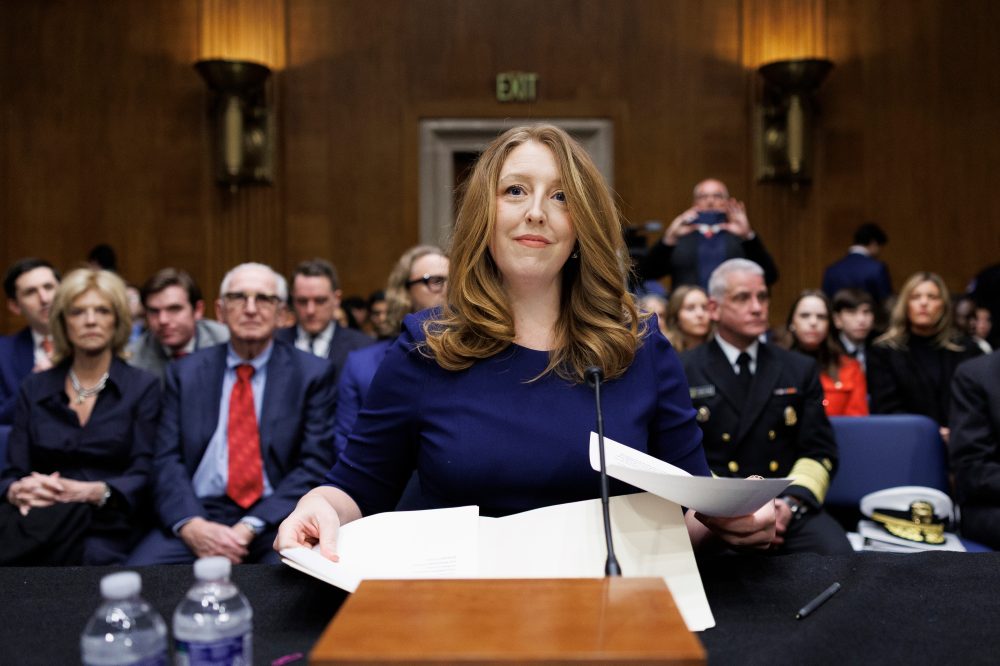

WASHINGTON — Dr. Casey Means’ bid to become the nation’s top doctor has hit a wall in the Senate, where lawmakers from both parties continue to express concerns about her qualifications and stance on vaccines more than a month after a contentious confirmation hearing.
The 38-year-old wellness advocate and Stanford-trained physician has seen her nomination stall despite intense lobbying efforts by the White House and Make America Healthy Again supporters, highlighting deep divisions over health policy even as Congress has largely backed President Trump’s other priorities.
Means, who left traditional medicine before completing her surgical residency, faces questions about her limited experience and her close ties to Health Secretary Robert F. Kennedy Jr. Her alignment with Kennedy’s push to reduce vaccine recommendations has drawn fire from lawmakers across the political spectrum and much of the medical establishment.
For her nomination to move forward, Means needs unanimous support from Republicans on the Senate Health, Education, Labor and Pensions Committee. However, two key GOP senators — Lisa Murkowski of Alaska and Susan Collins of Maine — indicated after last month’s hearing that they still have unanswered questions.
When asked Tuesday about her position, Murkowski told reporters “I’m just in the same spot” regarding her reservations about supporting Means. Collins and committee chairman Bill Cassidy, a Louisiana physician who grilled Means about vaccines during the hearing, have not responded to requests for comment about the holdup.
White House spokesperson Kush Desai defended the administration’s choice, saying they’ve had “productive conversations with the Senate” about advancing her nomination. He emphasized that her “elite academic credentials, research background and advocacy on America’s chronic disease epidemic will make her a critical asset for President Trump’s push to Make America Healthy Again.”
Kennedy spokesman Andrew Nixon backed Means, stating she has “communicated a vital public health message that people voted for, that we need to fundamentally transform our health care system” to focus on healthy lifestyle choices rather than “sick care.”
The charismatic speaker and author champions ideas central to the MAHA movement, arguing that Americans receive too much medical intervention and that dietary and lifestyle modifications should be the foundation of efforts to combat widespread chronic illness.
However, critics have targeted her for maintaining an inactive medical license, occasionally not revealing financial ties to health-related brands she endorses, and some of her previous statements on medical issues.
During her hearing, senators pressed Means to clarify her position on Kennedy’s sweeping efforts to reduce vaccine recommendations and how she would communicate with Americans about these changes if confirmed.
Both Murkowski and Cassidy questioned Means about her previous skepticism regarding the hepatitis B vaccine given at birth, which the CDC stopped recommending for all children last year before a federal judge temporarily reversed that decision. Means described the hepatitis B vaccine as important and life-saving but maintained that parents should make their own choices after consulting with physicians.
Cassidy also asked whether she would encourage Americans to get flu and measles vaccinations during current outbreaks nationwide. Rather than making that commitment, she stressed the importance of informed consent.
Collins inquired about Means’ past support for therapeutic psychedelic mushroom use. Means, who has spoken positively about her personal experiences with these substances, explained that her comments as a private citizen differed from what she would say as a public health official and that she wouldn’t recommend psychedelics to the general public.
After it became clear that Murkowski and Collins were hesitant, MAHA activists launched a campaign encouraging supporters to flood the senators’ offices with phone calls.
“Please call both of them. Call them time after time. Get your friends to call them,” Tony Lyons, leader of the Kennedy-affiliated group MAHA Action, urged supporters during a recent call. “This is critical. We need to get this done.”
During the month-long delay, opposition to Means’ nomination has grown louder. Dr. Jerome Adams, who served as Trump’s surgeon general during his first term, has repeatedly used social media to argue she’s unqualified due to her inactive medical license. In an interview, he said Republicans in Congress and the Trump administration have privately expressed disapproval of the selection but view it as Kennedy’s decision.
“What I keep hearing from folks is, ‘This is what Bobby wants,’” Adams said.
Although federal law doesn’t mandate that surgeons general hold active medical licenses, they must join the U.S. Public Health Service Commissioned Corps, which requires current licenses for membership.
During her confirmation hearing, Means explained that she voluntarily made her Oregon medical license inactive because she wasn’t treating patients and noted that Admiral Brian Christine, who oversees the Commissioned Corps, had confirmed her eligibility for the position.
Even if Means clears the committee, she may struggle to win confirmation from the full Senate, where she can only afford to lose three Republican votes if all Democrats oppose her. Republican Senator Thom Tillis of North Carolina, who has announced he won’t run for reelection, told The Associated Press he’s inclined to vote against Means if her nomination reaches the Senate floor.
“Her resume already puts me on alert — and then I don’t think she did herself any favors in the hearing,” Tillis said.
At nearly 300 days since her May nomination, Means’ confirmation timeline has stretched almost twice as long as the typical presidential appointee in Trump’s second term, according to Partnership for Public Service data. The organization reports that Trump’s nominees have averaged 157 days from nomination to confirmation during the first 400 days of his presidency.
Some confirmations have moved much faster. Markwayne Mullin, the new Homeland Security secretary who was sworn in Tuesday, completed his confirmation hearing, floor vote, and swearing-in within one week.
Part of the delay in Means’ case stems from the birth of her son last October, which occurred on the same day as her originally scheduled confirmation hearing. The hearing wasn’t rescheduled until February, four months later.
Chris Piper, who manages public policy and stakeholder engagement at the Partnership for Public Service, noted that the extended period following Means’ rescheduled hearing is also uncommon. He said nominees typically advance from committee within a week of their hearing.
“A monthlong delay following a hearing is atypical for most nominations, particularly at this level of position,” he said.