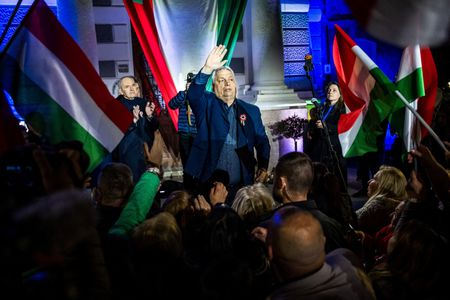

BUDAPEST, March 25 – Hungarian Prime Minister Viktor Orban, who describes himself as a country boy and helped establish Hungary as a stronghold of right-wing populism, confronts his most challenging electoral battle in his 16-year tenure against a one-time ally seeking to remove him from power in the April 12 national vote.
The 62-year-old Orban has secured support from former U.S. President Donald Trump and several prominent European conservative figures, yet most polling data indicates his nationalist Fidesz party is trailing behind Peter Magyar’s center-right, pro-European Union Tisza party amid Hungary’s economic struggles.
Once a passionate anti-Communist activist during the Cold War era, Orban has become the EU’s most tenured current leader and maintains hero status among his supporters. However, domestic and international critics charge him with steering Hungary toward authoritarian governance.
Orban entered the world in 1963 in a rural community outside Budapest, pursued legal studies, spent time studying political philosophy at Oxford University, and even competed in semi-professional football before assuming the prime minister role initially in 1998 at the young age of 35.
Under Orban’s leadership, Hungary became a NATO member, though he was voted out in 2002. Following eight years as opposition leader, he achieved a decisive electoral triumph in 2010, which allowed him to restructure Hungary’s constitution and enact significant legislation designed to establish what he termed an “illiberal democracy.”
His concentration of executive authority, new restrictions on non-governmental organizations and press freedoms, plus the undermining of judicial independence have sparked confrontations with the European Union regarding democratic principles, resulting in the suspension of billions of euros in Hungarian funding.
When Europe faced its 2015 migration crisis, Orban positioned himself as the protector of Hungary’s national character and Christian values, rejecting EU requirements to accept asylum seekers, primarily Muslims from Middle Eastern and other regions. His administration has systematically worked to diminish LGBTQ+ protections.
His uncompromising stance on immigration and initiatives to boost Hungary’s declining birth rates have garnered approval from fellow conservative leaders, including Trump.
Orban, who also achieved overwhelming electoral victories in 2014, 2018, and 2022, has received backing this election cycle from Italian Prime Minister Giorgia Meloni, France’s National Rally leader Marine Le Pen, and Alternative for Germany’s Alice Weidel.
Trump has also given his support to Orban, stating that U.S.-Hungary relations have achieved “new heights” through their leadership following years of tension under Democratic administrations in Washington.
“Core Fidesz supporters will be heartened by their prime minister rubbing shoulders with Trump,” analysts at think tank Eurasia Group said.
“But while there has been a flurry of trade deals in areas such as defence and energy, there appears to be no additional concrete political aid for the election (from Trump).”
Orban has preserved strong relationships with Russia, a crucial energy provider, and China, whose companies are constructing significant electric vehicle and battery manufacturing facilities in the landlocked Central European nation.
He has attempted to characterize the election as a decision between “war or peace,” implying that Tisza seeks to involve Hungary in the conflict occurring in adjacent Ukraine, which the party vehemently rejects.
“For peace, Fidesz is the safe choice,” Orban said on the campaign trail in February. He has repeatedly clashed with Ukrainian President Volodymyr Zelenskyy and angered Hungary’s EU allies by obstructing a 90 billion euro assistance package for Kyiv.
However, polling data suggests Hungarian citizens are more focused on domestic matters like healthcare and the economy, which has remained stagnant for three years.
Hungary endured the EU’s most severe inflation spike after Russia’s February 2022 Ukraine invasion, which pushed food costs near EU average levels, while Hungarian salaries remain the third-lowest among the 27-member bloc.
Even with generous family-friendly policies, including affordable loans and tax advantages, Orban seems to have alienated younger voters as he has shifted further rightward.
With Zavecz Research polling showing only one in five voters under 40 supporting Fidesz, Orban appealed to parents at a campaign event to emphasize the election’s importance to their adult children.
“I know young people like to turn against their parents and this can cause political problems,” said Orban, a father of five and a grandfather.
Despite participating in numerous campaign rallies and maintaining constant interviews and social media activity, he offered a rare insight late last year into the campaign’s potential impact after so many years in leadership.
“When I was a soldier (doing military service), they told us a soldier cannot be cold, he can only perceive the cold,” he said. “I am the same. I am not tired. It is just that my strength is running out.”