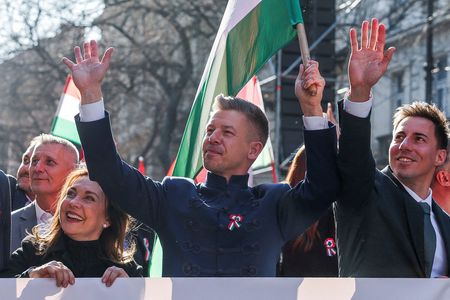

BUDAPEST – A man who once hung a photograph of Viktor Orban on his childhood bedroom wall is now positioned to end the Hungarian leader’s grip on power after more than a decade and a half.
Peter Magyar was just nine years old when Hungary emerged from communist rule in 1990, and he decorated his family home in Budapest with pictures of prominent political leaders of the era. Among them was Orban, then a young attorney who had gained national recognition for boldly calling for Soviet forces to withdraw from Hungary in 1989.
“There was a surge of energy around the regime change that swept me up as a child,” Magyar shared during an appearance on the Fokuszcsoport podcast last year.
Today, surveys indicate Magyar’s center-right, pro-European Union Tisza party holds an advantage over Orban’s nationalist Fidesz party heading into Hungary’s April 12 parliamentary contest.
Magyar, whose surname translates to “Hungarian,” emerged as a political force two years ago following a scandal involving his former spouse, Judit Varga, who had served as Orban’s justice minister. Varga stepped down from all political positions after public outrage over a controversial pardon in a sexual abuse case.
Following the incident, Magyar separated himself from the ruling party and leveled accusations of corruption and propaganda against it, explaining that he had grown disenchanted with Fidesz.
Magyar’s political ascent has been remarkably swift. Within just four months of his first major interview on the YouTube channel Partizan, his newly formed party captured 30% of the vote in the June 2024 European elections, placing second behind Fidesz while overwhelming other opposition groups.
The upcoming election carries weight beyond Hungary’s borders, with potential ramifications for Europe and the continent’s populist far-right movements.
Since 2010, Orban has worked to establish what he terms an “illiberal democracy,” implementing restrictions on press freedom and non-governmental organizations while diminishing judicial independence.
The Hungarian leader has cultivated relationships with Russian President Vladimir Putin and U.S. President Donald Trump, while frequently clashing with the European Union. Brussels has frozen billions of euros in funding over concerns about Hungary’s democratic institutions.
Magyar has committed to restoring Hungary’s Western alignment and eliminating Russian energy dependence by 2035 while maintaining “pragmatic relations” with Moscow. He has also vowed to secure the release of suspended EU funding, which could help jumpstart Hungary’s sluggish economy.
However, Magyar is proceeding cautiously to avoid alienating more conservative voters.
While he doesn’t categorically oppose Ukraine’s potential EU membership like Orban does, Tisza’s platform doesn’t endorse expedited entry for Kyiv. Similar to Fidesz, Tisza rejects EU migrant quotas and would maintain the border barrier constructed under Orban to prevent illegal immigration.
Experts suggest that tensions between Budapest and the EU – intensified by Orban’s blocking of a 90 billion euro aid package for Ukraine – might diminish under Tisza leadership.
“Orban has lost faith in the current form and direction of European integration, and is pursuing a policy of vetoes and obstruction,” explained Botond Feledy, a geopolitical analyst at Red Snow Consulting.
“Tisza has no objection in principle to integration and would pitch its battles at a practical level.”
Magyar has adopted elements of Orban’s political strategy, conducting a grassroots campaign that has penetrated Fidesz’s traditional rural strongholds.
His events prominently display Hungarian flags, mirroring Orban’s approach to appealing to voters’ patriotic sentiments.
Gabor Toka, a senior research fellow at the Vera and Donald Blinken Open Society Archives, credits Magyar’s rapid ascent to his consistent messaging and effective social media strategy.
“Many people are also reassured by the story of someone who has irrevocably come into conflict with the system, and has no way back,” Toka noted, referencing Magyar’s split with Orban.
Current polling shows Tisza leading Fidesz by 8-12 percentage points among committed voters, though government-aligned pollsters report the ruling party ahead.
Born in 1981 to a family of attorneys, Magyar pursued legal studies himself. He wed Varga in 2006, and when her career brought her to Brussels, Magyar entered Hungary’s diplomatic service, focusing on EU legislation. Upon returning home, he worked at a state bank before leading a student loan organization.
Magyar and Varga, who finalized their divorce in 2023, share three children.
Magyar characterizes himself as a person of faith who enjoys preparing meals and playing soccer with friends and his sons.
When asked in December about how politics had changed him, Magyar referenced media descriptions of his temper, responding: “Now I count to 10.”