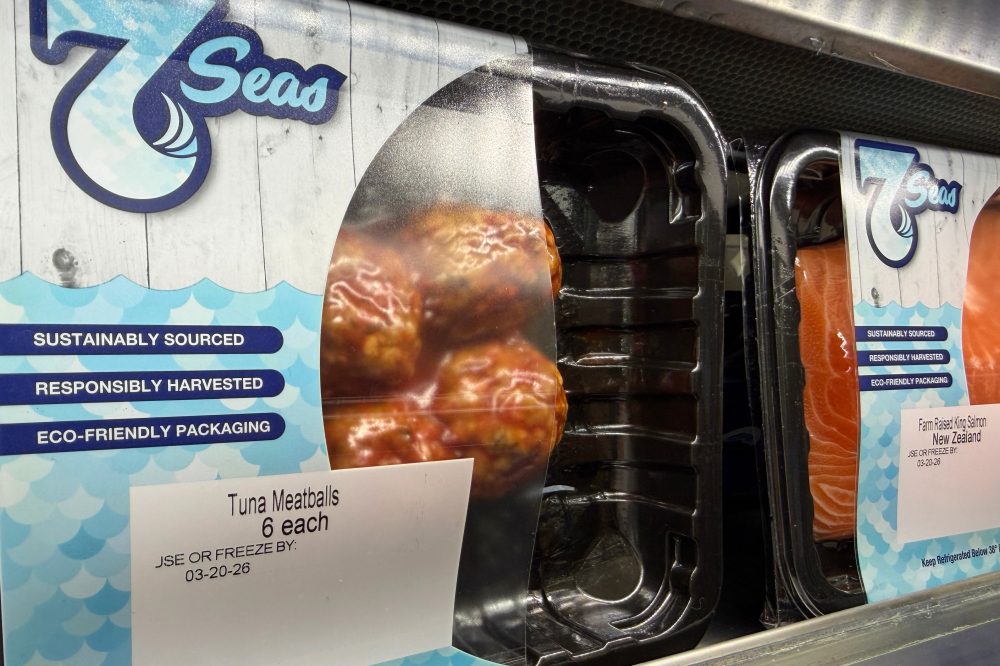

The seafood industry is taking an unusual approach to win over American consumers: making fish products that look nothing like fish at all.
Companies are now creating tuna nuggets that mimic fried chicken, shrimp formed into burger patties, and salmon processed into salami-style strips. This transformation was on full display at the recent Seafood Expo North America held in Boston.
Jack Chi, representing Taiwan-based Tuna Fresh, explained their strategy. “Our Taiwanese magic is making tuna taste like fried chicken,” Chi said. His company produces tuna as fried “nuggets” and breaded strips resembling chicken tenders. “We wanted to be able to engage in the U.S. market, and we found that fried foods are the way.”
Justin Rogers from SK Food Brands in Los Angeles has noticed this shift gaining momentum. “It’s been a big trend for the last couple of years,” Rogers said. His company now offers shrimp burgers in both small and large sizes. “It makes it more palatable to people who aren’t big seafood fans. Especially with things like these sliders, it gives them an entry point.”
The strategy targets a significant market opportunity. Americans consume approximately 19 pounds of seafood annually – a figure that has remained relatively unchanged for a century. This pales in comparison to the worldwide average of 45 pounds, with some European nations reaching 90 pounds per person yearly. Iceland tops the list at roughly 200 pounds per capita.
While disguising seafood isn’t completely novel – frozen fish sticks and McDonald’s Filet-O-Fish have existed for decades – today’s products represent a more dramatic departure from traditional presentation.
Holly Phillips from Seattle-based Harbor Bell Seafoods described their salmon snack strips, which come in smoked, lemon-pepper, mango, and original varieties. “It looks like a Slim Jim by design,” Phillips explained. “It doesn’t smell fishy. It doesn’t taste fishy.”
However, not everyone supports this camouflaged approach to seafood marketing.
“Eat fish that looks like fish!” declared Niaz Dorry, coordinating director of the North American Marine Alliance, which advocates for sustainable seafood practices. “The likelihood that that fish came from a community-based, scale-appropriate entity is much higher if that fish still looks like what it was when it was swimming in the water. Factory scale and fake are the two F-words I tell everybody to avoid.”
This transformation comes during challenging times for the seafood industry. The $24 billion market has remained stagnant for years, with growth limited to sushi sales and price increases. Remarkably, just 10% of consumers account for nearly half of all seafood purchases.
Steve Markenson, vice president of research and insights for consumer marketing firm FMI, sees parallels between sushi’s success and these new products, citing convenience and novelty as key factors. However, he remains skeptical about the strategy’s effectiveness.
“The non-seafood folks — which is about 40% of the population — I don’t know that this is really going to be appealing to them,” Markenson said. “They’re not looking to necessarily add seafood into their diet.”
Even dedicated seafood consumers might not embrace these alternatives. “They love what they love about it,” Markenson noted. “They might want it seasoned up a little, but they want that full-blown salmon.”
Joshua Bickert, a seafood market reporter and analyst for Expana, believes children might be the most receptive audience. “If you package it like hot dogs and hamburgers and chicken tenders, you maybe change that mindset at a younger age,” he suggested.
Mike Simon, owner of Florida-based Surfsnax, focuses on making unfamiliar foods more approachable. “We want to put it in a format that people are used to eating,” Simon said while demonstrating his salmon salami. “But it’s not hiding that it’s salmon.”
Among the most unusual offerings were fish spareribs made from Brazilian tambaqui, a substantial freshwater fish with a build suitable for creating pork-like ribs. Friocenter Pescados spokesman Danillo Souza Alves emphasized that tambaqui provides a better meat-to-bone ratio than traditional pork ribs.
“It’s a finger food. You can easily eat it in stadiums for football, baseball and hockey,” Alves claimed.
The trend extends to snack foods as well, with various seafood being transformed into chips, crackers, and crunchy sticks. Ina Park, representing the expo’s Korean pavilion, promoted Balance Grow’s Fried Calamari Snack, which resembled potato sticks.
“They taste like Cheetos,” Park said.