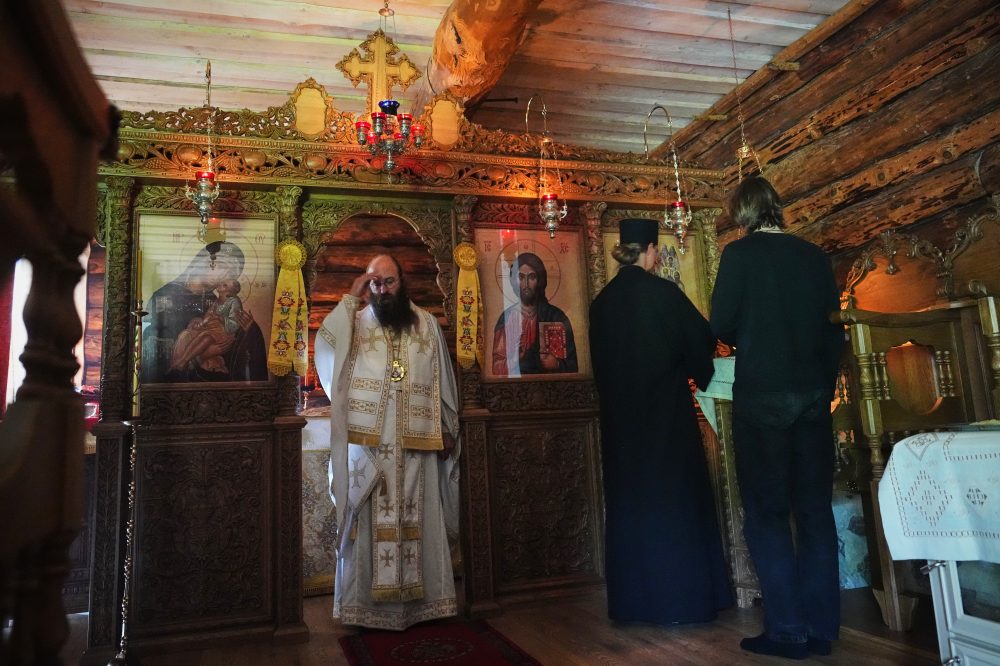

TALLINN, Estonia — Ancient liturgical words ring out in the Estonian language as Bishop Damaskinos, dressed in flowing white and gold vestments, leads prayers in a small, dimly lit chapel tucked behind curtains inside a working farmhouse — now home to a brand-new monastery.
Established last year in one of the most secular countries in Europe, the Kirikla Orthodox Monastery represents the first monastic community the Estonian Apostolic Orthodox Church has created in many years.
Since the Soviet Union fell, the Estonian Apostolic Orthodox Church has existed alongside a separate Orthodox church connected to the Moscow Patriarchate, which claims a larger following in the Baltic nation. Despite that, the Estonian Apostolic Orthodox Church has long held a goal of reestablishing its own male monastic tradition within the country’s borders.
Bishop Damaskinos, 41, who serves as the monastery’s abbot, and his fellow monk, the Rev. Paisios, are the first monks to actually live, work, and worship at the farmhouse monastery, located roughly 40 kilometers — about 25 miles — from the capital city of Tallinn.
Although the Estonian Apostolic Orthodox Church currently oversees more than 60 churches and a convent, the last time Orthodox monks called Estonia home was over 80 years ago, during the country’s period of independence between the two world wars.
With the monastery finally a reality after so many years, the daily prayers offered by Damaskinos and Paisios carry a reach far beyond the Baltic region.
“The monastery’s meaning is also global in the sense that we pray for the whole world,” Damaskinos said.
After morning services, Damaskinos — wearing a broad straw hat and black cassock — tends to a flower bed in the garden, while Paisios, 31, works alongside young volunteers in the potato field. The volunteers came to assist the monks during the summer.
Life at the monastery leaves little room for idle time. Work and prayer alternate throughout the day, with spiritual conversations woven in between — and very little opportunity to check a cellphone. Despite the demanding schedule, the monks say they feel genuinely rested. Paisios noted that young visitors to the monastery have responded positively to that way of life.
“They say, ‘It’s so nice to just put the phone away and not be focused on the phone the whole day, and just to get away from social media and everything and to be in the real world and connect with people,’” Paisios said.
Estonia, a country of roughly 1.3 million people, is known for its highly secular culture. Still, Priit Rohtmets, an associate professor of church history at the University of Tartu, says he is noticing early signs of growing religious curiosity among younger Estonians. This generation grew up without the anti-religious attitudes that were common during the Soviet era, when religion was looked down upon and most monasteries were shut down.
“They don’t have any bad experience with religion, they don’t have any experience with religion at all,” Rohtmets said. “This, of course, gives a chance for religious communities.”
For someone who wishes to become a monk, the path begins with a novitiate period of up to three years, during which the candidate follows the same daily routine as the other monks. When the abbot determines the novice is prepared, the person takes vows of poverty, chastity, and obedience, receives a new name, and commits to monastic life permanently.
Unlike Orthodox priests — who may wed before being ordained and serve in local parishes — monks are required to remain celibate and reside within a monastery.
Though Damaskinos and Paisios are currently the only two monks at Kirikla, the bishop says the small number does not concern him.
“What we are worried about is the spiritual quality of the monks,” he said, “that the monks actually take seriously their task of praying for the whole world.”
The monks structure their days according to rhythms Damaskinos first absorbed during his time at Mount Athos in Greece, a place that has been a cornerstone of Christian Orthodox monasticism for over 1,000 years. The day begins at dawn with individual prayer, followed by a group morning service, then gardening or construction work. The only unstructured time comes in the evening, following a second service.
While still getting settled, the monks open their doors to visitors on select days. Through social media, they welcome pilgrims and curious guests to attend services, step away from the pressures of daily life, and experience a different way of living.
“Monastic life is difficult, but through all these difficulties we find true happiness,” Damaskinos said. “So I hope that when people come here they see the happiness that we represent.”
Kirikla is the only Orthodox monastery in Estonia, though other faith traditions have established monastic communities in the country. A Dominican order returned to a small monastery in Tallinn in 1996, and a Theravada Buddhist monastery operates on Aegna Island.
Opening a new monastery anywhere in Europe in 2026 is an uncommon event — some existing monasteries are closing as fewer people take monastic vows. That makes Kirikla’s emergence, even at this modest scale, an encouraging sign for Orthodox believers and religious scholars alike.
The monastery currently has no buildings beyond the farmhouse, which was donated by a local businessman. To generate income, the monks may eventually sell produce from their garden or handcrafted items such as candles or incense. Even so, Damaskinos says his focus remains on something less tangible.
“What interests me more, rather than finishing the buildings, is to finish building the brotherhood,” he said. “It’s a work that never finishes, but at least it creates a good basis for monastic continuation here in Estonia.”