
NASHVILLE, Tenn. — For a brief but memorable stretch around the turn of the century, Nashville was home to one of the most unusual carousels ever built.
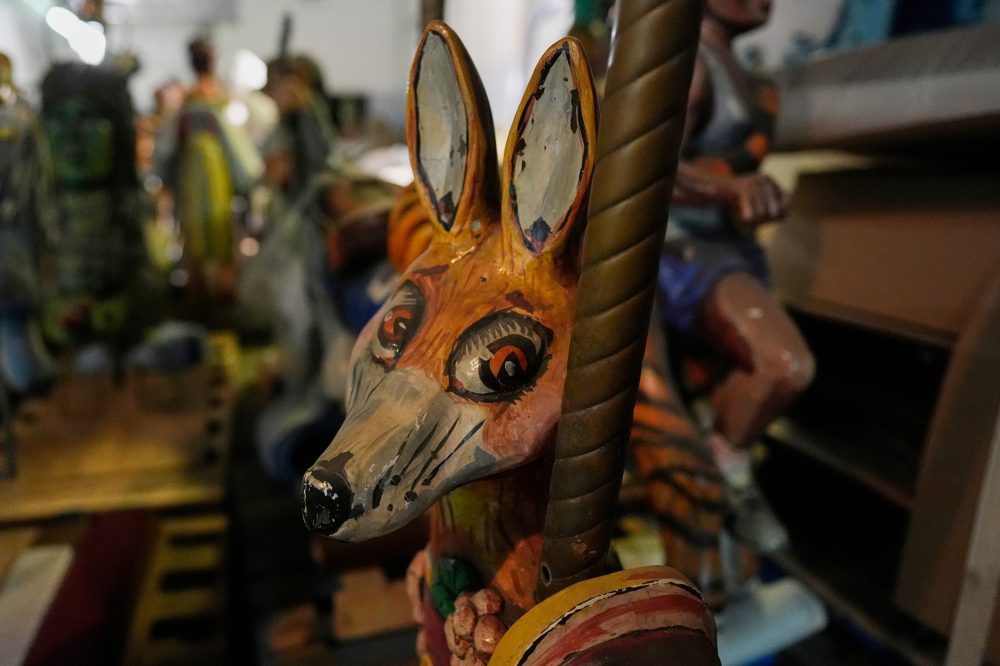
Artist Red Grooms, who called his creation a “sculpto-pictorama,” designed 36 imaginative figures tied to Tennessee’s culture and history. Legendary country guitarist Chet Atkins appeared riding the neck of a guitar. Frontier hero Davy Crockett was shown wrestling a bear. Riders could even climb aboard a chigger — the tiny summer mite infamous for latching onto ankles and causing a maddening itch.
The Tennessee Fox Trot Carousel was a one-of-a-kind attraction, but it struggled to find its footing financially. Positioned along the Nashville riverfront at the edge of downtown during a time when the area hadn’t yet become the tourist destination it is today, the carousel eventually could not sustain itself. It was taken apart and handed over to the Tennessee State Museum, which has kept it in a storage facility ever since.
Now, more than two decades later, there are growing efforts to bring the carousel back to life.
Tennessee State Museum Executive Director Ashley Howell says the single most common question she receives from the public is: “What about the Red Grooms carousel?”
When the museum took possession of the ride, it was in the process of planning a major new building. However, funding limitations meant no space was designated for the carousel. The new museum opened in downtown Nashville in 2018 and even featured a retrospective of Grooms’ work — but the carousel was not part of it.
In November, the museum reached out to gauge interest from private parties willing to partner with the institution on “the restoration, placement, and operation of the Red Grooms Fox Trot Carousel.”
Howell, who took over as the museum’s top executive in 2017, said she had intended to focus on the carousel earlier, but back-to-back crises in 2020 derailed those plans. A tornado struck the new museum and destroyed a storage building — and then, just days later, the COVID-19 pandemic brought everything to a halt.
Still, the ongoing public interest in the carousel’s return reflects “how beloved this work of art is to the community,” she said.
“It was only on the riverfront for a short time, but it has sort of lived in memory much longer than it was in operation,” Howell said. “We’re excited to think about next steps.”
Grooms was born in Nashville in 1937, but left after high school and built most of his career in New York. His art is known for its bold colors and playful spirit, and he frequently creates large-scale installations that visitors can actually walk through and touch.
Among his most celebrated works is Ruckus Manhattan, created in 1976. The New York Times once described it as “a walk-in carnival reconstruction of Manhattan landmarks and the sometimes bizarre fauna that inhabit them,” complete with a subway car that served as “a form of participation theater.”
Marina Pacini, who organized a Grooms exhibition for the Memphis Brooks Museum of Art in 2016, described him as fundamentally a storyteller whose work is packed with “absolutely riveting” details.
“They operate on multiple levels, but you do not have to be an art expert in order to enjoy unpacking what’s going on in them,” she said. “People adore his work.”
While selecting pieces for that exhibition, Pacini visited the carousel in storage and said it was difficult to choose favorites among the figures.
“The generosity of him making something like a carousel — that he put that much thought and effort into the individual characters and into how he defined them — and then to create them into something that you can actually climb on! I mean, most people go to museums and you’re not allowed to touch anything,” she said. “Here you are, you’re actually getting to climb onto a work of art. How much more fun could it possibly be?”
Grooms, now 89 years old, did not respond to requests for comment about the carousel.
Some of his most devoted fans and collectors are based in Nashville, and when his Manhattan gallery closed a few years ago, he moved his representation to David Lusk, who runs galleries in both Nashville and Memphis.
An exhibition held last year featuring drawings and behind-the-scenes materials from the making of the Fox Trot Carousel reignited public interest in the ride, Lusk said.
He noted that a key question still hangs over the project — “whether it’s an artwork or whether it’s meant for people to be straddling and riding it.” If it requires the painstaking restoration of a fine art masterpiece, the costs could be prohibitive. But if the goal is simply to get it spinning again for the public, museum-quality perfection may not be necessary.
“He’s pretty assured that it is in good shape and ready to go again. So it’s just frustrating that it’s not out there for people to enjoy,” Lusk said. “Red wants it used — looked at, used, loved.”