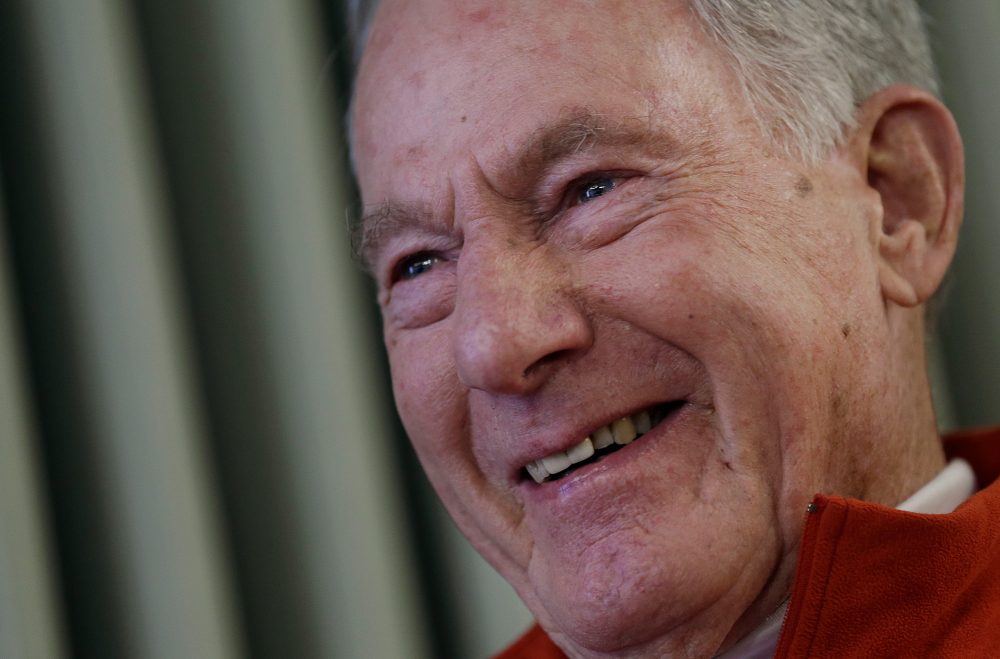

SEATTLE — Jim Whittaker, the pioneering mountaineer who made history as the first American to successfully summit Mount Everest, passed away Tuesday at his Washington residence. He was 97 years old.
Whittaker’s historic achievement occurred in 1963, a full decade after Sir Edmund Hillary and Tenzing Norgay became the first climbers to conquer the world’s tallest peak. His family confirmed he died at his Port Townsend, Washington home.
The towering climber’s Everest triumph transformed the previously reserved outdoorsman into an overnight sensation, leading to countless speaking engagements and requests to support charitable endeavors.
His mountaineering success also opened doors to high-profile social circles, particularly within the Kennedy family network. Whittaker developed a strong friendship with Robert Kennedy and later climbed a 14,000-foot Canadian mountain named Mount Kennedy following the politician’s 1968 assassination.
Having served as state campaign chairman for Kennedy, Whittaker was deeply affected by his friend’s death.
The 6-foot-5 mountaineer once described Bobby Kennedy as “one of the grittiest little guys you’ve ever seen,” adding that “It’s not how big you are but how tight you are wound that counts.”
Whittaker’s passion for climbing started during his Boy Scout days exploring Washington’s Olympic Mountains. He often spoke about how the combination of beauty and peril in mountaineering heightened one’s awareness.
“You’re in nature, participating in God’s creation … it’s such a high, such a spiritual thing,” Whittaker explained during a 1981 interview.
“I think it’s good to participate in that and to face life,” he continued. “When you live on the edge, you can see a little farther.”
He acknowledged that danger was an inherent part of the pursuit.
“The mountains are fair, but they really don’t care,” Whittaker observed in 1987.
His accomplishments on both Mount Everest and K2, the planet’s second-highest summit, secured his place in mountaineering history. He shared elite climbing status with his identical twin brother Lou, who spearheaded the first American team to climb Everest’s northern route.
Lou Whittaker passed away in 2024 at 95 years old.
However, Jim Whittaker often said his most meaningful accomplishment came in 1981 when he guided 10 disabled climbers to the summit of 14,410-foot Mount Rainier. For those participants, he later reflected, “that was Mount Everest.”
Despite scaling Mount Rainier over 100 times, Whittaker never underestimated the mountain’s challenges. He warned that unpredictable weather conditions, even on relatively smaller peaks, “can turn a good climber into a beginner” within hours.
After decades of confronting extreme risks on the world’s most treacherous summits, Whittaker shared in a 1980 conversation that he wished to “die in my sleep with the television on.”
In his later years, Whittaker joined other experienced climbers in opposing mandatory electronic tracking devices for mountaineers. Such requirements had been proposed for Oregon’s Mount Hood, where over 35 climbers had perished since the early 1980s.
Speaking to The Associated Press in 2007, Whittaker said individual climbers could choose to use such devices, but mandatory requirements would diminish climbing’s essential character.
“If you take all of the risk out of life, you lose a lot. You’re removing a personal liberty from somebody who wants to go and explore without having a safety net,” Whittaker explained during a phone call from Idaho, where he was on a climbing expedition. “You want to go into the wild and enjoy nature and not be followed.”