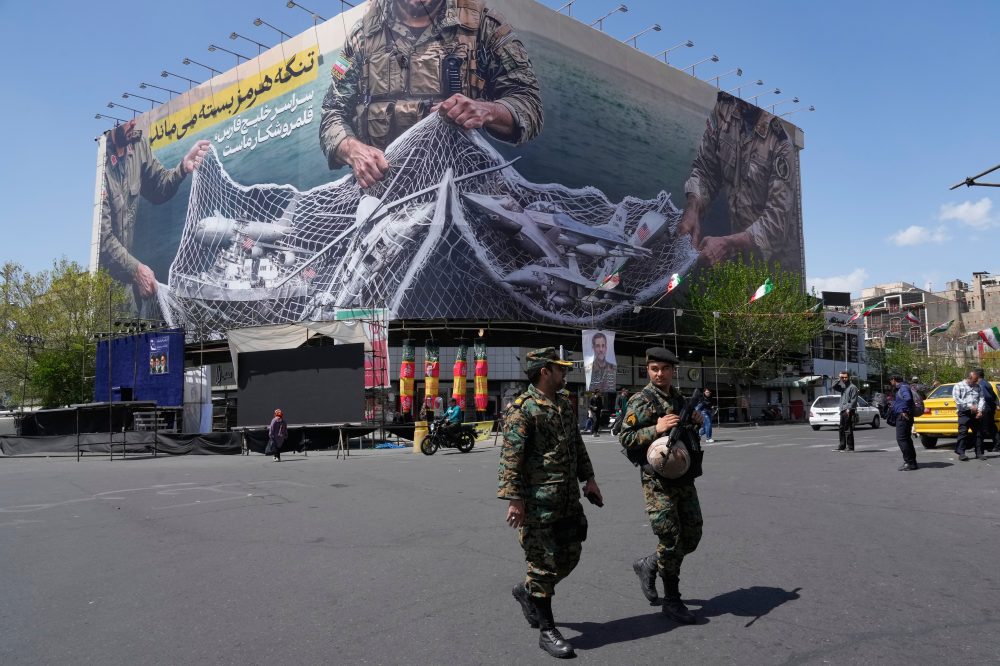

FRANKFURT, Germany (AP) — As part of negotiations to halt hostilities with the United States and Israel, Iran has put forward a demand to establish toll collection rights in the Strait of Hormuz before allowing the crucial oil shipping route to reopen.
However, imposing fees on vessels passing through this waterway would break a fundamental principle that has governed international maritime commerce for centuries: the freedom of peaceful navigation. This long-standing concept was formally written into the United Nations Convention on the Law of the Sea, which became binding in 1994.
Reopening this critical passage would relieve global economic pressures that have driven energy and fertilizer costs dramatically upward since hostilities commenced on February 28. However, accepting Iran’s toll collection demands would solidify the Islamic Republic’s authority over a waterway that carries 20% of global oil shipments — while financially benefiting the very military forces the conflict was launched against.
President Donald Trump has prioritized getting the strait reopened. However, the White House announced Wednesday that he rejects the toll proposal, and experts indicate Gulf oil-producing nations share this opposition.
Experts report they have observed no increase in shipping traffic through the waterway since ceasefire announcements, contrary to White House assertions.
Following the initiation of military action by the U.S. and Israel, Iran quickly used its strategic position by shutting down the strait through vessel attacks and attack threats, creating conditions too dangerous for safe passage. This blockade immediately created supply shortages in Asian nations heavily reliant on regional energy, drove up fuel costs in America and Europe, and posed risks to worldwide economic expansion.
Iran subsequently implemented a vessel screening process that shipping experts nicknamed the “tollbooth.”
Vessels received instructions to avoid the strait’s center in Iranian and Omani territorial waters, instead taking longer routes around Iran’s Larak Island. After providing comprehensive details about crew members and cargo to representatives of Iran’s Islamic Revolutionary Guards Corps, certain ships received passage approval — with at least two vessels reportedly making payments equivalent to $2 million in Chinese currency.
Iran’s comprehensive 10-point peace proposal contains language permitting Iran and Oman to impose charges on ships traveling through the Strait of Hormuz, according to a regional official who requested anonymity to discuss negotiations they personally participated in. This official indicated Iran would direct collected funds toward reconstruction efforts.
However, the Law of the Sea Treaty’s Article 17 ensures “innocent passage” rights for vessels that pose no threat to coastal nations. Therefore, permitting Iran and Oman to begin charging for strait passage would establish a concerning precedent, according to legal experts.
Maritime navigation freedom across global waters has remained a core right for centuries, based on “the idea that the sea doesn’t belong to anyone,” explained Philippe Delebecque, a professor and maritime law specialist at Paris’ Sorbonne University.
“Freedom of navigation has always been recognized, including specifically in straits,” he stated. The worry is that if the Strait of Hormuz could face closure, similar restrictions might follow at the Strait of Gibraltar between the Mediterranean and Atlantic, or the Strait of Malacca near Indonesia.
He described such a situation as “the end of an international society.”
Although 172 nations have approved the U.N. convention, both Iran and the United States remain among those that have not ratified it.
“Not having ratified the convention doesn’t give (Iran) total freedom of action in the Strait of Hormuz,” stated Julien Raynaut, who leads the French Association of Maritime Law, a professional organization. “It remains subject to international law and notably this customary right of passage.”
An Iranian toll system could prompt China to determine it could limit movement in the Taiwan Strait, Raynaut noted.
Oman and Iran may encounter diplomatic pressure to follow the convention, said Constantinos Yiallourides, a senior research fellow at the British Institute of International and Comparative Law.
Free passage “is in the interest of everyone,” he stated. “We all want to get the best products at the best prices.”
Some economists argue that from a purely financial perspective, the global economy would hardly notice additional expenses from Strait of Hormuz tolling.
As an example, a $2 million fee on a large tanker transporting 2 million barrels of oil equals a $1-per-barrel cost increase for that shipment’s oil.
“The burden does not fall on global consumers, but overwhelmingly on the Gulf states that supply the oil that transits the strait,” reported the Bruegel think tank in Brussels. It noted the world economy would immediately gain from strait reopening — returning 20% of global oil to markets and driving prices down.
Additionally, by reducing oil prices, it would remove a multibillion-dollar geopolitical advantage for Russia, whose oil has become more sought after despite sanctions.
International oil prices have risen from approximately $72 per barrel before the conflict to as much as $118 on March 31. On Monday, Brent crude, the global standard, was trading at $94.55, dropping significantly following ceasefire news.
Saudi Arabia, the largest Gulf producer, praised the ceasefire agreement between the U.S. and Iran but urged keeping the Strait of Hormuz accessible “without any restrictions.”
Gulf nations have been forced to halt approximately 12 million barrels daily of crude production because no practical alternative exists around the strait for most of their oil. The two pipelines that circumvent it lack sufficient capacity to compensate for all lost oil, and constructing new pipelines would require years.
Considering the negative aspects of the toll proposal, Gulf states would only accept it if all alternative options appeared significantly worse, Bruegel stated.
A primary Western concern is that toll revenue would likely benefit the Islamic Revolutionary Guard Corps, which oversees Iran’s ballistic missile development, suppresses domestic political opposition, and appears on terrorist organization lists maintained by the U.S. and European Union.