
Energy markets experienced dramatic volatility Monday as Iran escalated military operations against Israel and Gulf nations, just hours after Iranian television announced that Mojtaba Khamenei, son of the deceased supreme leader, would take over the country’s top position.
The appointment of the younger Khamenei gives him direct control over Iran’s Revolutionary Guard paramilitary forces and positions him as a key decision-maker in the nation’s military strategy.
Global financial markets reacted sharply to the developments, with crude oil costs jumping significantly on Monday. The price surge has raised fresh concerns about potential inflationary pressures and reduced consumer spending in the United States, which drives much of the nation’s economic activity. Japan’s Nikkei 225 stock index dropped as much as 7% during early trading, with other Asian financial markets following suit.
Saudi Arabia escalated its rhetoric against Tehran on Monday, warning Iran it would become the “biggest loser” if attacks on Arab nations continue. The Saudi warning followed what appeared to be a drone strike targeting the kingdom’s major Shaybah oil production facility.
Bahrain’s national oil company announced force majeure on Monday regarding its petroleum shipments following an Iranian strike that ignited fires at its refinery facility.
The Bahrain News Agency reported the force majeure declaration, a legal action that allows companies to suspend contractual duties due to exceptional circumstances.
The company stated its operations “have been affected by the ongoing regional conflict in the Middle East and the recent attack on its refinery complex.”
Officials maintained that domestic energy needs would continue to be satisfied.
The United Arab Emirates reported Monday that its defensive systems were actively intercepting incoming drones and missiles from Iran, marking the second such attack the country faced that day.
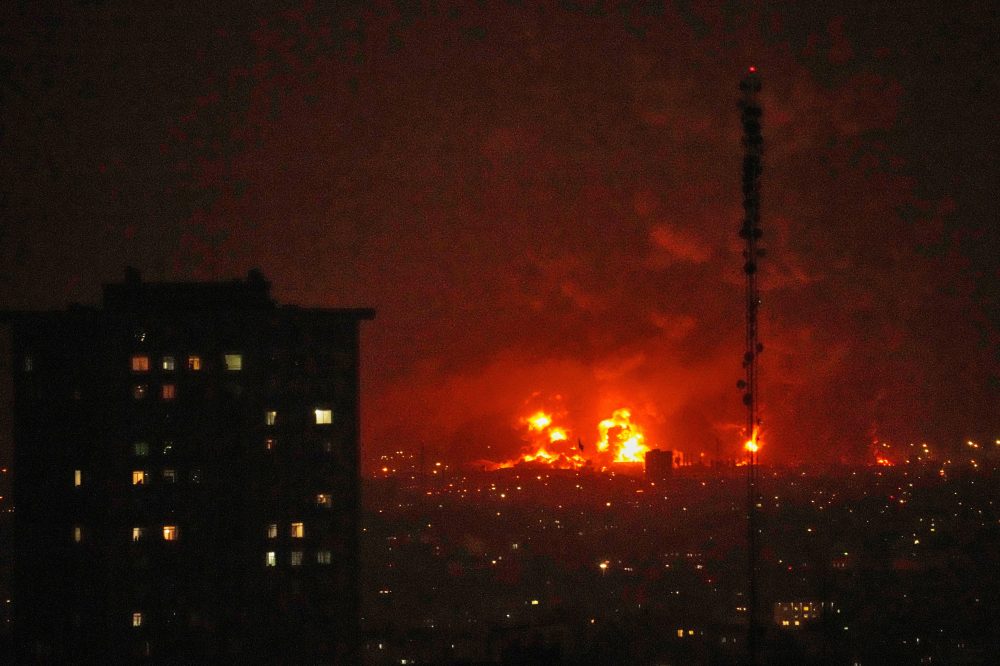
Monday’s Iranian assault on Bahrain ignited what appeared to be a blaze at the island nation’s primary oil refinery, creating massive smoke clouds visible across the area.
Internet footage allegedly captures the flames at the Sitra refinery complex.
Bahrain’s official news service later reported that “a fire broke out due to the Iranian aggression targeting a facility in Maameer, with material damage but no loss of life.”
Maameer is a Bahraini community located next to the refinery.
Bahraini officials did not immediately confirm the refinery itself was directly struck, although it has been targeted in multiple Iranian attacks since hostilities commenced.
Israeli forces announced Monday strikes against targets in Iran’s Isfahan city, focusing on security installations.
The Israeli military described hitting command facilities belonging to Iran’s Revolutionary Guard and its volunteer Basij militia in that area.
Military officials also reported striking a rocket engine manufacturing plant and missile launching positions.
Iran has not yet confirmed the Israeli attacks. Tehran has provided no information about equipment losses since fighting began February 28.
A Chinese diplomatic representative in the Middle East urged all parties to cease military operations and condemned attacks targeting civilian areas and non-combatants.
Special Envoy Zhai Jun, during meetings in Saudi Arabia with Foreign Minister Prince Faisal bin Farhan, stated Sunday that the independence, safety and territorial boundaries of all Gulf nations must remain protected, according to a Chinese Foreign Ministry announcement.
China imports substantial quantities of oil and natural gas from the region.
Zhai also conducted meetings with Jassim Mohammed al-Budaiwi, who leads the Gulf Cooperation Council, the Foreign Ministry confirmed.
South Korean President Lee Jae Myung warned Monday that dramatic fuel price increases could destabilize his nation’s economy and directed officials to accelerate efforts to establish alternative fuel supply routes beyond the Strait of Hormuz.
Lee addressed a Cabinet session after the country’s financial markets opened with an 8% decline, as worries mounted about how the expanding Middle Eastern conflict might impact an economy heavily reliant on international trade and imported energy.
Lee instructed officials to actively deploy a 100 trillion won ($67 billion) market stabilization fund launched last week to minimize stock market fluctuations and enhance oversight of disruptive market behaviors, including fuel price manipulation or stockpiling.
Foreign Minister Cho Hyun reported Seoul was in discussions with Gulf nations to establish alternate shipping routes to decrease dependence on the Strait of Hormuz, potentially utilizing different UAE ports.