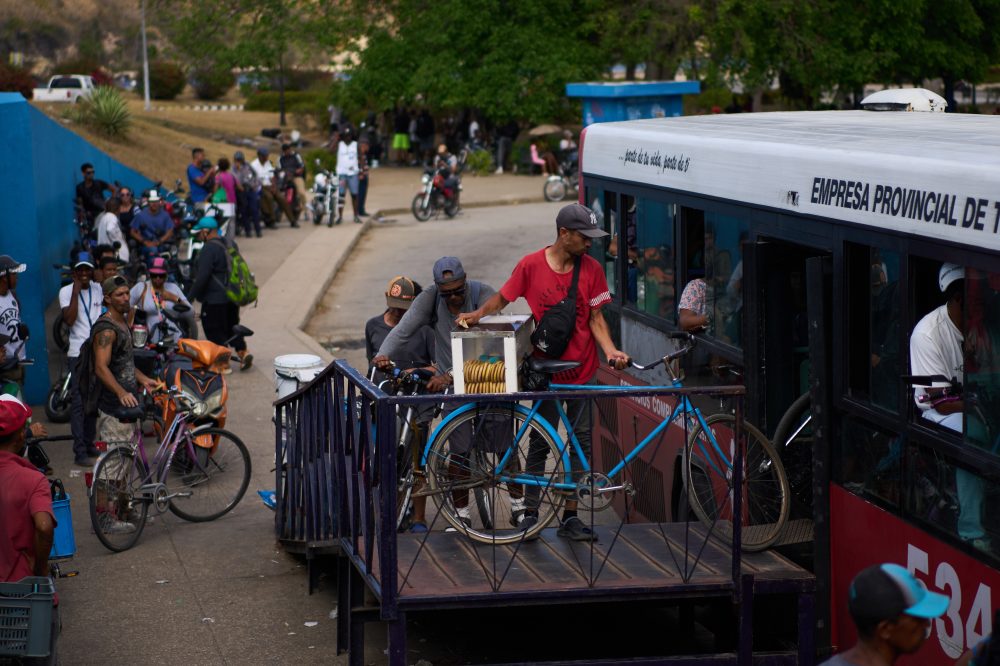

HAVANA — During a scorching hot day in Cuba’s capital city, crowds of people with bicycles, scooters and electric motorcycles lined up at the entrance to the Havana Bay Tunnel. These commuters were waiting for the Ciclobús, a specialized transit vehicle designed to carry passengers and their two-wheeled transportation through the underwater passage connecting Old Havana with the city’s eastern districts.
This diesel-fueled vehicle holds approximately 60 passengers along with their bikes and motorcycles, completing sufficient daily runs to move over 2,000 commuters. The bus design includes passenger seating at the front, while half the metal structure consists of an open cargo area. Travelers board using a special ramp and remain with their vehicles throughout the journey, gripping wall-mounted handholds for stability. Two-wheeled vehicles cannot travel through the tunnel independently.
Although the Ciclobús has operated for years, its importance has reached unprecedented levels as Cuba confronts its worst energy shortage in decades.
Energy restrictions implemented by former U.S. President Donald Trump this past January have compelled the nation to limit gasoline distribution to just 20 liters per vehicle through a complex reservation system requiring weeks or months of waiting, effectively shutting down public transit. Currently, Havana’s roads show few automobiles but overflow with thousands of bicycles and compact electric motorcycles that have become residents’ primary transportation method.
“My husband owns a bicycle, so I’m riding as his companion,” explained Ingrid Quintana, an East Havana resident employed in the historic district, while awaiting the tunnel transport. “It’s an option we have, because there’s no public transportation and we can’t afford to pay for a private taxi, so we ride the Ciclobús.”
The Ciclobús operates the island’s most compact public transit route, spanning 3 kilometers in approximately 15 minutes.
Following departure near the Havana Bay Tunnel in the old city, riders experience a bumpy trip through the dark underwater corridor. The journey concludes in eastern Havana, a vast residential area housing hundreds of thousands of people. The alternative overland path requires navigating around the enormous bay, creating a 16-kilometer journey through sparsely inhabited industrial port zones with poor road conditions.
Ticket prices range between 2 and 5 Cuban pesos (worth pennies in U.S. currency on unofficial markets) based on whether passengers transport bicycles or motorcycles.
For comparison, shared taxi service from eastern neighborhoods through the tunnel costs 1,000 Cuban pesos (approximately $2). Cuban workers typically receive monthly wages of 7,000 Cuban pesos (roughly $14).
Operated by Havana’s government transportation agency, the Ciclobús began service during the 1990s throughout the “Special Period,” the economic crisis following the Soviet Union’s collapse that isolated the island, leading then-President Fidel Castro to distribute Chinese bicycles to citizens.
Eventually, the service became less popular as people returned to conventional buses and shared taxis. However, it now experiences renewed demand as fuel shortages compel more Cubans to depend on bicycles, electric tricycles, scooters and motorcycles for daily travel.
“Most jobs are on the other side, in the city, and that’s why we have to ride it to get across,” stated 32-year-old physical education instructor Bárbaro Cabral, clutching his bicycle as the Ciclobús filled with commuters.