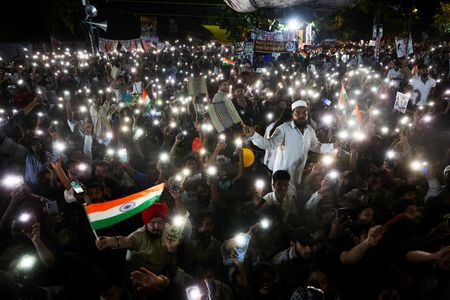

NEW DELHI — Hundreds of demonstrators backing India’s youth-driven “Cockroach” movement descended on the nation’s capital Monday, pushing forward with a march toward parliament even after police refused to grant permission for the demonstration.
The movement, which has been building for months, is being viewed as the most significant public challenge to Prime Minister Narendra Modi since he began his third term in office. It has attracted millions of followers on social media and has been gaining momentum on the ground as well.
The protest gained fresh energy after activist Sonam Wangchuk was forcibly transported to a hospital by police on Saturday. Thousands of supporters streamed into the protest site at Jantar Mantar in central New Delhi throughout the night, arriving in time for the march on the same day parliament opened its monsoon session.
Heavy barricades lined the protest area, with scores of police officers and paramilitary personnel stationed nearby — setting up a potential standoff just a few kilometers from parliament if demonstrators attempted to push forward.
Crowds chanted “Quit, quit” — calling on both Education Minister Dharmendra Pradhan and Prime Minister Modi to step down.
The Cockroach Janta Party, known as CJP, was born out of public outrage after national medical school entrance exam papers were leaked in May. The breach impacted more than two million students who were forced to retake the test.
“All these leaders in power are illiterate and I am here to protest because we do not want question papers to leak,” said Adi Nathan, a 21-year-old student from Meerut, a city roughly 100 kilometers from the capital. “This should come to an end.”
Mohammed Tabrez, 22, said he traveled from Amroha in Uttar Pradesh state — approximately 165 kilometers away — to take part. He is preparing for competitive exams that determine entry into professional programs and government jobs.
“We want this corruption to end,” he said. “We want all the frauds in paper leaks, in competitive examinations to end and this is the reason I have come here.”
The CJP initially built its following almost entirely online, gaining 22 million Instagram followers within days before expanding its reach and winning support from some opposition political parties.
CJP founder Abhijeet Dipke and his supporters launched a sit-in last month calling for Education Minister Pradhan’s resignation. Wangchuk joined them on June 28, beginning an indefinite hunger strike at the site.
In a handwritten note shared from his hospital bed on his X account Monday, Wangchuk outlined conditions under which he would end his fast. He said he would stop if the government acknowledged accountability for recent failures in the education system and for exam paper leaks, or if CJP protesters were permitted to reach parliament and lawmakers pledged to address the issues in the chambers.
He added that he would also end the fast if lawmakers and party leaders visited him in the hospital and offered the same assurances, noting that his health prevents him from joining the march himself.
Analysts say the CJP’s rise reflects deep frustration among young Indians over persistent problems including high youth unemployment and recurring exam paper leaks. Government data shows that while overall unemployment for those aged 15 and above stood at 3.1% in 2025, the rate for those between 15 and 29 was considerably higher at 9.9% — climbing to 13.6% in urban areas, compared to 8.3% in rural regions.