
MONTGOMERY, Ala. — Nearly six decades after civil rights demonstrators faced violent opposition from Alabama law enforcement before completing their historic march under federal escort, a new generation of activists has walked those same final steps in Montgomery.
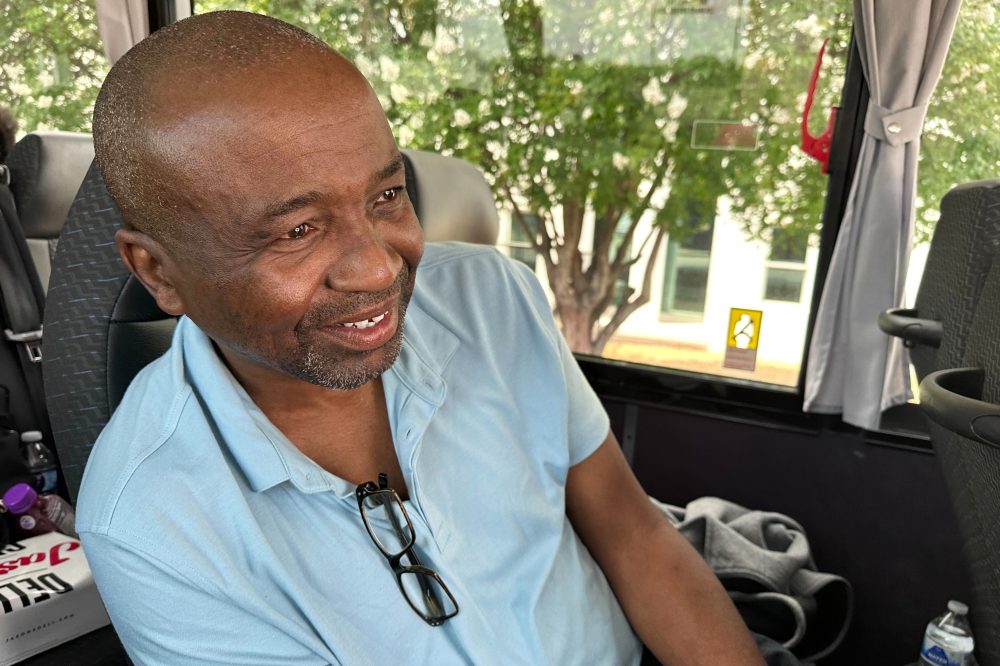
Keith Odom, now 62, was just a toddler when the original 1965 voting rights demonstration took place. The union worker and grandfather traveled from Aiken, South Carolina, to Atlanta on Saturday, where he boarded one of two buses carrying several dozen activists to Alabama’s capital city.
“The history here — being a part of it, seeing it, feeling it,” Odom, who is Black, said as he stepped onto Dexter Avenue where the original march ended.
Standing near the Alabama Capitol, Odom gazed at a stage positioned close to where the Rev. Martin Luther King Jr. delivered his speech at the conclusion of the 1965 demonstration.
However, Odom noted with regret that Saturday’s participants weren’t merely honoring that pivotal moment in civil rights history. They had come to restart the battle. The 1965 demonstration helped convince Congress to pass the Voting Rights Act, which Democratic President Lyndon B. Johnson signed into law, strengthening political representation for Black and other minority voters for over fifty years.
The “All Roads Lead to the South” gathering marked the first large-scale organizing effort following a U.S. Supreme Court decision that significantly weakened the historic voting law. In a 6-3 decision that eliminated a majority Black congressional district in Louisiana, the court determined that using race as a factor in drawing electoral boundaries constitutes discrimination. This ruling has prompted several states, including Alabama, to redraw U.S. House districts in ways that reduce Black voters’ ability to elect their preferred candidates, as Black voters predominantly support Democratic candidates.
“I’m not trying to live a life that’s going backwards,” Odom stated. “I want to go forward, for my grandchildren to be able to go forward.”
The bus passengers and the atmosphere upon their arrival in Montgomery created connections between past and present struggles.
“I talked to my grandmother before I came, and she was so excited,” said Justice Washington, a Kennesaw State University student whose name reflects her family’s confidence in America’s democratic ideals. “My grandmother told me she did her part, and now it’s time for me to do mine.”
None of the Atlanta bus passengers had been old enough to vote when the Voting Rights Act was enacted. The youngest participant was born during Democrat Barack Obama’s historic 2008 election as the nation’s first Black president.
Kobe Chernushin, an 18-year-old white recent high school graduate from Atlanta’s northern suburbs, works as an organizer with the Georgia Youth Justice Coalition. He spent the day recording Khayla Doby, a 29-year-old organization executive, creating social media content for their supporters.
“I believe in the power of showing up,” he stated.
The buses departed from the Georgia congressional district formerly represented by John Lewis, who suffered injuries on Selma’s Edmund Pettus Bridge at age 25. Though Lewis passed away in 2020, Saturday’s participants celebrated that proposed federal election reform legislation bears his name. If some Democrats succeed, the measure would counter the U.S. Supreme Court’s ruling, strengthen the Voting Rights Act, and prohibit the type of redistricting manipulation that Republican President Donald Trump has encouraged.
“I’m here because of the same forces that pulled on John Lewis when he was a student,” said Darrin Owens, 27, who previously worked for former Vice President Kamala Harris and currently trains Democratic candidates.
“Political activism is personal,” Owens explained, clarifying that he attended Saturday as a private citizen rather than in his professional capacity. “Sometimes those lines are blurred, and as a Black person in America, a Black person living in a Southern state, I’m committed to action that stops what I consider to be un-American, this possibility that the person who represents me is someone who is not from my community and does not understand me or my community.”
Upon arrival, Owens observed no federal authorities patrolling Montgomery’s streets, unlike the second march in 1965 when a wounded, recovering Lewis witnessed federal protection. This time, many of the Alabama state troopers and local police officers working the area were Black.
Fair Fight Action, an organization stemming from Georgia Democrat Stacey Abrams’ political network, organized the buses and provided lunch. Abrams gained national recognition through her unsuccessful 2018 and 2022 campaigns to become the first Black woman elected governor in U.S. history, a milestone that remains unachieved.
Montgomery has historically marketed itself as both the birthplace of the Confederacy and the birthplace of the modern Civil Rights Movement.
“It feels like our country is stuck in this pattern of making progress, then there’s a huge backlash, and then people have to go through the same battle again just to get to where we were,” observed Phi Nguyen, a 41-year-old civil rights attorney from Atlanta whose parents were Vietnamese refugees.
She stood near the church where a young King organized the Montgomery Bus Boycott in 1955, not far from where Jefferson Davis was sworn in as Confederate president in 1861.
While walking, Phi Nguyen and her sister Bee, a 44-year-old former Georgia General Assembly member who sought statewide office, encountered two other women. Carole Burton and Tondalaire Ashford, both 72-year-old Montgomery residents, have maintained their friendship since attending segregated junior high and the newly desegregated Sidney Lanier High School.
“I don’t call it ‘integration,’” Ashford said, gesturing to her dark skin. “It was never real integration, and it’s not like we can ever just blend in.”
Burton characterized them as part of “the second wave” of Black students. “It wasn’t easy,” she recalled. “And we had to support each other.”
They remembered their parents being denied voting rights during the era of poll taxes, literacy tests, and other discriminatory barriers that the Voting Rights Act eventually prohibited. Despite this history, they smiled while sharing family stories with the Nguyens.
Burton explained that immigrants, descendants of enslaved people, and Native Americans follow different but connected journeys. “We just want to be treated like people with the same rights and opportunities the country has promised us,” she said. “They’ve never fully lived up to it.”
For Odom, who started his Saturday journey in South Carolina, the current U.S. Supreme Court’s actions reflect this ongoing struggle by rejecting race-conscious electoral policies designed to guarantee fair representation rather than merely the “technical right to vote.”
He remembers spending decades represented by Strom Thurmond, a segregationist Democratic governor who became a “Dixiecrat” presidential candidate and later a Republican U.S. senator well into the 21st century. Odom expressed concern that his state might lose U.S. Rep. Jim Clyburn, a senior Congressional Black Caucus member, through redistricting.
“They want to take away that legacy when we’re still living with Strom’s?” Odom questioned.
Odom also worried that Saturday’s young participants might be exceptional rather than representative of their generation.
“I was talking to a 20-year-old co-worker about this trip,” he shared. “She told me she supported me but didn’t want to do it or work for anybody” seeking office. “She wondered what any of them are going to do for her.”
Despite this concern, he said that upon returning home, “I’m still going to tell her what I saw and what I heard.”