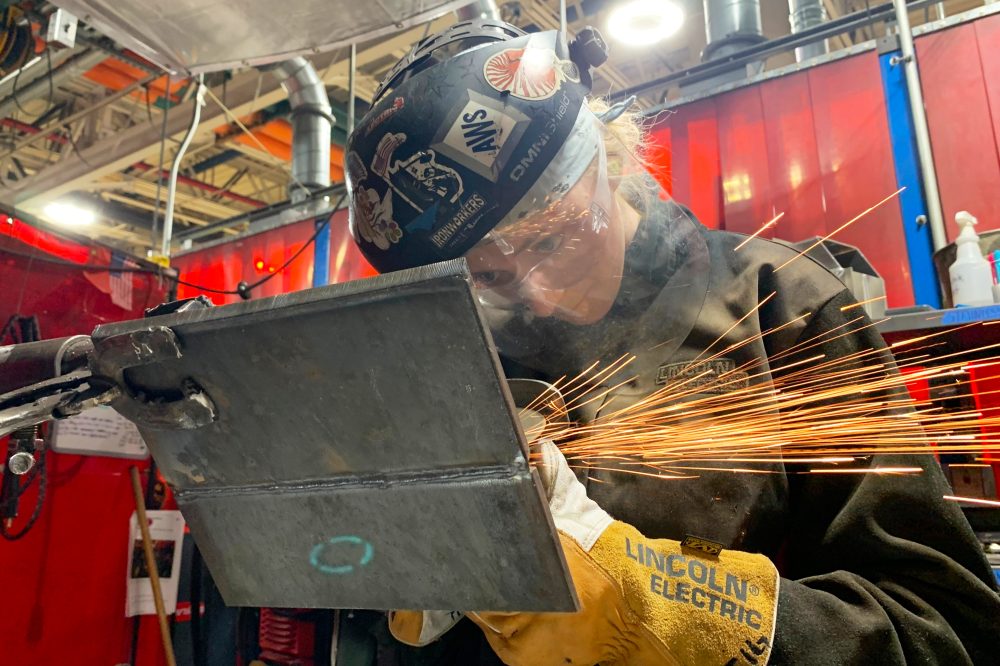

A young woman from Michigan is preparing to make history in an unexpected field.
Mikala Sposito, 21, has achieved her childhood ambition of breaking barriers after becoming the first female to represent America in welding at the upcoming WorldSkills Competition in China.
“I always wanted to be the first female to do something,” Sposito explained about her lifelong aspirations.
The Dexter, Michigan resident secured her historic position by claiming victory at the USA Weld Trials held in Huntsville, Alabama, during the earlier part of this year.
“It was very, very close the whole time, but I was the one who made it to Shanghai,” Sposito remarked about her qualifying performance.
WorldSkills functions as an international showcase for skilled trades excellence, often compared to Olympic competition for technical fields including construction, information technology, manufacturing and robotics.
Sposito attends Washtenaw Community College, which has sent six students to WorldSkills competitions throughout its history. The Ann Arbor institution claims to have graduated more WorldSkills welding competitors than any other American educational facility. Among those alumni is Alex Pazkowski, who placed second in 2013 and now serves as Sposito’s instructor and mentor.
Pazkowski traveled with her to the national championships in Alabama and will continue coaching her through upcoming international competitions spanning from Canada to Australia before the September WorldSkills event.
Combined with 80 weekly hours of welding practice at the college, Sposito faces “a long, hard road” according to Pazkowski.
“But at the end of the day, if you’re successful, it’s gonna open up all kinds of doors for you,” he noted.
The competition will test her technical skills and craftsmanship within strict time limits and demanding international criteria.
Sposito expressed excitement about competing against global talent and experiencing international travel for the first time.
Regarding her groundbreaking role, she stated: “I don’t see the gender aspect of it.
“I mean, welding doesn’t take any brute strength or anything. It’s actually very fine and precise.”
However, she acknowledges that women comprise a small percentage of participants in the field she discovered at age 10. She hopes her international success in joining metals through heat and pressure might encourage other women to enter the profession.
“Being the first female to do it is very cool,” said Sposito, who plans to pursue a bachelor’s degree in welding engineering at Wayne State University in Detroit. She’s considering following Pazkowski’s path by eventually teaching at the community college.
Regardless of her future direction, she’s pleased to serve as an example for “many women in the trades who have possibly struggled.”