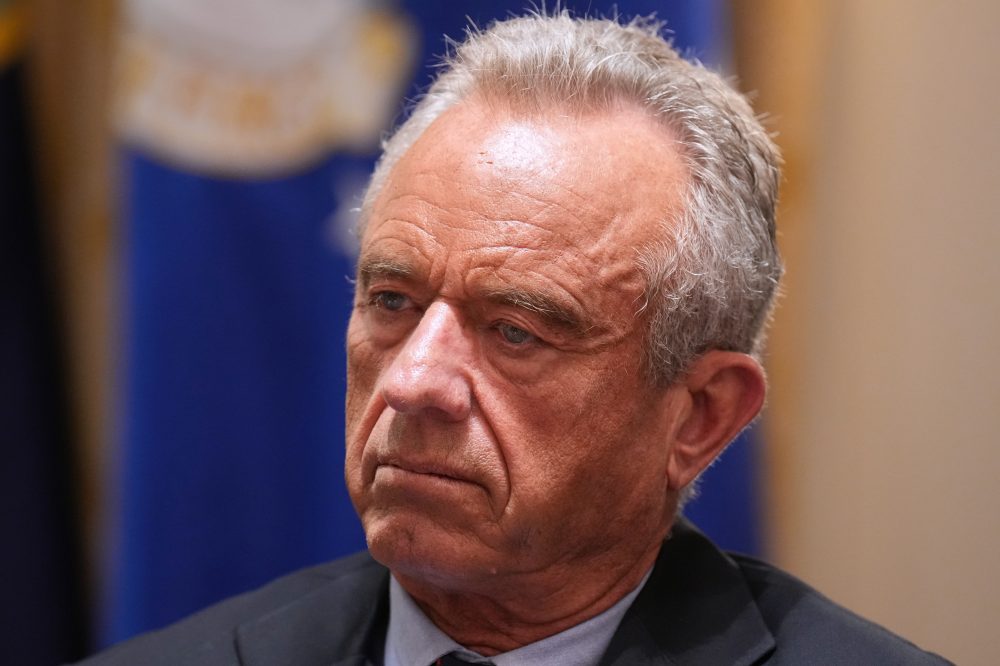

DES MOINES, Iowa — A senior Senate Democrat has accused Health Secretary Robert F. Kennedy Jr. of breaking federal law after he reportedly made phone calls encouraging third-party candidates to withdraw from two Iowa congressional races.
Senator Ron Wyden, an Oregon Democrat and the ranking member of the Senate Finance Committee, submitted a formal complaint to the U.S. Office of the Special Counsel on Monday. He is asking investigators to determine whether calls Kennedy made in June violated the Hatch Act — a law dating back to 1939 that places restrictions on political activities by federal government employees. Wyden argued that Kennedy misused his official position to interfere in elections where the Trump administration wants Republican candidates to prevail.
“Kennedy has spent sixteen months using his official position to undermine the health and well-being of his fellow Americans, and now he is using his official position to undermine the integrity of democratic elections too,” Wyden said in a written statement.
The allegations come at a time when Kennedy has been traveling to competitive congressional districts across the country as a prominent surrogate for the administration, promoting its efforts to encourage healthier eating habits and physical activity. But the complaint focuses on a separate role Kennedy allegedly took on — contacting Libertarian candidates and pushing them to exit races where they might draw votes away from Republican contenders. Control of Congress hangs in the balance during this midterm election cycle, where every seat could influence federal policy for the next two years.
Spokespeople for Kennedy and the U.S. Department of Health and Human Services did not respond when asked for comment.
According to the complaint, Kennedy spoke with Marco Battaglia, a Libertarian running in Iowa’s 3rd congressional district, on June 8, and with Rick Stewart, a Libertarian running in Iowa’s 2nd congressional district, on June 11. Both districts are among the most competitive in the nation. In recent election cycles, Libertarian candidates in Iowa have pulled in roughly 2 to 3 percent of the vote. Republicans challenged the ballot paperwork of both Battaglia and Stewart. Battaglia was removed from the general election ballot, while Stewart remains on it. Both cases are currently being contested in district court.
“They don’t want our people in there. They feel we are spoilers,” said Stephanie Berlin, chair of the Libertarian Party of Iowa. “This is just another example of the major two parties trying to strangle us out of ballot access.”
Berlin was present when Kennedy spoke with Stewart and was the person who recorded that conversation. She said she viewed Kennedy’s words as an implied quid pro quo, even though she acknowledged he “skirted the line.”
A recording of the call, shared with The Associated Press, shows Kennedy did not make any direct request or specific offer to Stewart. Kennedy told Stewart he could serve as his “liaison with the White House” and suggested Stewart could, as Kennedy himself had done, “make an agreement that puts me in a position where I can make a real difference in people’s lives.”
“I can’t go into specifics because, you know, there’s legal prohibitions about that,” Kennedy said in the recording. “If it’s something that you want to work on together … if there’s other ways that you think you might be effective, you know, like I said, I will be your advocate.”
The Washington Post had previously reported on the recorded conversation between Kennedy and Stewart.
Stewart told the AP that it was obvious Kennedy wanted him to step aside, though he added that he believes Kennedy “did his best to stay on the correct side of the law.”
“That’s how all politics works,” Stewart said. “Everybody does their best to avoid breaking the rules, but they also do their best to go around the rules.”
Wyden took a stronger stance, contending that Kennedy’s suggestion of federal employment for Stewart constituted an illegal exchange and that Kennedy must be held responsible for his actions.
Battaglia also told the AP last month that Kennedy called him to encourage him to withdraw from the race, though he said he did not have a recording of that conversation.
Donald Sherman, president of the nonpartisan government watchdog group Citizens for Responsibility and Ethics in Washington, said the recording contains multiple instances of Kennedy referencing his official role and responsibilities as health secretary. Sherman described the situation as a “clear violation” of the Hatch Act that warrants investigation by the Office of the Special Counsel.
In the call with Stewart, Kennedy also said: “I don’t want to be fighting subpoenas for the next two years instead of improving America’s health. So for me, there’s an immediate, pragmatic reason for this phone call.”
Sherman noted that Kennedy could have made a political call without violating the Hatch Act — but only if he had used a personal phone, called from a personal location, and avoided any reference to the government or his government role.
“Invoking the White House specifically, referring to his official duties and his official role as HHS secretary, is where he blurs the line between whether he’s calling as a government employee or as a private citizen,” Sherman said. “That’s where the problem comes in.”
Hatch Act complaints against senior government officials are not uncommon. During the first Trump administration, the Office of the Special Counsel issued 15 warning letters to senior officials for potential violations. Former White House press secretary Karine Jean-Pierre was also found to have violated the law during the Biden administration for referencing “MAGA Republicans” at official briefings. However, actual penalties for Hatch Act violations are rare, and the Office of the Special Counsel did not recommend any punishment for Jean-Pierre.
Trump has moved during his second term to exert greater authority over independent agencies, including the Office of the Special Counsel — a dynamic that could affect whether the office takes action on Wyden’s complaint. Trump fired the head of the office early in his second term, and the Supreme Court recently ruled that the president can remove members of independent agency boards without cause.
Craig Holman, a lobbyist for the watchdog group Public Citizen who has filed his own Hatch Act complaints against Trump administration officials, said he does not expect the office to act in this case, even though he views Kennedy’s conduct as a violation.
“RFK using his official position, citing his official position, in his phone call and his connection to the White House and his ability to get the White House to provide favors – all of that would constitute a direct violation of the Hatch Act,” Holman said.
Holman added that the Office of the Special Counsel has the authority to recommend Kennedy’s removal from his position, but said, “I am not expecting that.”