
A Tyrannosaurus rex fossil known as “Gus” has shattered auction records, fetching $50.1 million at a sale held Tuesday in New York — making it the priciest dinosaur fossil ever sold at auction.
The auction house Sotheby’s announced the sale, noting that the 67-million-year-old specimen surpasses the previous dinosaur auction record of nearly $45 million, which was set in 2024 when a nearly complete stegosaurus sold through the same auction house. Before that, the record had been held by a T. rex nicknamed “Stan,” which went for close to $32 million back in 2020.
“Gus is not only an exceptional find, but a specimen that’s been excavated, documented, prepared, and cared for with real excellence,” said Cassandra Hatton, Sotheby’s vice chair, following the sale. “The market responds when great specimens are taken care of in the right way.”
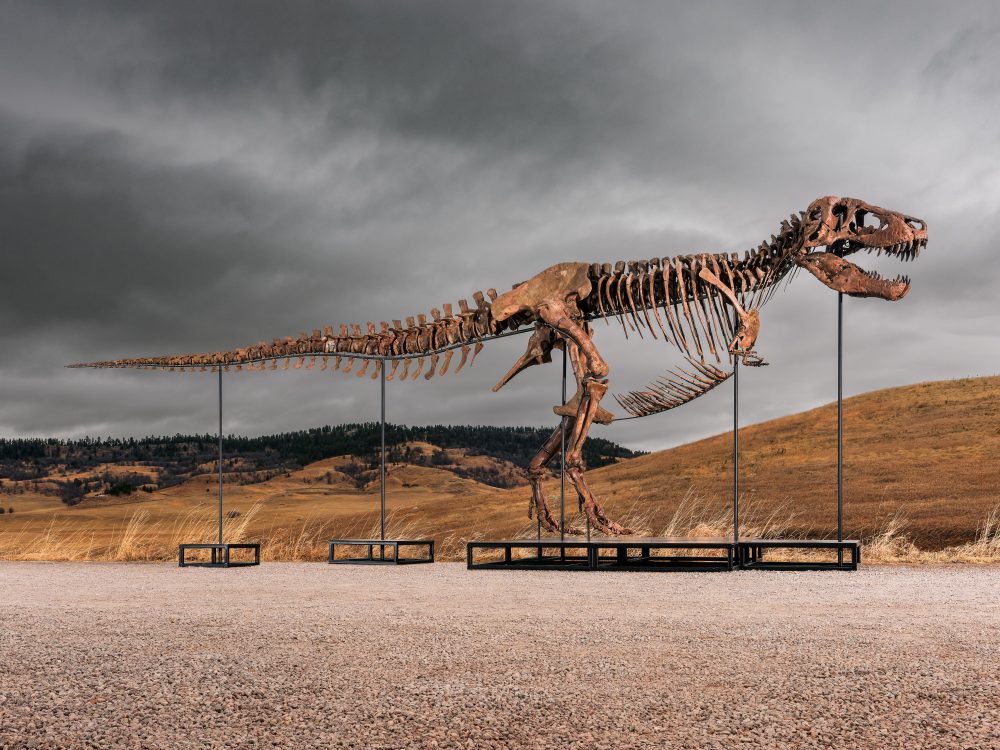
The fossil is displayed in an upright pose with its tail stretched out and its right foot lifted slightly off the ground. As an adult specimen, “Gus” stands roughly 12½ feet tall — about 3.8 meters — and stretches 38 feet, or 11.5 meters, in length.
Sotheby’s describes the fossil as approximately 63% complete. Among its notable features is an “exceptionally preserved” skull with a wide-open jaw full of powerful teeth, two well-preserved feet, and several rarely found bones, including a furcula — commonly known as a wishbone.
The fossil was unearthed in 2021 on a ranch in South Dakota. It was named “Gus” in tribute to the property owner, Gary Licking, who passed away during the approximately five-year process of excavating, restoring, and mounting the specimen.
Seven prospective buyers competed for the fossil, with the mystery winner prevailing after a 10-minute bidding battle, according to Sotheby’s.
At one point during the live and online auction, auctioneer Phyllis Kao urged the bidders to go bigger: “Try a bigger bite. It’s a T. rex, after all.”
Requests for more information about the winning bidder and their intentions for the fossil went unanswered. Ahead of the sale, experts had estimated “Gus” would bring in somewhere between $20 million and $30 million.
Prior to the auction, the Society of Vertebrate Paleontology — an organization representing scientists, scholars, and students — called for fossils of this significance to be placed in museums or research institutions where they can remain accessible to the public and to future researchers.
“The discovery of an important fossil is only the beginning of its scientific story,” said Kristina Curry Rogers, the society’s vice president, in a prepared statement. “Many of the most significant advances in paleontology have come years or even decades after a fossil was collected, as new analytical methods and technologies allowed scientists to ask entirely new questions of specimens already housed in museum collections.”
The previous record-holder, the stegosaurus known as “Apex,” is currently on extended loan to the American Museum of Natural History in Manhattan. “Sue” the T. rex — the first dinosaur ever auctioned, sold by Sotheby’s in 1997 — is now a featured exhibit at the Field Museum in Chicago. “Stan,” meanwhile, is on display at the Natural History Museum Abu Dhabi, posed in a dramatic scene alongside another fossilized T. rex over the remains of a triceratops.
The Tyrannosaurus rex, whose name roughly translates to “King of the Tyrant Lizards,” dominated the top of the food chain during the late Cretaceous period. With its powerful jaws and notably short arms, it has become the most iconic and recognizable of all dinosaurs, appearing in everything from children’s television like Barney the purple T. rex to the long-running “Jurassic Park” film franchise.
According to Sotheby’s, these massive creatures once roamed what is now western North America, during an era characterized by warm climates, elevated sea levels, and fertile coastal floodplains — conditions that supported the large plant-eating dinosaurs, such as the triceratops, that T. rexes preyed upon.