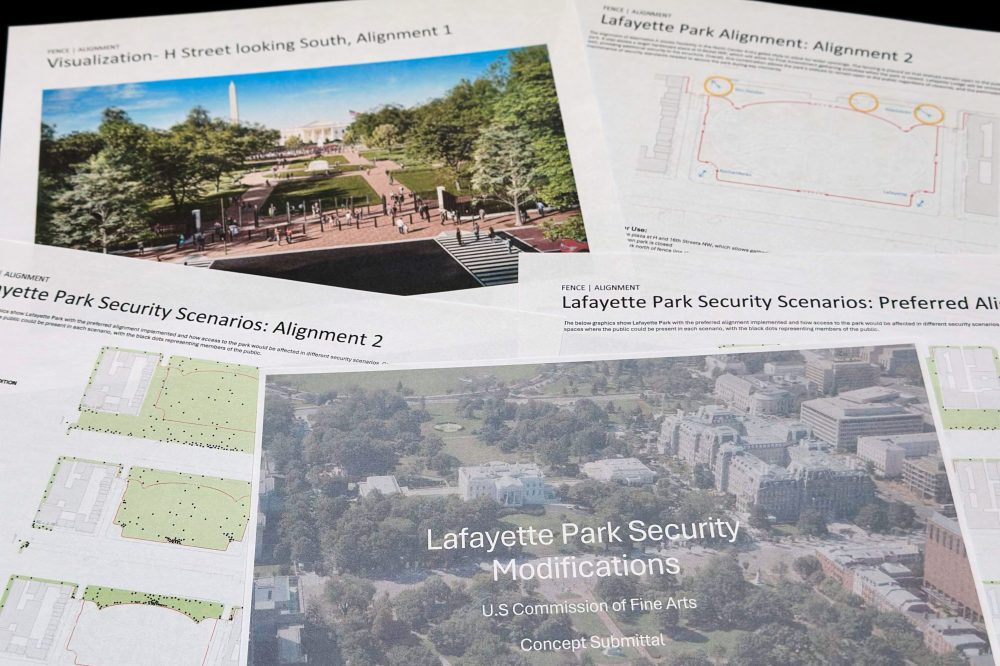

WASHINGTON — The Trump administration has put forward plans to tighten security around the White House, including erecting a fence around Lafayette Park to allow law enforcement to restrict public access when needed.
The U.S. Commission of Fine Arts, which oversees the design of construction projects on federal land in Washington, was scheduled to take up both proposals at a Thursday meeting. The plans were posted publicly on the agency’s website ahead of the session.
Commissioners were also expected to revisit the design of an underground facility intended to screen the large numbers of tourists, staff, and guests who visit or work at the White House. All seven members of the commission were appointed by the Republican president.
These proposals are being advanced at a moment when presidential security has taken on heightened urgency. President Donald Trump has survived multiple assassination attempts — two during the 2024 campaign and a third this past April while he was attending a dinner with White House journalists in Washington.
Concerns were further elevated the following month when U.S. Secret Service officers fatally shot a man who opened fire near a White House security checkpoint.
Administration officials say both projects would replace the temporary and makeshift security measures that have long been in place, such as barriers made from bicycle racks, with more permanent and effective solutions.
Trump toured Lafayette Park alongside Interior Secretary Doug Burgum to see progress being made there at his direction. The president has been working with the Interior Department and the National Park Service to restore the park’s dormant fountains.
“We’re really doing a job at Lafayette Park, which is really the entrance to the White House, and that’s going to be completed very shortly and it’ll be incredible,” Trump said in June.
The administration’s 79-page proposal covers the 8-acre (3-hectare) park and calls for fencing the entire perimeter, with gates at the north and south entrances to manage public access. The plan offers two options — one that includes the four monuments at the park’s corners and one that does not. The proposal notes that leaving the monuments outside the fence would leave them vulnerable to vandalism.
The plan is backed by the Secret Service and the Executive Office of the President, in coordination with the Interior Department and National Park Service. Its stated goals are to “enhance long-term safety,” preserve Lafayette Park’s identity as a significant National Park Service landscape, and “maintain public access to this nationally symbolic space.” The park draws large crowds for protests and celebrations.
Lafayette Park has not had a permanent fence surrounding it since the 1800s. The Secret Service expects construction on the fence to begin sometime next year.
The administration is also seeking similar fencing along Pennsylvania Avenue on the north side of the White House complex, stretching from the Treasury Department building at 15th Street to the Eisenhower Executive Office Building at 17th Street. That portion will be treated as a separate proposal and submitted to the commission at a later date.
The commission also reviewed a revised design for an underground screening facility to be built beneath Sherman Park, a federal property southeast of the White House. The facility would handle security screening for public tour visitors, large-event guests, White House staff, and contractors.
An earlier version of the design placed the facility’s entrance at the southern end of the park. Following consultations, the entrance was moved to the western edge to avoid conflicts with existing infrastructure and reduce the visual impact on surrounding views.
Officials say the permanent facility will do away with the temporary screening tents currently used during events, strengthen security on the White House complex, and create a better experience for visitors.
The Secret Service, Interior Department, National Park Service, and Executive Office of the President are aiming to break ground in August on the 33,000-square-foot (3,066-square-meter) underground structure, with a target completion date of July 2028.
Under the proposed screening process, visitors would first show identification at an above-ground pavilion before descending to a lower level for a second security checkpoint. Once cleared, they would ride escalators up to the White House grounds.