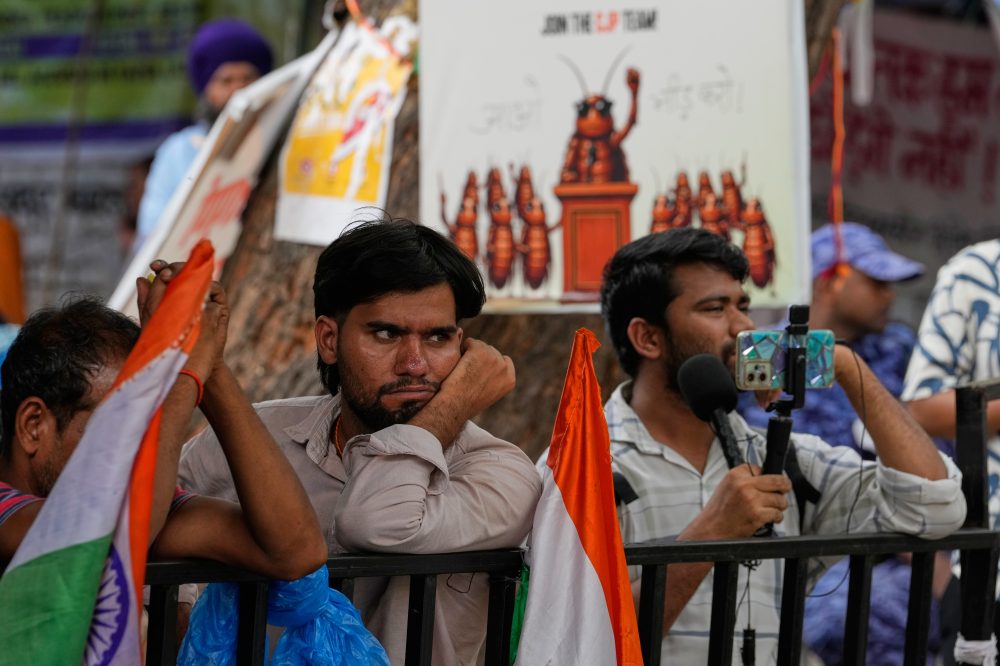

NEW DELHI (AP) — As dawn broke over a protest camp in New Delhi, student demonstrators rolled up their sleeping gear after yet another night outdoors. Inside a tent at the center of the camp, activist Sonam Wangchuk rested, his body visibly weakened after weeks of refusing food.
“If not fasting, what? Riots in the streets? That’s what we don’t want to do. So this is a peaceful way to take your voice to the government,” Wangchuk said one recent afternoon as concerned supporters stopped by to check on him.
At 59 years old, Wangchuk has emerged as an unexpected face of India’s Cockroach Janta Party — a youth-driven movement that exploded onto social media two months ago, fueled by outrage over alleged leaks in the nation’s highly competitive college entrance exams.
Now in its third week of the hunger strike, movement organizers are pushing hard to maintain pressure on Prime Minister Narendra Modi’s government, which they accuse of turning a deaf ear to their calls for the education minister to step down.
“There has been no kind of response from the government. They have left Sonam Wangchuk to die,” said Abhijeet Dipke, a Boston University student who founded the Cockroach Janta Party.
The movement traces its origins to May, when Supreme Court Chief Justice Surya Kant compared certain unemployed young people to “cockroaches” during an unrelated court hearing. Rather than taking offense, supporters adopted the label as a symbol of toughness, transforming it into a satirical political campaign that attracted more than 21 million Instagram followers within just a few days.
The group is demanding the resignation of education minister Dharmendra Pradhan over the alleged exam leaks, along with a complete overhaul of the examination system and financial compensation for families of students who died by suicide — whether connected to the leaks or broader exam pressures.
For countless young Indians, a single entrance exam can determine their entire future, deciding whether they land a government job or gain admission to medical school.
Dipke said the movement’s massive online following has begun translating into real-world action. Since a major demonstration in New Delhi in early June, he said thousands of supporters have shown up at universities and rallies across other Indian cities.
The involvement of Wangchuk, a prominent climate activist, signals that the protest has attracted professionals far outside the education sphere.
The movement is drawing increasingly high-profile attention, with opposition politicians from multiple parties and some Bollywood celebrities visiting the camp or publicly backing the cause in recent days.
Still, physical turnout in New Delhi has been modest compared to the movement’s enormous online presence. Most days, a few hundred people gather at Jantar Mantar for a sit-in, with numbers typically climbing to around 1,000 by evening. Many supporters have endured weeks of monsoon rain, sleeping in tents at the site.
Unlike traditional political parties, Dipke explained, the movement operates without any formal organizational structure. Supporters fund their own travel to New Delhi, where they camp at Jantar Mantar — a designated public protest area surrounded by police barricades. Authorities have made no effort to shut the protest down.
Ajay Zingade, a 33-year-old IT professional, said repeated exam paper leaks drove him to join the protest even though his own student days are long behind him.
“I am just exercising my fundamental right of dissent,” he said.
Organizers say the movement has evolved into a wider push for accountability and a restoration of public trust in institutions — including the judiciary, the political system, and the media — that students feel have let them down.
“The system needs a complete overhaul because the current system is no longer accountable or even taking basic responsibility,” Dipke said.
Despite the ongoing demonstrations, the government has neither entered into negotiations nor publicly responded to the movement’s demands. The education ministry did not reply to questions from the Associated Press.
Senior figures in Modi’s government have largely brushed off the movement. The education minister accused its members of working against the country’s interests, while other government officials argued that although students’ concerns merit attention, there is no obligation for the government to sit down and negotiate with them.
Protest organizers say the government’s continued silence has only strengthened their determination as Wangchuk’s hunger strike presses on.
“In a democracy the government is supposed to listen to the people, to have a dialogue with the people, and more importantly to be answerable to the people. I don’t know why the government isn’t doing that,” Dipke said.
For Wangchuk, the hunger strike is a way to channel public frustration into peaceful civil disobedience.
“It’s to demand accountability, which is important in any government,” he said.
Organizers say they are gearing up to escalate their campaign with a planned march to Parliament on Monday, which Wangchuk described as a way to bring their demands directly before lawmakers.
“We hope that government is sensible enough to reward peaceful ways rather than wait for not-so-peaceful ways,” he said.
Dipke made clear that the movement is prepared to keep up the pressure indefinitely.
“The government was thinking that maybe if they ignore us: These are kids, they will go back home. But I think we have proved that we are here for the long battle, and we are not going to go back home,” he said.