
When Donald Trump lost to Joe Biden in 2020, the very officials he had appointed to oversee the Department of Justice, cybersecurity agencies, and intelligence departments all reached the same conclusion — the election was conducted fairly, without major fraud or foreign interference.
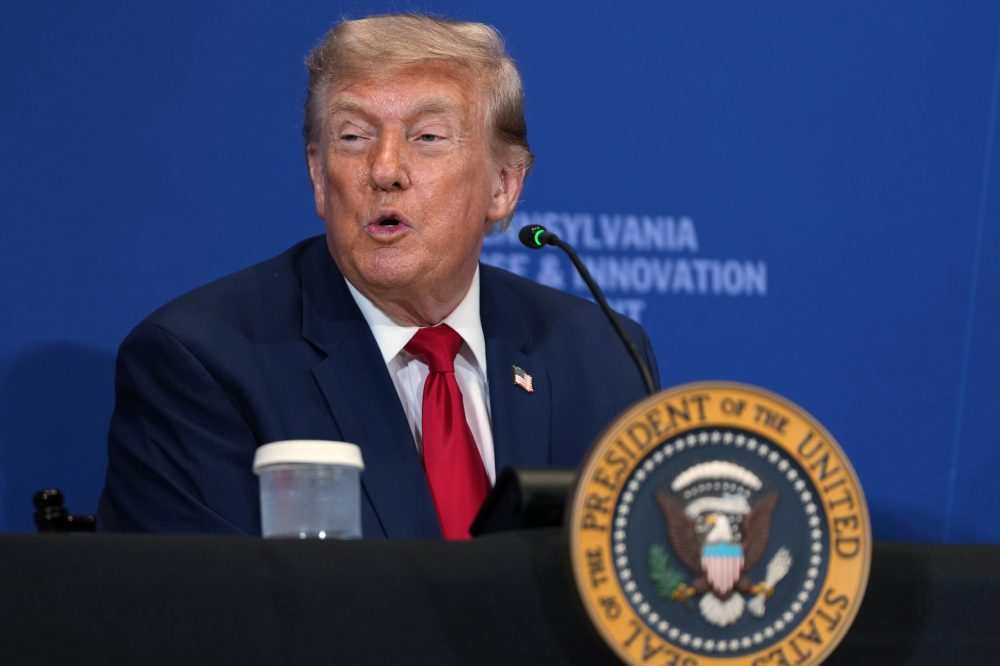
Now in his second term, Trump has been working to use the power of his office to challenge that widely accepted conclusion, and he is expected to take that effort to a national audience Thursday night in a primetime address.
Trump has already surrounded himself with loyalists who have repeated his unsubstantiated claims that the 2020 election was stolen, and he has made clear he expects those around him to fall in line.
The extent to which accepting Trump’s disputed narrative has become a requirement within his administration was on display this week during a Senate confirmation hearing. Many of Trump’s nominees have avoided directly answering who won the 2020 election, instead offering only that Biden assumed the presidency. Jay Clayton, Trump’s pick to serve as the next national intelligence director, followed that same approach during his confirmation hearing Wednesday.
When asked about Biden, Clayton said, “He had the most electoral votes. He was declared the winner.”
Sen. Mark Kelly, an Arizona Democrat, pushed back: “And who has the most electoral votes? Is it the person who wins or the person who loses?”
Clayton replied, “That’s your characterization. I’m not going to continue to do this.”
Trump has also embraced elaborate conspiracy theories claiming that an international network infiltrated American voting machines — theories that have already resulted in defamation lawsuits against those who repeated them publicly.
In the days leading up to his speech, Trump has hinted at “really big news,” saying “it doesn’t get bigger, because without free and fair elections, you don’t have a country.”
Those who study elections are bracing for another wave of misinformation.
Victoria Bassetti of States United, a nonpartisan organization that supports state election officials, warned that the evidence is firmly settled. “There has been six-plus years of consistent findings from the intelligence community and from everyone who’s looked at it that there was no foreign interference in 2020, and our voting systems were secure and accurate,” she said. “I suppose the president could come up with some new assertion or new conclusion. It would fly in the face of all the evidence.”
The 2020 election has been examined extensively. Trump and those backing his claims lost dozens of court challenges — including cases heard by judges Trump himself had appointed. Multiple audits, recounts, and investigations, including those conducted by Republicans, turned up no significant issues with the vote or the counting process.
Trump’s own attorney general at the time, William Barr, stated publicly that there was no evidence of significant fraud, a position that drew Trump’s anger. The official Trump appointed to oversee monitoring of cyberattacks on U.S. election infrastructure, Chris Krebs, declared the 2020 election secure and free of tampering — a statement that led Trump to fire him and, after returning to power in 2025, to call for an investigation into Krebs.
An intelligence assessment finalized on January 7, 2021, during the final days of Trump’s first term and released in the early weeks of the Biden administration, found no evidence of foreign manipulation of vote totals or election equipment. Additionally, Trump himself signed a federal document last year — part of a routine review of potential foreign election interference — that stated “there has been no evidence of a foreign power altering the outcome or vote tabulation in any United States election.”
Since returning to the White House, Trump has launched a new review of the 2020 election. Federal agents have seized voting records from Fulton County, Georgia, which is run by Democrats, and Maricopa County, Arizona, which is run by Republicans — two high-profile counties that were central to 2020 conspiracy theories.
Trump chose Kurt Olsen, a well-known figure in election conspiracy theory circles, to lead the investigation. Olsen was previously sanctioned by the Arizona Supreme Court for making false statements in a lawsuit he filed to contest the 2022 loss of an Arizona governor’s race by one of Trump’s allies.
David Becker, a former Department of Justice attorney who now leads the Center for Election Integrity and Research, was blunt in his assessment. “He has committed untold taxpayer resources,” Becker said. “They’ve found nothing.”
A search warrant affidavit filed in connection with the Fulton County case was reportedly filled with previously debunked conspiracy theories about voting in that county. Hundreds of FBI analysts were reassigned to review the materials.
Despite this, election conspiracy theorists — active since Election Day 2020 — have been speculating that Trump is on the verge of presenting undeniable proof of massive election fraud.
One theory circulating claims that Venezuela, and possibly other nations, manipulated U.S. voting machines to deny Trump a victory. Venezuela’s former president, Nicolas Maduro, is currently awaiting trial in Manhattan on federal drug trafficking charges after being removed from his country’s capital by the U.S. military.
These theories have already cost their promoters dearly in court. Fox News paid $787.5 million to settle a defamation lawsuit stemming from airing those allegations in late 2020. Conservative outlets Newsmax and One America News have also reached settlements with voting machine companies over broadcasting similar claims.
A Denver jury found that Mike Lindell, a prominent election conspiracy theorist whom Trump endorsed this week as a Republican candidate for governor in Minnesota, defamed a voting machine company employee by publicly labeling him a traitor.
Becker described a pattern that has repeated itself over the past six years. Conspiracy theorists, including Trump, make sweeping public accusations — sometimes backed by what appears to be vast amounts of data from complex election databases. But in courtrooms, where claims must be grounded in actual evidence, they have consistently failed.
Becker argued that any new claims from Trump should face the same test. “If someone’s alleging a crime that occurred six years ago, we shouldn’t be responding to their claims,” he said. “We should be demanding they meet the burden of proof.”