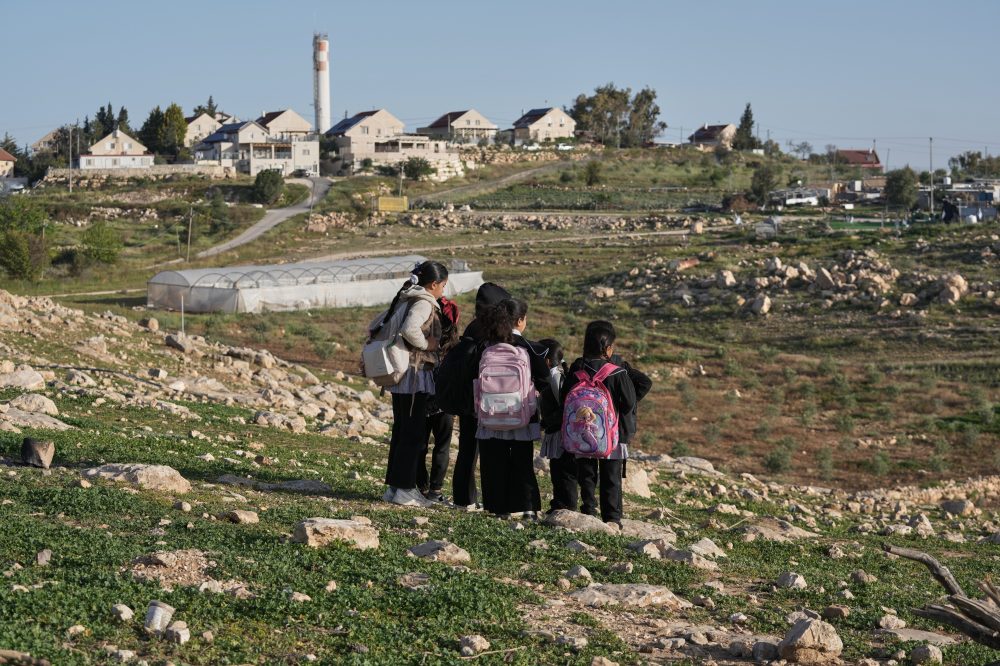

RAMALLAH, West Bank — When Palestinian siblings Hajar and Rashid Hathaleen attempted their familiar walk to school this week, they discovered coiled barbed wire blocking their usual route from their neighborhood to the center of Umm al-Khair village.
Video footage shared with The Associated Press by Palestinian residents shows that Israeli settlers erected the barrier during the night. Local Palestinians describe this improvised barrier as another effort by settlers to expand their influence in this section of the occupied West Bank, where government-supported demolitions, fires, and property damage occur frequently, while settler violence—sometimes deadly—rarely faces legal consequences.
The community’s struggles were featured in the 2024 Academy Award-winning documentary “No Other Land,” though the international attention hasn’t reduced the violence or prevented land seizures. Residents claim Israel has leveraged the Iran conflict to strengthen its control over the area, as settler attacks increase and military forces impose new wartime movement limitations for security reasons.
“It was a good chance for settlers to do what they want, with no rules,” said Khalil Hathaleen, who leads the village council and belongs to the extended family that comprises most of Umm al-Khair’s residents. He explained that settlers have taken advantage of the war to claim territory, destroy olive trees, and conduct nighttime raids on neighboring communities.
Similar to Israeli children, Palestinian students remained home until last week’s ceasefire due to the danger of falling missile fragments, which forced school closures.
On Monday and Tuesday, Hajar, Rashid, and their fellow students gathered near Israeli flags, the wire barrier, and recently cut trees while their families and community leaders insisted they be permitted passage. Video evidence shows that on Monday, the children encountered clouds of tear gas and sound grenades thrown by armed individuals in an unmarked white vehicle, including some in military uniforms.
The Israeli military confirmed troops deployed “riot dispersal means” near Carmel, the settlement adjacent to Umm al-Khair. While acknowledging children’s presence, officials stated the unspecified measures targeted adults in the vicinity, not the students. The Har Hevron Regional Council, which governs local settlements in the region, did not respond to inquiries about the fence.
Residents of the Bedouin community and surrounding villages have traveled the 3-kilometer (1.8-mile) route from Khirbet Umm al-Khair neighborhood to the village center for many decades. “We are determined to keep it,” Khalil Hathaleen declared.
This barrier represents another method of limiting Palestinian movement as Israeli settlements expand throughout the occupied West Bank. Palestinians say it follows a familiar sequence where settlers construct fences or claim agricultural land that Palestinians consider theirs, then work to establish this new arrangement with Israeli military support.
According to Hathaleen, Israeli forces occasionally restrain the settlers, but typically they accommodate settler demands. “We are refused a solution,” he stated.
International consensus widely regards the settlements as illegal. Israel considers the territory disputed and maintains its final status depends on future negotiations. These outposts are constructed without Israeli government approval, which sometimes removes them but often ignores them or even provides retroactive legal recognition.
Hathaleen reported that the military’s civil administration department instructed Umm Al-Khair to redirect students along a different path. However, parents explained the alternative route extends roughly twice the distance and poses greater risks, requiring passage near Carmel settlement.
“We have deep concerns as parents and as residents that the (Israeli) occupation and soldiers will attack students,” expressed Al-Mutasim Hathaleen, another parent.
Tuesday saw some students reach school via buses using the alternative route. However, classrooms remained half-vacant and playgrounds stayed empty. Wednesday brought no classes due to Palestinian Authority salary reductions for area teachers. Khalil Hathaleen announced that Thursday, children will attempt their regular route to school again.
Challenging the settlers’ determination carries potential dangers.
Israeli officials and military commanders have recently raised concerns about escalating violence and lawlessness from extremist settlers in the occupied West Bank, where arson attacks and fatal incidents persist. Israeli soldiers and settlers have killed at least 35 Palestinians across the territory in 2026. Settlers have killed eight Palestinians—matching the entire 2025 total.
Following a settler’s killing of a 23-year-old Palestinian man, Israeli rights organization B’Tselem characterized what it termed “daily unbridled violence” as Israeli government policy, observing that many participants serve as army reservists.
“These militias are fully backed by the state of Israel and enjoy complete impunity for killing, assaulting and looting Palestinian residents,” the organization stated.