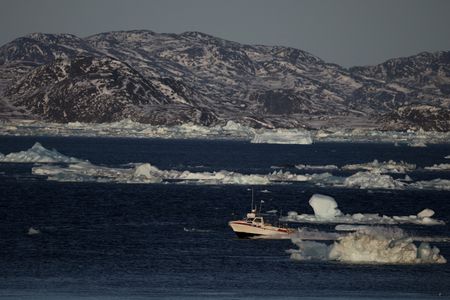

An international team of approximately 80 scientists and crew members departed Britain this week aboard the polar research ship RSS David Attenborough, bound for Greenland on a mission to determine whether the island’s rapidly melting glaciers pose a threat to a critical Atlantic Ocean current system — and by extension, Europe’s climate.
The voyage, lasting between five and six weeks, comes just after Britain and Western Europe experienced their hottest June months ever recorded, a stretch of extreme heat that strained power grids, forced school closures, and contributed to excess deaths across the region.
Kelly Hogan, a marine geophysicist at the British Antarctic Survey, which is leading the expedition, reflected on the urgency of the mission. “The heat waves in the UK and in Europe the last few months have really driven home that it’s difficult for us to adapt to even quite small changes in our climate,” she told Reuters during an interview on board the ship.
The expedition is part of a £20 million initiative known as GIANT — which stands for Greenland Ice sheet to AtlaNtic Tipping points. The project aims to better understand how glaciers break apart and flow into the ocean, and what consequences that process carries for the broader environment.
Researchers are particularly worried that an influx of freshwater from melting glaciers could interfere with a rotating ocean current system that plays a key role in keeping Europe’s climate stable. Disruption to that system could trigger more severe weather events and contribute to rising sea levels.
Ship Captain Matt Neill, who first traveled to Antarctica as a cadet with the British Antarctic Survey back in 2011, said he has personally witnessed the accelerating pace of climate change. “Lots of the glaciers are all receding very very quickly, and much more than you would think… So it’s even more important than ever during these very dynamic times that we are out there and gathering the data and improving the models,” he said.
While the vessel is officially named after the celebrated naturalist David Attenborough, many in Britain know it by a different name — “Boaty McBoatface,” the winning suggestion from a public naming poll held in 2016. That name was ultimately given to a sophisticated submersible aboard the ship, which will dive 1,500 meters beneath the glacier mélange — a dense mixture of sea ice and snow that forms where the glacier meets the ocean — to map its shape and study how it affects glacier behavior.
“It’s going to be collecting a lot of data that’s never really been collected before,” said Sam Smith, an operations engineer at the National Oceanography Centre.
Information gathered throughout the mission will be channeled into the development of next-generation climate models and an early-warning system designed to detect the risk of glacier collapse before it occurs.