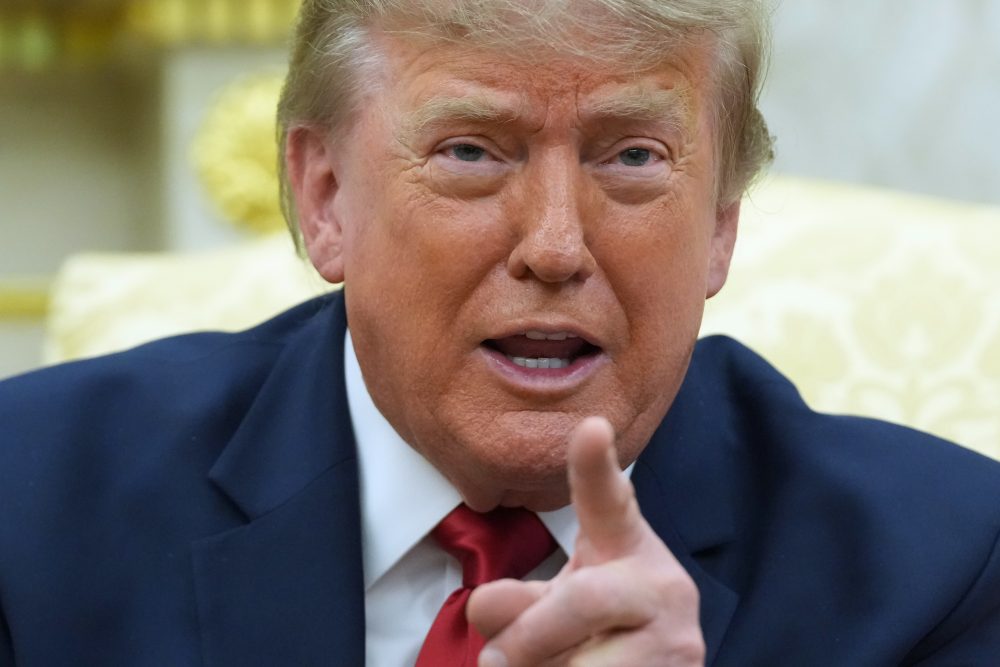

WASHINGTON (AP) — President Donald Trump is preparing to address the nation in a primetime speech this Thursday, and he says elections will be a central topic. The announcement has raised concerns that he may once again revisit long-disproven theories about his 2020 loss to Democrat Joe Biden — all while pressing fellow Republicans to tighten federal voting rules before the upcoming midterm elections.
Trump has kept the specifics of the 9 p.m. Thursday address close to the vest, even as he faces the collapse of a potential deal to end the war with Iran and deals with fallout from recent deadly shootings involving Immigration and Customs Enforcement officers. When reporters asked him Tuesday for a preview, Trump gave little away but teased that he has “really big news.”
“It doesn’t get bigger, because without free and fair elections, you don’t have a country,” Trump said from the Oval Office. He declined to elaborate, saying he wanted to “save it” for the speech itself, though he did hint the address would cover a range of subjects.
“We’ll be discussing other things, too,” Trump added. “It’s going to be a very big announcement.”
Trump has previously used the prestige of a primetime presidential address — a format usually reserved for major national milestones — for politically charged messages. One such speech in December blamed Democrats for difficult economic conditions. Thursday’s address, however, appears set to go further, using the national platform to amplify disputed election claims in front of a massive audience ahead of midterms that could significantly limit Trump’s power for the rest of his term.
On Monday, Trump revived unfounded allegations of voter fraud in the Los Angeles mayoral primary. During an interview with conservative outlet Newsmax, Trump claimed Republican Spencer Pratt lost his primary bid due to fraud, pointing partly to California’s slow vote-counting process.
Federal prosecutors announced last month that they were launching fraud investigations in the state after Trump drew public attention to those allegations.
Trump’s fixation on voting fraud goes back at least to 2016, when he declined to commit to accepting the outcome of the election against Democrat Hillary Clinton. After his victory, he formed a voting integrity commission intended to back his claim that widespread fraud had cost him the popular vote — but that commission dissolved without finding any supporting evidence.
Following his 2020 defeat to Biden, Trump again cried foul, zeroing in on Biden’s slim margin of victory in Georgia. Trump personally called the state’s secretary of state and pressured him to “find 11,780 votes” — precisely the number needed to flip Georgia’s result. Trump and more than a dozen allies were subsequently indicted in the state, though those charges were later dropped.
Numerous audits and reviews — many conducted by Republicans, including Trump’s own attorney general at the time — concluded that no significant fraud took place in the 2020 election.
Even before his 2024 victory, Trump had been laying the groundwork to allege cheating if he lost again. Once back in office, he filled his administration with officials who support his false claims about 2020 election fraud.
Repeatedly insisting he has won the White House “three times,” Trump has made voting regulations a signature issue of his second term. He has called for legislation requiring voter ID and drastically curtailing mail-in voting. With midterm races approaching that will determine control of Capitol Hill, Trump has been stoking new doubts about election integrity in a bid to protect his political standing in Washington.
Earlier this year, FBI agents raided elections offices in Fulton County, Georgia, seizing materials related to the 2020 election. Tulsi Gabbard, who was serving at the time as Trump’s director of national intelligence, traveled to Atlanta to oversee the search warrant’s execution.
Maryland Gov. Wes Moore, who was in Georgia campaigning for Democratic Sen. Jon Ossoff and gubernatorial candidate Keisha Lance Bottoms, reacted with a smile Tuesday when asked about Trump potentially relitigating the 2020 election during a national address.
He described the strategy as one “for losers.”
“I think people are exhausted by having conversations about elections that happened six years ago, that we have the answer to,” Moore said. “He continues to bring this up because he cannot get out of his mind that he actually could have lost.”
Trump has also set his sights well beyond Georgia, targeting states that allow mail-in voting broadly. He said he personally called a U.S. attorney in California and demanded scrutiny of last month’s governor’s primary as ballots were still being counted.
Last week, Trump removed the remaining members of the federal Election Assistance Commission, a bipartisan body that had pushed back on his efforts to require proof of U.S. citizenship from voters before they could register.