
VIENNA (AP) — The renowned coffee shops of Vienna have welcomed the Eurovision Song Contest with open arms. However, they’ve also felt the impact of controversy surrounding Israel’s participation in the glittering pop music event.
Officials initially excluded Israel when they announced their list of “Eurofan Cafes” — Vienna establishments serving dishes and music from participating nations.
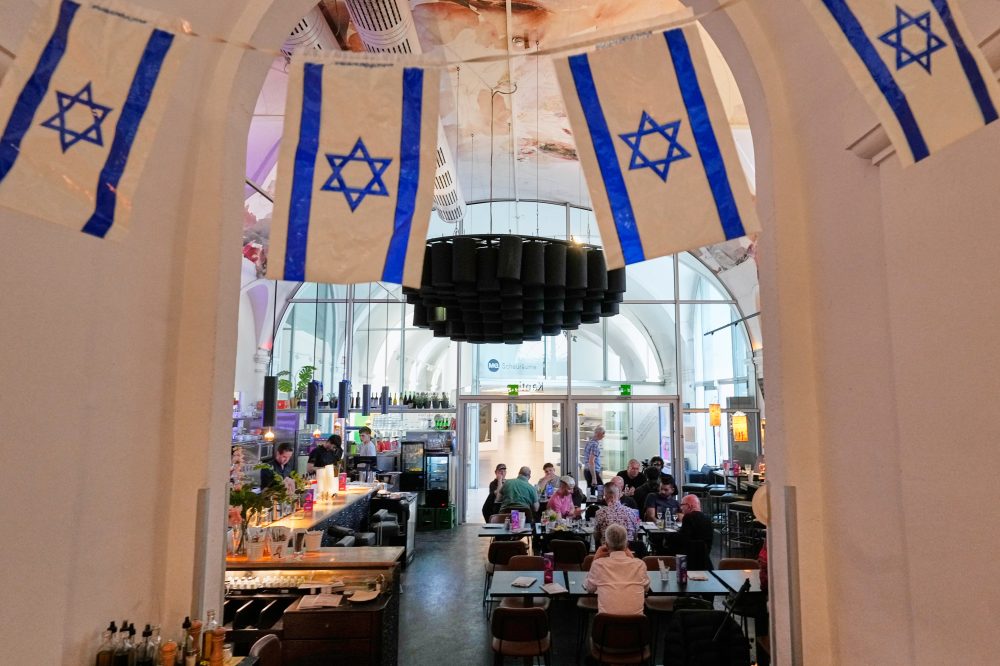
MQ Kantine, a contemporary café located in the city’s artistic museum district, volunteered to fill the gap. The establishment now features falafel, bagels with lox and kosher wine on its menu, small Israeli flags strung across the ceiling — and a police officer stationed at the entrance.
Heavy security measures are in place throughout Vienna during the international music competition, whose “United by Music” theme feels somewhat empty this year. Five nations are refusing to participate due to Israel’s involvement. Pro-Palestinian activists have organized a protest concert — among multiple Eurovision alternative events happening across Europe — and plan an anti-Israel demonstration before Saturday’s grand finale.
At MQ Kantine, volunteers rotate shifts watching for possible problems. However, the atmosphere has remained welcoming so far, according to Daniel Kapp, a PR consultant and pro-Israel advocate.
“It’s beautiful,” he said, watching patrons enjoy coffee and beer on the café’s outdoor seating area in the warm spring weather, though he acknowledged that the police presence indicates things are “not entirely normal.”
“My feeling is that Austria to a certain degree has learned from its history,” Kapp said, referencing the lethal antisemitism during Nazi rule before and throughout World War II. “Which is why the support for Israel is a lot more normal than it is in other countries.”
Israel has participated in Eurovision for over five decades, claiming victory four times. However, its involvement has faced opposition since launching military action in Gaza following the Hamas-led cross-border assault on Oct. 7, 2023, which killed 1,200 people. Over 73,000 Palestinians have died since the conflict started, according to the territory’s Health Ministry, which functions under Hamas control and maintains detailed records generally considered reliable by the international community.
Israel’s government has consistently justified its military campaign as retaliation for the Oct. 7 assault. However, several experts, including those appointed by a United Nations organization, have characterized Israel’s Gaza offensive as genocide. Israel, which is home to numerous Holocaust survivors and their families, has strongly rejected this accusation.
Recent Israel-Hezbollah conflicts in Lebanon and the U.S.-Israeli confrontation with Iran have escalated tensions further.
The 2024 Eurovision event in Malmo, Sweden, and the previous year’s competition in Basel, Switzerland, witnessed pro-Palestinian demonstrations demanding Israel’s exclusion. Five nations — Iceland, Ireland, the Netherlands, Slovenia and Spain — withdrew from the 2026 contest after organizers permitted Israel to participate.
These conflicts have created a divided Eurovision experience. A celebratory party environment exists within the Wiener Stadthalle arena and the separate Eurovision Village fan area. However, entry requires navigating extensive security, including searches, scanners and a complete bag prohibition inside the venue. Armed officers maintain a highly visible street presence.
Concern about potential terrorist threats remains elevated in the city following a 21-year-old Austrian man’s guilty plea for planning to attack a Taylor Swift concert in Vienna in 2024, after allegedly swearing loyalty to the Islamic State group.
Israeli performer Noam Bettan informed Israeli media that, similar to last year’s Israeli representative Yuval Raphael, he rehearsed performing while facing hostile crowds. Occasional shouts mixed with applause when he performed during Tuesday’s first Eurovision semifinal. He earned a place in Saturday’s finale by ranking among the top 10 in combined viewer and national jury voting.
Contest organizers reported removing four individuals from the 10,000-person audience for disruptive conduct.
Austrian Eurovision enthusiast Ivo Herzl, who attended the semifinal, described “the vibe was incredibly positive.” He demonstrates Israel support by creating and selling Mazel Lov T-shirts — a wordplay on “mazel tov,” a Hebrew and Yiddish congratulatory expression.
“Vienna has always been a city of tolerance,” Herzl said. “It’s the city of music and we’ll always do everything possible for everyone to enjoy a musical event.”
Some Israeli supporters expressed comfort with the extensive security measures. Oz Yona, experiencing his first Eurovision, reported encountering “no hate” and felt Austria addresses antisemitism seriously.
He attended with friends to support Israel, though he remained pessimistic about Bettan’s prospects — for artistic rather than political considerations.
“I don’t think he will win,” Yona said. “Finland is better this year. Greece is better this year. We have a good song, but not a winning song.”
Birgitta Peterson and Kristina Nilsson, wearing coordinated pink bomber jackets and calling themselves The Swedish Ladies, enjoy discovering new cities and reuniting annually with their “Eurovision family” of fellow supporters. They intend to display Israeli flags during Saturday’s finale, after Swedish participant Felicia stated earlier this year that she questioned Israel’s contest participation.
They describe how Israel-related tensions have split a fan community historically recognized for its welcoming nature and celebration of diversity.
“The wounds are very deep at the moment,” Nilsson said.
“This event should really be about ‘united by music’ and happiness,” she added. “That’s what Eurovision is all about.”