
PUNTLAND, Somalia — Abdi Ahmed Farah has watched most of his hundreds of goats perish. The 70-year-old herder never imagined his region of Somalia could go three years without consistent rainfall.
Water purchases have left him drowning in debt. The water reservoir beside his tent sits nearly dry. His family survives on just one daily meal of rice mixed with sugar and oil. His newborn, the youngest of 22 children born just three weeks ago, receives only sporadic drops of breast milk from his wife.
“I have considered abandoning my family because I cannot provide for them,” Farah stated, positioned protectively near his dwindling food reserves.
Another devastating drought has struck millions across Somalia, a nation ranked among the globe’s most susceptible to climate disasters. Rivers have run dry while harvests have failed. Climate experts believe this drought may rank as the most severe in the country’s recorded history.
The emergency has worsened due to reduced aid contributions, particularly steep cuts from the Trump administration, alongside escalating costs from the Iran war. Somalia imports the majority of its fuel from Middle Eastern nations and relies on foreign sources for 70% of its food supply.
Maize and sorghum production during the October-December rainy period hit record lows in Somalia, the U.N. Food and Agriculture Organization reported.
Nutrition specialists caution that close to half a million children could experience severe acute malnutrition, the most dangerous form. This figure would exceed the number of children needing treatment during the 2011 and 2022 droughts, UNICEF data shows.
“2026 is the worst year on record for Somalia in terms of drought,” stated Hameed Nuru, the U.N. World Food Program director for Somalia. “Children have started dying.”
Government officials and United Nations representatives calculate that 6.5 million residents confront emergency hunger levels, accounting for one-third of the nation’s population and marking a 25% jump since January.
Relief organizations work to stretch available resources while the Somali diaspora sends financial assistance home, though humanitarian officials caution these efforts fall short of meeting needs.
“This drought is not just another cycle of dry season. It’s a repeated climate shock with shrinking humanitarian support,” explained Mohamed Assair, a manager with Save the Children in Puntland, a semi-autonomous region.
Farah’s herd once numbered 680 goats, but inadequate food and water combined with drought-related diseases have killed all except 110 animals, which barely survive.
“There is no market for my goats because they are so thin. Previously we would trade them for rice, but now we can’t,” he explained. Farah’s family established camp near Usgure village ten days earlier. Nearly a dozen goat carcasses scatter the surrounding area.
In Usgure, housing 700 families, community leader Abshir Hirsi Ali described the local economy’s collapse due to dependence on herders like Farah. Businesses have shuttered while food supplies have diminished.
A brief recent rainfall created puddles of contaminated water. “Some families were so desperate they drank it … now there is a high number of people with fever,” Ali reported.
Save the Children occasionally delivers free water to Usgure, though commercial water delivery services have increased prices fourfold and a 50-kilogram bag of flour now costs $40, representing a one-third price increase.
“I’m not only afraid for my family but the future of the whole village,” said Muhubo Tahir Omar, a 47-year-old mother of 11 children.
Omar, like other parents, sold her livestock to cover educational expenses, “but when we didn’t pay, the teachers left.” Her remaining goat has fallen ill.
Decades of warfare in Somalia have forced millions from their homes. The current drought has displaced an additional 200,000 people this year, U.N. estimates indicate.
Families traverse difficult terrain carrying minimal provisions.
“People are on the move … and when people move, people die,” noted Kevin Mackey, the Somalia director for humanitarian group World Vision. He recently encountered people who traveled nine days on foot to reach assistance in southern Dollow.
Approximately 80 families reside in a displacement camp near Shahda village in Puntland.
Shukri, a 20-year-old mother of four, typically manages one daily meal from charitable donations. Currently no food remains available and clean water access is restricted.
“The children got diarrhea (from dirty water) and malnourishment worsened,” said Shukri, who provided only her first name. “I know a few people who have died.”
Many migrate to Mogadishu, the capital, where food remains scarce.
Fadumo, a 45-year-old mother of seven, relocated there from Lower Shabelle, where al-Qaida-linked al-Shabab militants already threatened livelihoods.
“The water sources we depended on for farming, including the river, dried up,” Fadumo said. “Conflict made our situation even worse, forcing us to flee.”
Drought devastated Somalia in 2022 with an estimated 36,000 deaths, the U.N. reported. Now the emergency assistance previously mobilized for such crises has diminished.
“Unless there is a sudden and substantial response from donors, the outlook is deeply concerning. A drought of similar severity in 2022 received a response five times greater than what we are seeing,” said Antoine Grand, head of the International Committee of the Red Cross in Somalia.
Aid funding to Somalia declined to $531 million in 2025 primarily due to reduced contributions from the United States, which previously served as Somalia’s largest donor. In 2022, aid funding totaled nearly five times more at $2.38 billion.
WFP planned to assist 2 million people with food aid this year but has reached only 300,000 due to funding shortfalls.
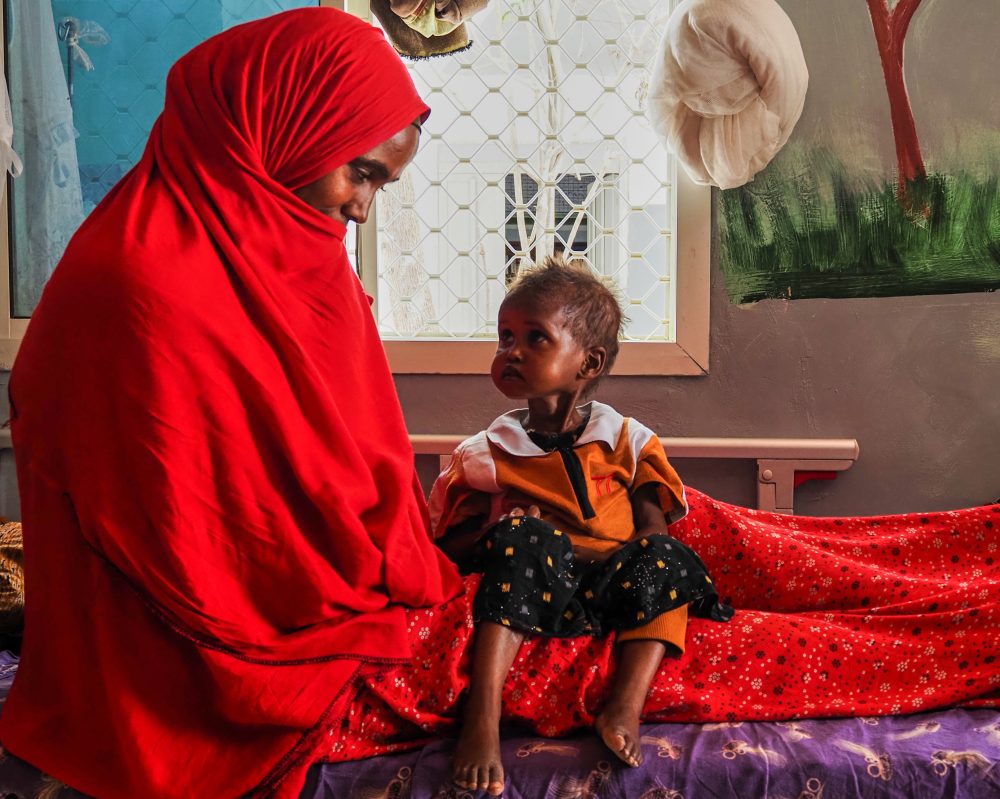
A treatment center at the hospital in Qardho, Puntland, cares for children with severe acute malnutrition. However, therapeutic milk supplies have become scarce, forcing nurses to use homemade substitutes like cow’s milk, director Shamis Abdirahman explained.
The facility receives approximately 15 children monthly, though staff anticipate increases as displaced populations arrive.
Four-year-old Farhia weighs only 7.5 kilograms. Her eyes appear sunken while her bones show prominently beneath her skin.
Her family fled to Qardho after all their goats died, her mother Najma explained.
“I don’t know what to hope for, or see how we can get back to what we had,” she said.