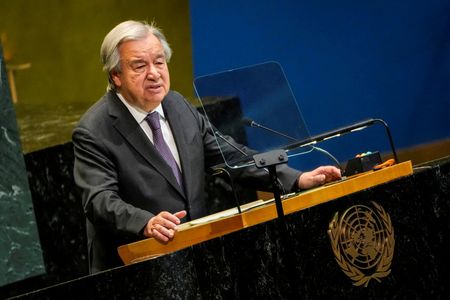

United Nations Secretary-General Antonio Guterres kicked off a new diplomatic push on Tuesday, traveling to Cyprus in hopes of persuading its two divided communities to return to peace negotiations after almost ten years of stagnation.
This marks Guterres’ first trip to the island in his role as U.N. chief. While there are some encouraging signs that both sides may be open to resuming talks, the two communities remain at odds over the basic conditions under which those negotiations would take place. A continued failure to reach an agreement would deepen tensions between NATO member nations Greece and Turkey, and further complicate Turkey’s relationship with the European Union.
Guterres, whose term as U.N. Secretary-General ends in late 2026, held separate meetings Tuesday with Greek Cypriot leader Nikos Christodoulides and Turkish Cypriot leader Tufan Erhurman. All three are scheduled to sit down together Wednesday in the U.N.-administered buffer zone that runs through the middle of the island.
Reports from Cypriot media suggest the United Nations has put together a set of proposals designed to help bridge the gap between the two sides, though U.N. officials have pushed back on the idea that any finished plan is in place.
Christodoulides has expressed a desire to pick up where talks broke down in 2017, operating under a U.N.-supported framework that would create a bizonal, bicommunal federation on the island.
Erhurman, who won election as the Turkish Cypriot leader last year, ran his campaign on the idea of exploring a federal solution — a significant shift from his predecessor, who had insisted on a two-state arrangement. That said, Erhurman has made clear he will not participate in another open-ended process without first reaching agreement on political equality and the rules that would guide any negotiations.
The island was divided in 1974 when Turkey launched a military invasion following a brief coup orchestrated by the Greek military junta that was in power at the time. Under a treaty that granted the former British colony independence in 1960, Britain, Greece, and Turkey all hold status as so-called “guarantor powers,” each with the right to intervene.
A shared Greek and Turkish Cypriot governing arrangement collapsed in 1963, and the United Nations deployed a peacekeeping force the following year. That mission is now among the longest-running peacekeeping operations in the world, with troops monitoring a 180-kilometer, or roughly 112-mile, ceasefire line separating the two sides.
The southern portion of the island is governed by an internationally recognized Greek Cypriot administration that represents Cyprus as a whole within the European Union — a body whose rotating presidency it held in early 2026. The northern part is controlled by a breakaway Turkish Cypriot state that only Turkey recognizes.
A major sticking point in previous rounds of negotiations has been disagreement over what role Turkey would have in any post-settlement arrangement. Greek Cypriots strongly oppose any direct Turkish involvement, while Turkish Cypriots argue that Turkey’s participation is non-negotiable.
Turkey’s official position continues to be that Cyprus should be divided into two separate states, a stance that both Greek Cypriots and Greece firmly reject.