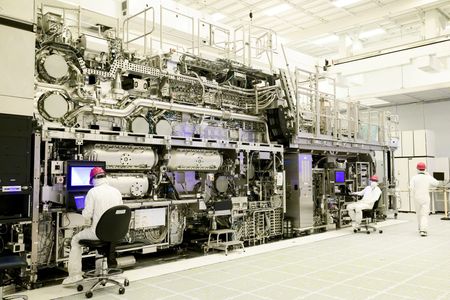

China has taken a major step in its push for semiconductor independence, beginning mass production of domestically developed immersion deep-ultraviolet, or DUV, lithography machines — a technology that sits at the heart of advanced chip manufacturing, according to a source familiar with the situation.
A little-known Chinese state-owned company called Shanghai Aishengna Electronic Technology Group is spearheading the production effort. The source, who asked not to be identified given the sensitivity of the matter, said the company has brought together teams from leading Chinese lithography startups to carry out the work.
The move is being seen as a victory for President Xi Jinping’s national initiative to make China self-sufficient in semiconductor technology — one of his top priorities. However, analysts do not expect it to immediately threaten the business of Dutch industry giant ASML, which has long dominated the DUV market.
Tech industry publication The Information first reported on Monday that an unidentified state-backed Shanghai company had started building the machines, with plans to produce roughly five units this year and around 20 by 2027. This report is the first to name Aishengna as the company behind the effort.
According to the source, Aishengna’s DUV machine still requires additional testing and currently falls well short of matching ASML’s comparable models. That said, if successfully deployed, the Chinese-made equipment would give domestic chipmakers an alternative supply of tools should Western governments tighten export restrictions or limit the servicing of foreign lithography equipment.
The Information, citing two people with knowledge of the matter, reported that the Chinese-built DUV machines are expected to be delivered this year to major Chinese chipmakers including Semiconductor Manufacturing International Corp, Hua Hong Semiconductor, and memory chip producer ChangXin Memory Technologies.
ASML’s stock dropped more than 8% on Monday. The company did not immediately respond to a request for comment. Semiconductor Manufacturing International Corp, Hua Hong, and ChangXin Memory Technologies also did not reply to comment requests.
Corporate records show Aishengna was founded in August 2023 with registered capital of 7 billion yuan — roughly $1 billion — and is backed by two state-owned shareholders: Shanghai Electric Holding and a subsidiary of Shanghai International Trust. The company has no public website and has made no public disclosures about its operations.
The source said Aishengna has absorbed teams from lithography startup Yuliangsheng, which had been testing a DUV prototype last year, as well as from Shanghai Micro Electronics Equipment, known as SMEE. Yuliangsheng is an affiliate of a Huawei-backed equipment manufacturer called SiCarrier. Both SMEE and Yuliangsheng are deeply involved in China’s broader semiconductor self-sufficiency push. Corporate and recruitment records indicate that Aishengna and Yuliangsheng share the same Shanghai address.
None of the companies — Aishengna, its shareholders, SMEE, or Yuliangsheng — responded to requests for comment.
China has been blocked by the United States from purchasing ASML’s most cutting-edge extreme-ultraviolet, or EUV, lithography systems. Dutch export controls have also limited China’s access to certain advanced DUV machines.
Immersion DUV machines work by placing a thin layer of water between the projection lens and a silicon wafer, allowing for the printing of smaller circuit patterns compared to conventional dry systems. These machines are used to produce a wide variety of chips and can be adapted to manufacture more advanced semiconductors through a technique called multiple patterning, which involves exposing the same layer repeatedly.
Reuters previously reported in December, citing sources, that China had successfully built a prototype EUV system — the type of machine used to produce the world’s most advanced chips — though that technology remains years away from full production.