
KHARKIV, Ukraine (AP) — An agricultural business owner in Ukraine who established a volunteer military unit with just 30 members during the early stages of Russia’s invasion wasn’t sure he’d survive to witness its growth — but both he and his force endured.
That small group has since expanded into a 40,000-member corps recognized as among Ukraine’s most capable fighting units within the official defense structure.
“Ukraine needs to have an effective modern army. And this is our number one guarantee of the country’s security,” said Vsevolod Kozhemyako, who owns a major agricultural business and now serves as an adviser to the Khartiia Corps Commander.
This dramatic growth illustrates a wider change happening throughout Ukraine’s armed forces, as new formations like the Third Army and Azov Corps emerge, moving away from Soviet-era methods that soldiers have long criticized.
While discussions about potential peace agreements remain stalled and international focus turns toward Middle Eastern conflicts, Ukraine continues pursuing solid security assurances from allies, especially the United States.
However, many Ukrainians have reached a different understanding through this war: their nation’s best protection may come from their own military forces.
“We have kids, we have grandkids, and we will stay on this territory,” Kozhemyako said. “The future of this country depends on us.”
Following the Soviet Union’s collapse, Ukraine received a substantial military and weapons stockpile. However, by 2014, Russia’s seizure of Crimea and armed conflicts in eastern regions revealed serious weaknesses from insufficient funding, corruption and strategic confusion, leading to volunteer recruitment and overdue military changes.
These reforms helped Ukraine resist the 2022 invasion, but as fighting continued, some fundamental issues — inflexible top-down command, overwhelming bureaucracy and a culture of concealing problems due to fear of retaliation — started returning, affecting battlefield performance.
Kozhemyako explained that his unit needed to follow a different approach from the beginning. As an active military member since 2014 surrounded by veterans, he recognized the regular army’s limitations.
“They didn’t want to join the post-Soviet army, but they wanted to fight,” Kozhemyako recalled.
Most were civilians with business backgrounds, he explained. They contributed their leadership experience and aimed to create an organization that encouraged initiative.
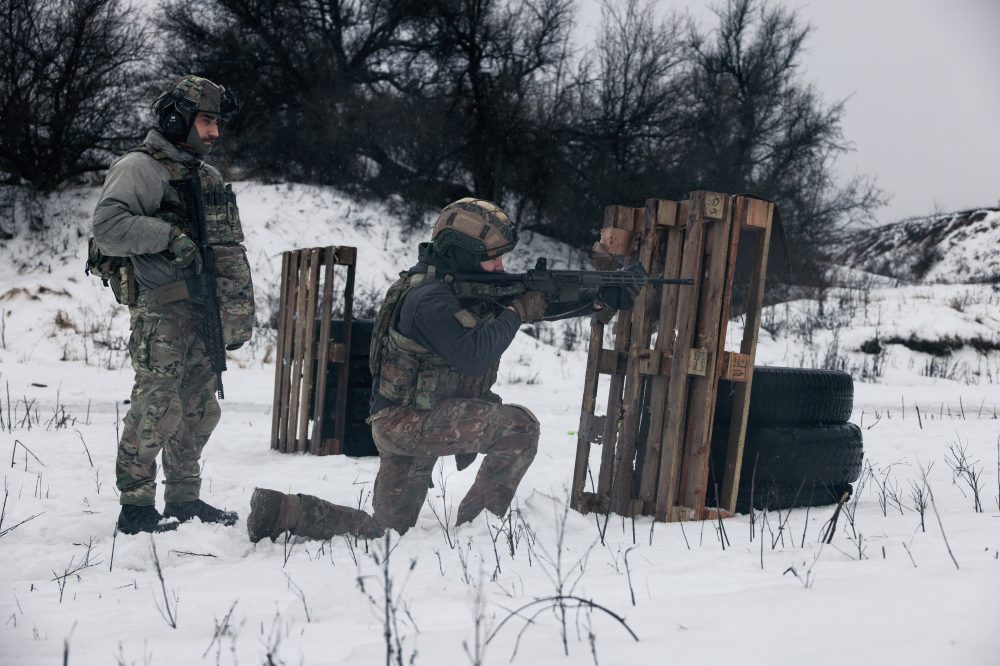
The process started with learning and implementing U.S. Army planning techniques, merging them with combat experience and adjusting as warfare developed. The unit adopted Western procedures including Troop Leading Procedures (TLP) and After Action Reviews (AAR), using internal specialists to improve these methods.
TLP enable smaller units to organize operations more quickly, which proves essential for taking advantage of brief battlefield opportunities. AAR encourage soldiers to analyze events, causes and improvements, a system the corps has applied especially thoroughly to its rapidly advancing technology use.
Khartiia’s emphasis on quickly advancing technologies has attracted international notice. In a Military Review article, the U.S. Army’s professional publication, Maj. Gen. Curtis Taylor highlighted Khartiia’s December 2024 drone operation near Kharkiv as a significant milestone — the first completely robotic attack against Russian positions. For the U.S. Army, he suggested, this represented a signal to reconsider how its armored units must change to survive modern warfare.
This technology now forms part of routine operations. A 23-year-old platoon leader transferred to Khartiia from a standard unit received responsibility for ground robotic systems regularly used for supply transport and evacuation.
He and other soldiers interviewed for this report requested anonymity following Ukrainian military guidelines, though higher-ranking officials may speak publicly.
The soldier noted how little attention was given to strict formalities that characterized his previous unit — from rigid uniform requirements to repetitive procedures unconnected to combat.
“People understand why we are here, and they don’t overload us with unnecessary tasks,” he said, having just walked through the military position wearing blue plush house slippers.
He also described a different command relationship, contrasting it with the rigid structure he previously experienced, where punishment fears often discouraged honest communication.
“When officers look at you from above, like in rear units, they become almost like enemies to you,” he said. “In Khartiia, relationships are different. When you go on a mission, you trust the people giving you orders.”
These changes have produced concrete battlefield results. In December 2025, the Khartiia Corps spearheaded a counteroffensive in the Kupiansk area, freeing several villages north of the city and advancing to the Oskil River. The Institute for the Study of War reported that capturing Kupiansk had been a Russian objective since mid-2025, but despite extended efforts, Russian forces couldn’t achieve major progress there.
The Khartiia Corps has experienced no significant defeats and hasn’t disclosed casualty numbers, following standard practice for both warring sides.
The Washington-based research organization concluded in December that the operation showed Ukrainian forces can still “conduct successful counterattacks and make tactically significant gains, particularly when Russian forces are overstretched.”
Operating mainly through independent recruitment and fundraising, the corps has developed a professional human resources system and strong reputation, actively utilizing YouTube and social media, collaborating with public personalities and simplifying online donations.
A Ukrainian military officer handling public outreach for a Ground Forces unit explained that the Third Army Corps, followed by Khartiia, became pioneers in this area whose strategies others carefully examine when developing their own. These two corps were among the first to establish their own identities, something now crucial for the army facing constant recruitment needs.
“The approaches that work in the commercial sphere translate perfectly here — only you are competing not for profit, but for people, equipment and attention of the volunteers,” he said.
Entering one of Khartiia’s underground command centers feels more like visiting a gaming facility than a military headquarters. However, instead of video games, numerous large screens mounted across walls display live reconnaissance video from Ukraine’s Kharkiv region front lines. Supervising everything is a former bodybuilding instructor who advanced from soldier to senior officer, wearing a Khartiia sweatshirt with an energy drink beside his keyboard.
“One of our secrets is that we don’t spare people during training — we train them constantly,” he said. “But during combat, it’s the opposite. People come first. We don’t save drones or equipment at the expense of our people.”
This philosophy is something Khartiia now attempts to spread by creating direct partnerships with units sharing similar approaches.
The Khartiia and 3rd Army Corps recently established a joint training program, sharing resources and knowledge to develop unified fighting methods.
For the commanders, who are also front-line neighbors, the reasoning is practical: after months of exchanging strategies, both units identified the same critical weakness in the broader army — an urgent need to reform basic combat training for soldiers, sergeants and junior officers.
Ihor Obolienskyi, commander of the Khartiia Corps, calculated that approximately 300,000 troops currently serve along the front line, with the two corps representing roughly 80,000 — sufficient, he said, to create significant military change, even though reform remains challenging in what he called an inherently resistant system.
Leaders from other units have already contacted the corps to study their model, indicating growing military demand for change.
Still, whether senior command will abandon its Soviet heritage remains uncertain.
“We want to give a tool to the General Staff,” said Andrii Biletskyi, the commander of 3rd Army Corps, during a joint briefing. “Whether they accept it or not — that is their decision.”