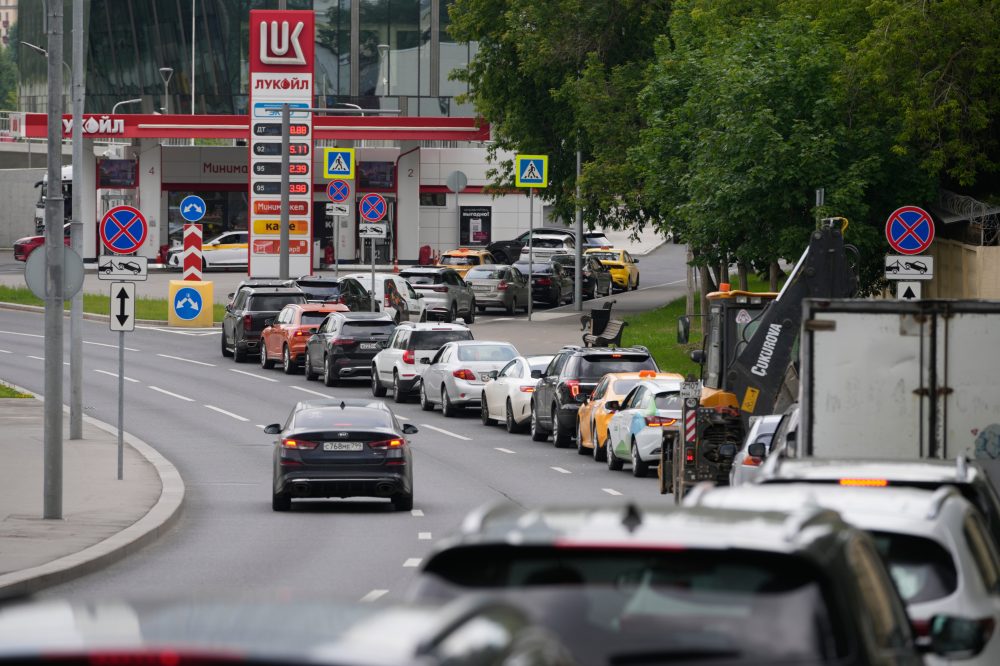

Frustration is mounting at gas stations across Russia as months of Ukrainian drone strikes against oil refineries have ignited fires, disrupted production, and left drivers waiting in lines that stretch for hours along roadsides.
Fuel rationing has been put in place across many parts of the country, with videos circulating on social media showing angry drivers confronting empty pumps and sticker shock at rising prices. The situation grew so dire in the Siberian city of Irkutsk that the mayor ordered portable toilets placed outside gas stations to serve those stuck waiting in line.
For a nation that ranks among the world’s top energy producers, the crisis is without precedent — and it has brought the reality of Russia’s ongoing war against Ukraine home to everyday citizens in a way few other developments in the now five-year conflict have managed.
The situation prompted an unusual public acknowledgment from President Vladimir Putin, who admitted that “problems persist for both motorists and businesses” and that “there are still queues at petrol stations, and finding the right grade of petrol isn’t always easy.”
Putin maintained that the shortages are “not critical” and “temporary,” but that message appeared to offer little comfort to at least one Moscow driver waiting in line. Even the Russian capital — typically shielded from economic hardships more than the rest of the country — has not been spared.
“I think the situation is not very good,” the motorist told The Associated Press on Monday, the day following Putin’s televised comments. “They say one thing on television, and in reality it’s another. … People are queueing everywhere,” the man added, choosing not to give his name due to safety concerns.
A tally by the AP identified more than 50 reported Ukrainian strikes on Russian oil refineries, fuel depots, terminals, and related infrastructure — including on the illegally annexed Crimean Peninsula — since late March. Some facilities have been hit repeatedly; a refinery in the Black Sea town of Tuapse was struck four separate times in just over two weeks.
The cumulative damage has taken a serious toll on Russian fuel output. In June, Russia processed crude oil at a rate of 3.95 million barrels per day — a 25% drop compared to the same period a year earlier and the lowest level in more than two decades, according to Gary Peach, an oil markets analyst at Energy Intelligence. “The outages are extraordinary,” he said.
Gasoline production has dropped 17%, falling from 1.03 million barrels per day to 850,000 — well below what Russia needs to meet domestic demand. The country exports very little of its gasoline supply.
Roughly one-third of Russia’s oil refining capacity is currently out of service, according to Chris Weafer, CEO of Macro-Advisory Ltd. Consultancy. He noted that because refineries do not publicly disclose the full extent of damage, his estimate is based on industry sources and anecdotal reports.
“It comes at a very critical time for the Russian economy, in that the agriculture season, particularly the harvest season, is now starting to ratchet up,” driving demand even higher, Weafer said.
Ukrainian officials have characterized the strikes as part of a deliberate strategy to pressure Moscow into ending the war by disrupting military logistics, cutting supply lines, and weakening Russia’s ability to launch attacks along the front lines. Kyiv has also specifically targeted Crimea, seized from Ukraine in 2014 in a move that most of the world does not recognize. Earlier strikes forced authorities in Crimea to implement fuel rationing in May and eventually halt civilian sales altogether for several weeks, before limited sales later resumed in the city of Sevastopol.
Ukraine has also launched significant drone attacks on Russia’s two largest cities. A June 3 strike on an oil terminal in St. Petersburg sent thick black smoke into the sky just as Putin was preparing to host his annual economic forum aimed at drawing foreign investment. On June 18, a similar dark cloud rose from the Moscow Oil Refinery on the edge of the capital, with oily black droplets reported falling in the area.
By late June, some form of fuel rationing had been reported in more than half of Russia’s regions. Some areas placed hard limits on all gas stations, while others saw fuel chains cap how much a driver could purchase at one time.
Government officials blamed hoarding and panic-buying, urging drivers to refuel only when necessary. Gasoline and aviation fuel exports have been restricted, and authorities were also weighing a ban on diesel exports. The possibility of importing fuel was under consideration, with Kremlin spokesman Dmitry Peskov saying talks with certain countries were “underway” — a step he described as “aimed at reducing panic-buying.”
The shortages have spread to distant Russian regions where no drone attacks have occurred. Viktor Shkurenko, a retail store owner in the Omsk region, called a newly announced limit of 40 liters — roughly 10.5 gallons — per vehicle “unexpected.”
“Nothing was bombed here. We have the biggest oil refinery in Siberia right here, and it gave us confidence that this fuel crisis won’t come to us,” he said, voicing concern about the potential impact on his businesses. As of Saturday, however, he said his company had not yet experienced any difficulty refueling its vehicles.
In the Siberian region of Zabayakalye, east of Lake Baikal, media reports indicated that a garbage collection service suspended pickups and some bus routes were reduced. Beyond ordering portable toilets at gas stations, the city of Irkutsk also raised public transit fares as of Wednesday, citing increased fuel costs.
Pavel Kharitonenko, acting head of the Irkutsk branch of the opposition Yabloko party, told AP he has found it easier to simply walk or take public transportation. “I don’t have the fuel, and I don’t want to queue at gas stations,” he said. He noted that the Irkutsk region, which is home to a Rosneft oil refinery, has been experiencing severe shortages for several days with lines continuing to grow.
Putin stated that Russia’s gasoline stockpiles are only 4% lower than they were a year ago. Analyst Weafer says that “reportedly, there are good supplies of fuel around the country. The problem is it’s in the wrong place.” Getting those supplies redistributed to regions in need is a massive logistical challenge in a country as large as Russia. “There should be enough, but it will take several weeks to get it from where it is to where it’s needed,” Weafer said. “It’s just a huge logistics operation to do that.”
Repairing the damaged refineries is also a complicated matter. Ukraine’s strikes have destroyed specialized equipment that is typically imported, making repairs slow and costly as Russia attempts to find replacements while evading international sanctions. “They manage to get these things up and running, not necessarily at full capacity,” said Peach. “But the extent of the damage this time is so extensive that they won’t get back to winter levels of refining this summer.”
Some facilities may not be worth fixing at all until a ceasefire or armistice is reached, Peach added, since they would likely “get knocked down again.” The Moscow Oil Refinery — which supplied 40% of the fuel used in the capital and surrounding area — is expected to take at least three months to repair, according to Weafer. Barring further attacks on Russian energy infrastructure, he estimated the shortage will likely persist “probably throughout the summer” as agricultural demand remains elevated through September.