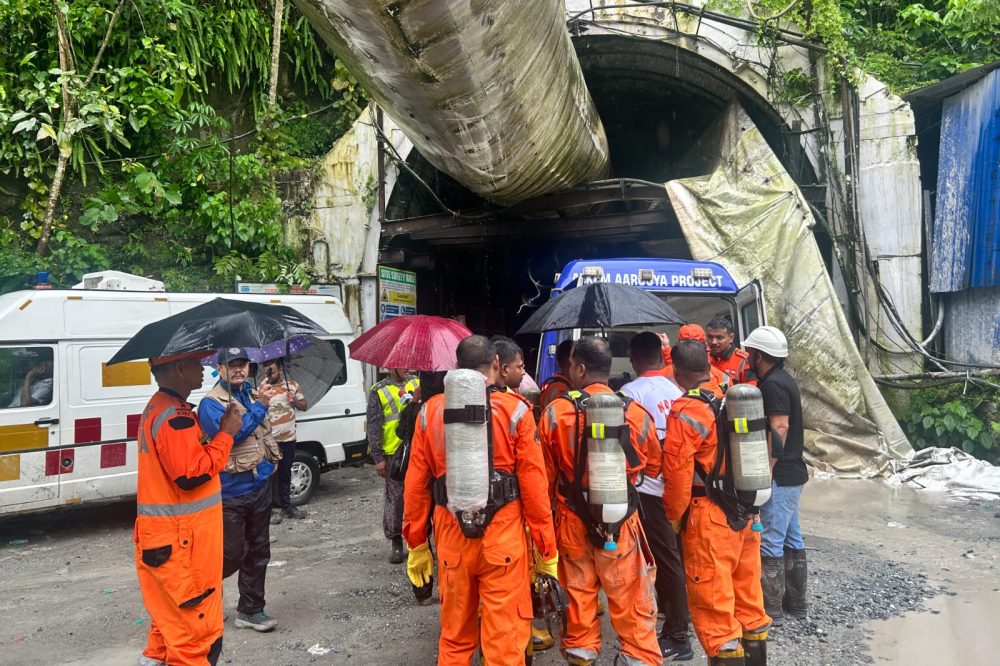

At least 10 people have lost their lives and 17 more remain unaccounted for after what officials believe was a gas explosion brought down a section of an under-construction tunnel at a hydropower project in Sikkim, a Himalayan state in northeastern India near the Chinese border.
The explosion tore through the tunnel on Monday at Samardung village, roughly 40 kilometers — about 25 miles — from the state capital of Gangtok. Workers at the time were engaged in construction on the 500-megawatt Teesta hydroelectric project. Civil official Anupama Tamling told reporters that survivors who escaped the blast described hearing a massive explosion before debris came crashing down, trapping dozens of workers inside.
When news of the disaster reached authorities, six officials from the state-owned National Hydroelectric Power Corporation, known as NHPC, which is overseeing the project’s construction, entered the tunnel to assist with rescue operations — only to become trapped themselves.
“We have recovered 10 bodies so far and 17 others are feared trapped,” said local police chief Sonam Dolma in a statement to reporters.
Rescue teams, including personnel from the National Disaster Response Force, have faced serious challenges reaching those still inside due to the buildup of deadly gases throughout the tunnel.
“We found toxic gases such as methane, carbon monoxide and hydrogen sulphide inside the tunnel,” said NDRF official Nitin Kumar, speaking to reporters at the scene. He added that rescue workers are relying on specialized breathing equipment as they push through the hazardous environment in search of survivors.
Construction disasters are not unusual in India, where rapid infrastructure development frequently runs up against unstable geology, safety shortcomings, harsh weather, and construction oversights. In the Himalayan region specifically, the combination of seismic activity, fragile mountain terrain, and unpredictable underground conditions makes tunnel construction particularly dangerous. A similar tragedy unfolded in 2023, when part of a tunnel in the northern state of Uttarakhand gave way, trapping 41 workers underground for 17 days before a successful rescue.
Experts note that the Teesta River basin, where this latest project is located, sits in a seismically active zone characterized by young, brittle rock formations laced with fractures and underground pockets capable of holding ancient gases.
Dr. Devesh Walia, a geology professor at North-Eastern Hill University in the neighboring state of Meghalaya, explained that the region’s rock formations are relatively young and in some areas linked to coal-bearing strata. “It is quite possible that methane along with other gases accumulated underground and may have triggered an explosion,” he said.