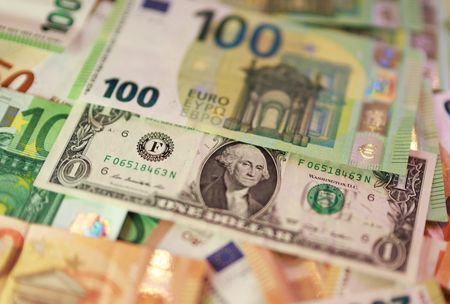

The American dollar strengthened Thursday, supported by rising U.S. Treasury yields as investors bet the Federal Reserve will increase interest rates this year, while ongoing Middle East tensions between the U.S. and Iran prompted investors to seek safe-haven assets.
Market attention centered on a crucial summit between Donald Trump and China’s Xi Jinping taking place Thursday in Beijing, where the U.S. President seeks to achieve economic victories, preserve a delicate trade agreement and address challenging matters including the U.S.-Israeli conflict with Iran.
Before the summit, China’s offshore yuan maintained its position near a three-year high, trading at 6.7860 against the dollar with minimal movement.
Barclays analysts predicted the onshore yuan would remain stable in the short term, which would “also help ease the path of discussions between the U.S. and China.”
“However, pushback by the authorities, via fixings and intervention, suggests limited patience with rapid appreciation,” they added.
Currency traders have driven the yuan higher in anticipation of the Trump-Xi summit, expecting agreements between the world’s two biggest economies.
Across broader markets Thursday, the dollar maintained stability, keeping the euro unchanged at $1.1716 and positioned for a 0.57% weekly decline, its steepest drop in two months.
The British pound traded at $1.3527, heading toward an approximately 0.8% weekly loss, partly due to domestic political instability.
Measured against a currency basket, the U.S. dollar reached 98.46, climbing 0.63% for the week. It declined 0.04% versus the yen to 157.83, as traders watched for potential Japanese government intervention to support their weakening currency.
The dollar has gained momentum from emerging domestic inflation pressures, with Wednesday’s data revealing U.S. producer prices recorded their largest jump in four years during April.
This followed Tuesday’s numbers showing another substantial rise in consumer prices last month, pushing the annual inflation rate to its fastest pace in three years.
“The inflation data we received this week certainly won’t be welcomed by FOMC officials, including incoming Fed Chair Kevin Warsh,” said Carol Kong, a currency strategist at Commonwealth Bank of Australia.
The U.S. Senate confirmed Warsh as Fed Chair on Wednesday, placing the 56-year-old lawyer and financier in charge of the U.S. central bank.
“We forecast that the FOMC will have to start a tightening cycle from December this year, and we forecast three hikes in the cycle for now,” said Kong.
Markets now assign a 31.8% probability to a Fed rate increase in December, rising from just over 16% a week earlier, according to the CME FedWatch tool.
Shifting rate expectations and inflation concerns have pushed U.S. Treasury yields upward, with longer-term yields reaching their highest points since mid-2025 overnight.
The two-year yield stood at 3.9750%, near Wednesday’s 1-1/2-month peak, while the benchmark 10-year yield reached 4.4669%, approaching a one-year high from the previous session.
Among other currencies, the Australian dollar approached a four-year high at $0.7255, supported by expectations of aggressive domestic rate policies.
The New Zealand dollar fell 0.04% to $0.5933.