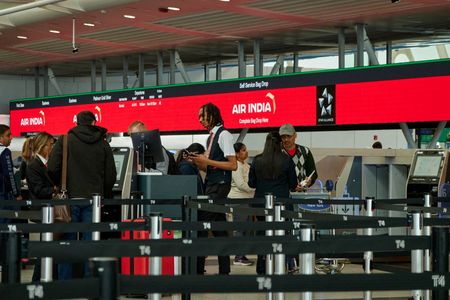

International airlines are seizing opportunities in India’s booming aviation sector as Air India struggles with massive flight reductions caused by Middle East conflicts and Pakistan’s airspace restrictions.
The ongoing Iran conflict and Pakistan’s ban on Indian carriers using its airspace have forced Air India to slash thousands of flights, creating openings for competitors like Lufthansa Group and Cathay Pacific to expand their presence in one of the world’s most rapidly expanding aviation markets.
Data from OAG reveals that foreign carriers now control 58.4% of India-origin international scheduled flights during March through May, compared to 51.2% during the same period last year. Meanwhile, Air India’s international departures from India dropped 17.5% year-over-year to 6,404 flights in the March-May timeframe, with the airline announcing additional cuts for June through August on Wednesday, affecting European and North American routes.
These setbacks represent a significant challenge to Air India’s goals of establishing itself as a major global carrier through fleet expansion with new widebody aircraft, cabin improvements, and additional direct connections to Europe and North America.
“The war has attacked every leg of Air India’s transformation plan,” stated Linus Benjamin Bauer, global managing partner at aviation consultancy BAA & Partners.
The Tata Group and Singapore Airlines-owned Air India has yet to achieve profitability since its government sale in 2022, with sources indicating the group expects record losses exceeding $2.12 billion for fiscal 2025-26. International operations generate more than 60% of the group’s revenue, according to a second source. Both sources requested anonymity as the financial information remains confidential.
In a May 1 staff communication, departing Air India CEO Campbell Wilson described how the “massive rise” in jet fuel costs “together with airspace closures and longer flying routes, has caused many of our international flights to become unprofitable.”
Pakistan’s airspace ban on Indian airlines, implemented in April 2025 due to diplomatic disputes, has forced expensive route changes. Air India declined to respond to inquiries from Reuters.
International air travel demand has surged in India, and despite frequent customer complaints about its aging fleet, Air India has traditionally been preferred for direct connections to key markets.
Air India’s scheduled European departures declined 5.1% year-over-year during March-May, while U.S. routes experienced a dramatic 77.4% drop in scheduled flights, according to Cirium route data.
While Emirates maintained steady operations with 2,196 India-origin flights in March-May, European carriers showed notable growth. Swiss, a Lufthansa subsidiary, increased its India departures by 39% to 247 flights during March-May, while Amsterdam-based KLM grew 19.5% to 294 scheduled flights.
Swiss’s expansion centered primarily on the Delhi-Zurich route, where scheduled flights jumped 76% to 155 during the period. The carrier added a second daily Delhi-Zurich service and reported “seeing very strong demand from India to Europe, and especially to the U.S.”
KLM confirmed increased Indian passenger traffic on its flights amid the Middle East crisis.
Cathay Pacific scheduled 588 India-to-Hong Kong flights during March-May, representing a 19% increase from the previous year. Cathay CEO Ronald Lam told Reuters in late March that numerous Indian travelers previously connecting through Middle Eastern hubs were now routing to the U.S. via Hong Kong.
However, bilateral aviation agreements may limit further expansion by foreign carriers, similar to restrictions that have constrained Gulf airlines’ growth in India.
Airlines are launching extensive marketing efforts to attract Indian customers, with German carrier Lufthansa illuminating Mumbai’s famous Sea Link bridge with its branding in March.
Air India’s challenges intensified when Dubai imposed daily flight limits on foreign carriers at its airports in March.
The Indian carrier has also encountered difficulties on U.S. routes, where some flight times have extended by nearly five hours due to airspace limitations.
On Wednesday, the airline suspended Delhi-Chicago service and reduced other U.S. routes for June-August. It had previously discontinued Delhi-Washington flights and services from Bengaluru and Mumbai to San Francisco since last year, allowing American Airlines and United Airlines to strengthen their India-U.S. market positions.
“Air India can still attract bookings when it offers lower fares,” explained Ravi Gosain, president of the Indian Association of Tour Operators. “But when its fares are similar to foreign airlines and routings are longer, passengers tend to prefer foreign carriers.”